Laboratório de Herpetologia, Instituto Butantan, São Paulo, Brasil.
Interunidades em Biotecnologia, Universidade de São Paulo, Instituto de Pesquisas Tecnológicas, Instituto Butantan, São Paulo, Brasil.
PLoS One. 2019 Sep 12;14(9):e0222206. doi: 10.1371/journal.pone.0222206. eCollection 2019.
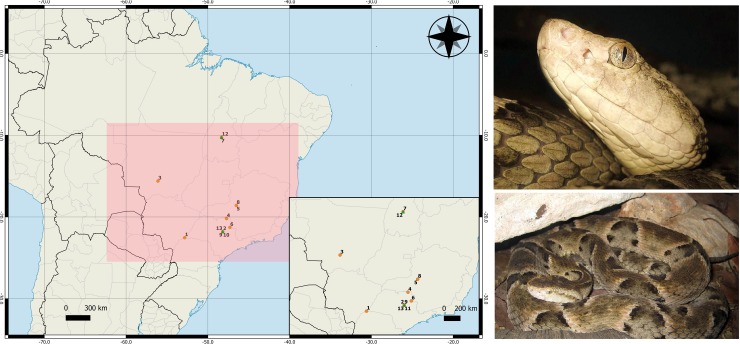
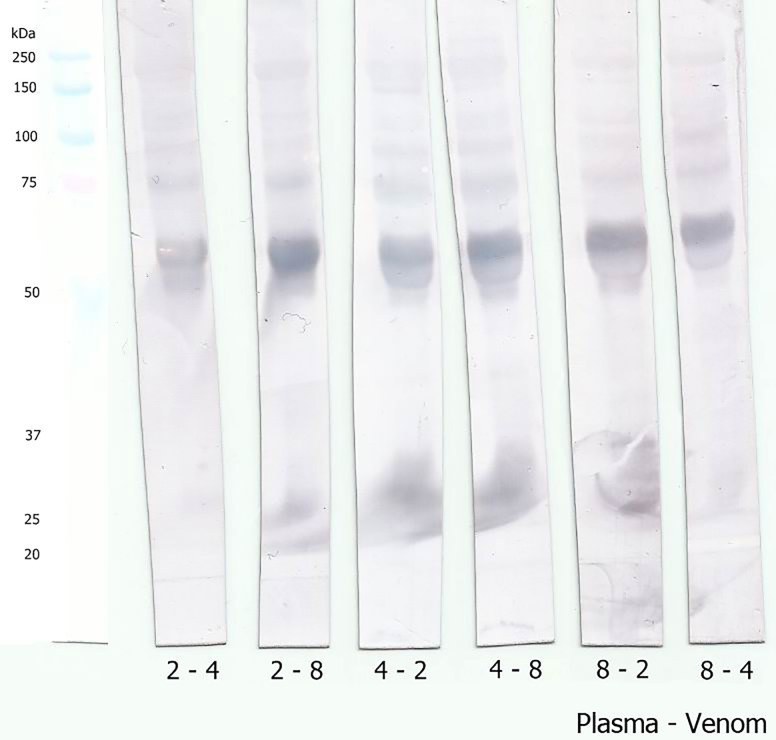
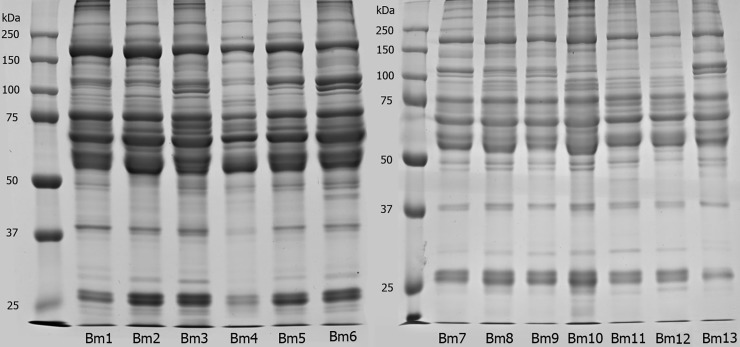
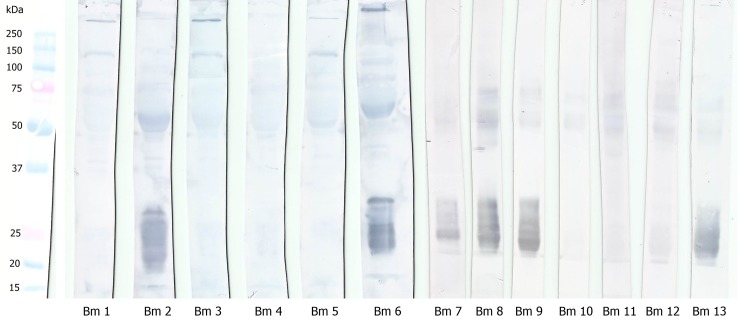
Snake venoms are complex protein mixtures with different biological activities that can act in both their preys and human victims. Many of these proteins play a role in prey capture and in the digestive process of these animals. It is known that some snakes are resistant to the toxicity of their own venom by mechanisms not yet fully elucidated. However, it was observed in the Laboratory of Herpetology of Instituto Butantan that some Bothrops moojeni individuals injured by the same snake species showed mortalities caused by envenoming effects. This study analyzed the biochemical composition of 13 venom and plasma samples from Bothrops moojeni specimens to assess differences in their protein composition. Application of sodium dodecyl sulfate polyacrylamide gel electrophoresis (SDS-PAGE) showed distinct venom protein profiles, but very homogeneous plasma profiles. Western Blotting (WB) was performed with plasma samples, which were submitted to incubation with the respective venom. Some individuals showed an immunorecognized band zone around 25 kDa, indicating interaction between the same individual plasma and venom proteins. Crossed-WB assay using non-self-plasma and venom showed that this variability is due to venom protein composition instead of plasma composition. These venoms presented higher caseinolytic, collagenolytic and coagulant activities than the venoms without these regions recognized by WB. Mass spectrometry analyses performed on two individuals revealed that these individuals present, in addition to higher protein concentrations, other exclusive proteins in their composition. When these same two samples were tested in vivo, the results also showed higher lethality in these venoms, but lower hemorrhagic activity than in the venoms without these regions recognized by WB. In conclusion, some Bothrops moojeni specimens differ in venom composition, which may have implications in envenomation. Moreover, the high individual venom variability found in this species demonstrates the importance to work with individual analyses in studies involving intraspecific venom variability and venom evolution.
蛇毒是具有不同生物活性的复杂蛋白质混合物,既能作用于猎物,也能作用于人类受害者。这些蛋白质中有许多在猎物捕获和这些动物的消化过程中发挥作用。已知有些蛇通过尚未完全阐明的机制对自身毒液的毒性具有抵抗力。然而,在布坦坦研究所的爬虫学实验室观察到,一些被同种蛇咬伤的 Bothrops moojeni 个体出现了因中毒而死亡的现象。本研究分析了 13 个 Bothrops moojeni 标本的毒液和血浆样本的生化组成,以评估其蛋白质组成的差异。十二烷基硫酸钠聚丙烯酰胺凝胶电泳(SDS-PAGE)的应用显示出明显不同的毒液蛋白图谱,但血浆图谱非常相似。对血浆样本进行了 Western Blotting(WB),将其与相应的毒液孵育。一些个体在 25 kDa 左右显示出一个免疫识别的带区,表明同一个体的血浆和毒液蛋白之间存在相互作用。使用非自身血浆和毒液进行的交叉-WB 分析表明,这种可变性是由于毒液蛋白组成而不是血浆组成所致。这些毒液的酪蛋白水解、胶原水解和凝固活性均高于未被 WB 识别的毒液。对两个个体进行的质谱分析表明,这些个体除了蛋白质浓度较高外,其组成中还存在其他独特的蛋白质。当对这两个相同的样本进行体内测试时,结果也表明这些毒液的致死率更高,但与未被 WB 识别的毒液相比,其出血活性更低。总之,一些 Bothrops moojeni 标本在毒液组成上存在差异,这可能对中毒有影响。此外,在本物种中发现的高个体毒液变异性表明,在涉及种内毒液变异性和毒液进化的研究中,进行个体分析非常重要。