MMWR Recomm Rep. 2019 Jul 19;68(2):1-33. doi: 10.15585/mmwr.rr6802a1.
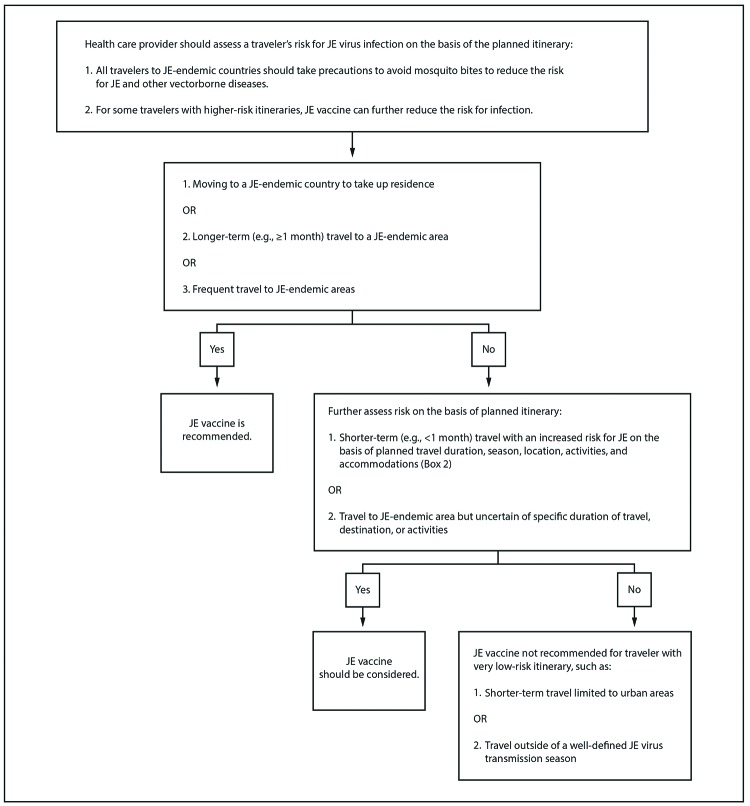
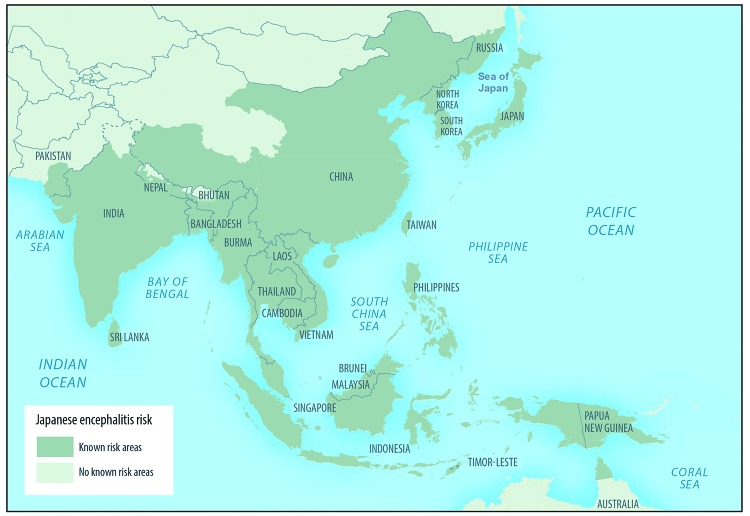
This report updates the 2010 recommendations from the CDC Advisory Committee on Immunization Practices (ACIP) regarding prevention of Japanese encephalitis (JE) among U.S. travelers and laboratory workers (Fischer M, Lindsey N, Staples JE, Hills S. Japanese encephalitis vaccines: recommendations of the Advisory Committee on Immunization Practices (ACIP). MMWR Recomm Rep 2010;59[No. RR-1]). The report summarizes the epidemiology of JE, describes the JE vaccine that is licensed and available in the United States, and provides recommendations for its use among travelers and laboratory workers.JE virus, a mosquitoborne flavivirus, is the most common vaccine-preventable cause of encephalitis in Asia. JE occurs throughout most of Asia and parts of the western Pacific. Approximately 20%-30% of patients die, and 30%-50% of survivors have neurologic, cognitive, or behavioral sequelae. No antiviral treatment is available.Inactivated Vero cell culture-derived JE vaccine (Ixiaro [JE-VC]) is the only JE vaccine that is licensed and available in the United States. In 2009, the U.S. Food and Drug Administration (FDA) licensed JE-VC for use in persons aged ≥17 years; in 2013, licensure was extended to include children aged ≥2 months.Most travelers to countries where the disease is endemic are at very low risk for JE. However, some travelers are at increased risk for infection on the basis of their travel plans. Factors that increase the risk for JE virus exposure include 1) traveling for a longer period; 2) travel during the JE virus transmission season; 3) spending time in rural areas; 4) participating in extensive outdoor activities; and 5) staying in accommodations without air conditioning, screens, or bed nets. All travelers to countries where JE is endemic should be advised to take precautions to avoid mosquito bites to reduce the risk for JE and other vectorborne diseases. For some persons who might be at increased risk for JE, the vaccine can further reduce the risk for infection. The decision about whether to vaccinate should be individualized and consider the 1) risks related to the specific travel itinerary, 2) likelihood of future travel to countries where JE is endemic, 3) high morbidity and mortality of JE, 4) availability of an effective vaccine, 5) possibility (but low probability) of serious adverse events after vaccination, and 6) the traveler's personal perception and tolerance of risk.JE vaccine is recommended for persons moving to a JE-endemic country to take up residence, longer-term (e.g., ≥1 month) travelers to JE-endemic areas, and frequent travelers to JE-endemic areas. JE vaccine also should be considered for shorter-term (e.g., <1 month) travelers with an increased risk for JE on the basis of planned travel duration, season, location, activities, and accommodations and for travelers to JE-endemic areas who are uncertain about their specific travel duration, destinations, or activities. JE vaccine is not recommended for travelers with very low-risk itineraries, such as shorter-term travel limited to urban areas or outside of a well-defined JE virus transmission season.
本报告更新了美国疾病预防控制中心免疫实践咨询委员会(ACIP)关于美国旅行者和实验室工作人员预防日本脑炎(JE)的 2010 年建议(Fischer M、Lindsey N、Staples JE、Hills S. 日本脑炎疫苗:免疫实践咨询委员会(ACIP)的建议。MMWR Recomm Rep 2010;59[No. RR-1])。该报告总结了 JE 的流行病学,描述了在美国获得许可和使用的 JE 疫苗,并为旅行者和实验室工作人员的使用提供了建议。JE 病毒是一种由蚊子传播的黄病毒,是亚洲最常见的可通过疫苗预防的脑炎病因。JE 发生在亚洲大部分地区和西太平洋部分地区。大约 20%-30%的患者死亡,30%-50%的幸存者有神经、认知或行为后遗症。目前尚无抗病毒治疗方法。已获准使用的减毒活vero 细胞培养衍生 JE 疫苗(Ixiaro [JE-VC])是唯一在美国获得许可和使用的 JE 疫苗。2009 年,美国食品和药物管理局(FDA)批准 JE-VC 用于 17 岁及以上人群;2013 年,许可范围扩大到包括 2 个月及以上的儿童。大多数前往疾病流行地区的旅行者患 JE 的风险非常低。然而,一些旅行者由于旅行计划而面临更高的感染风险。增加 JE 病毒暴露风险的因素包括 1)旅行时间较长;2)JE 病毒传播季节旅行;3)在农村地区停留;4)进行广泛的户外活动;5)在没有空调、纱窗或蚊帐的住宿中停留。所有前往 JE 流行地区的旅行者都应被告知采取预防措施避免蚊子叮咬,以降低 JE 和其他媒介传播疾病的风险。对于某些可能面临 JE 感染风险增加的人,疫苗可以进一步降低感染风险。是否接种疫苗的决定应个体化,并考虑以下因素:1)与特定旅行行程相关的风险;2)未来前往 JE 流行地区的可能性;3)JE 的高发病率和死亡率;4)有效的疫苗的可用性;5)接种疫苗后出现严重不良事件的可能性(但概率较低);6)旅行者对风险的个人认知和承受能力。JE 疫苗推荐用于移居 JE 流行地区的人、在 JE 流行地区长期(例如,≥1 个月)旅行的人、以及频繁前往 JE 流行地区的人。JE 疫苗也可考虑用于因计划旅行时间、季节、地点、活动和住宿而 JE 感染风险增加的短期(例如,<1 个月)旅行者,以及对具体旅行时间、目的地或活动不确定的 JE 流行地区旅行者。JE 疫苗不推荐用于风险非常低的旅行者,例如仅限于城市地区或在明确的 JE 病毒传播季节以外的短期旅行。