Harrington Heart & Vascular Institute, University Hospitals, Case Western Reserve University, Cleveland, OH, USA; SEHAT, Dalkhola, India.
Harrington Heart & Vascular Institute, University Hospitals, Case Western Reserve University, Cleveland, OH, USA; School of Public Health, Kent State University, Kent, OH, USA.
Glob Heart. 2019 Dec;14(4):355-365. doi: 10.1016/j.gheart.2019.08.003. Epub 2019 Sep 12.
Eighty percent of premature mortality from cardiovascular disease occurs in low- and middle-income countries. Hypertension, diabetes, and smoking are the top risk factors causing this disease burden.
The study aimed to test the hypothesis that utilizing community health workers (CHWs) to manage hypertension, diabetes and smoking in an integrated manner would lead to improved control of these conditions.
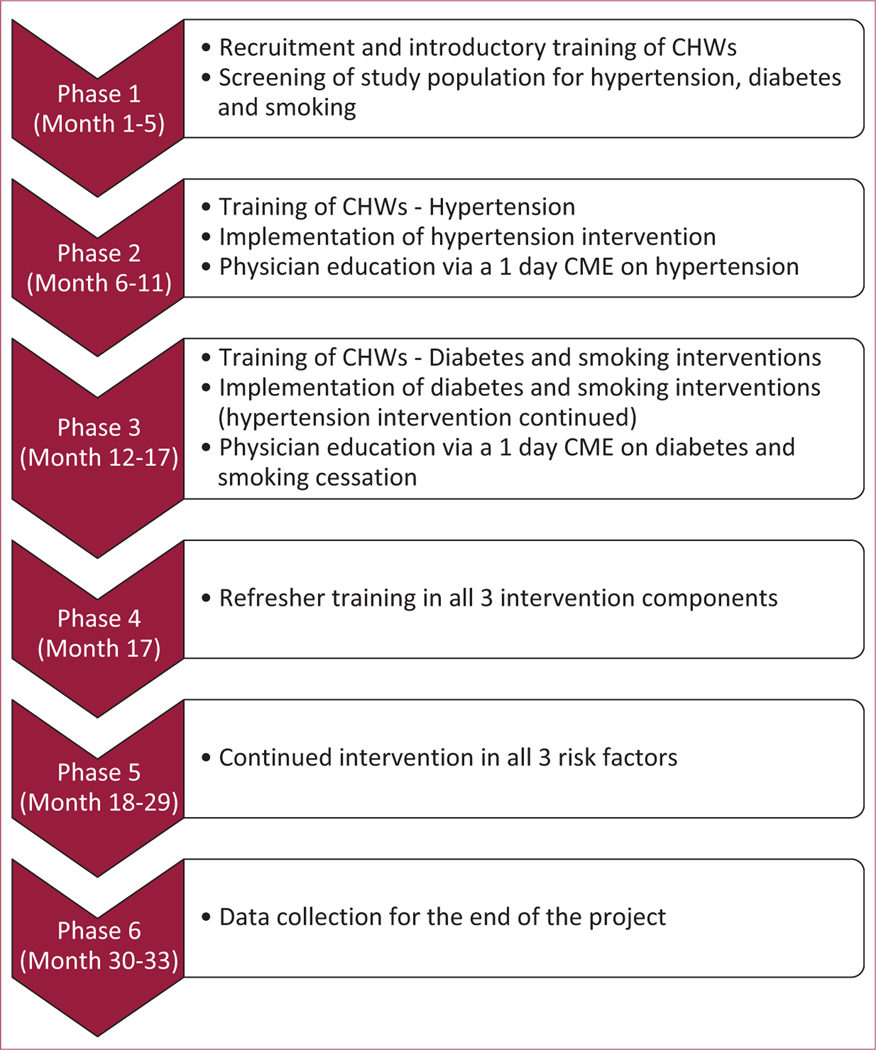
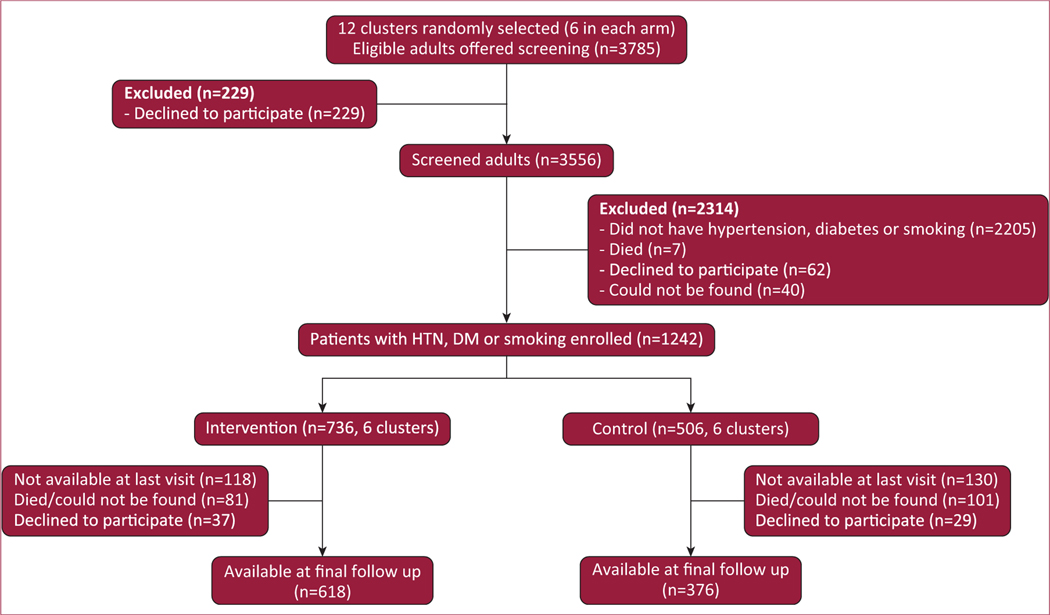
This was a 2-year cluster (n = 12) randomized controlled trial of 3,556 adults (35 to 70 years of age) in a single town in India, who were screened at home for hypertension, diabetes, and smoking. Of these adults, 1,242 (35%) had at least 1 risk factor (hypertension = 650, diabetes = 317, smoking = 500) and were enrolled in the study. The intervention group had behavioral change communication through regular home visits from community health workers. The control group received usual care in the community. The primary outcomes were changes in systolic blood pressure, fasting blood glucose, and average number of cigarettes/bidis smoked daily among individuals with respective risk factors.
The mean ± SD change in systolic blood pressure at 2 years was -12.2 ± 19.5 mm Hg in the intervention group as compared with -6.4 ± 26.1 mm Hg in the control group, resulting in an adjusted difference of -8.9 mm Hg (95% confidence interval [CI]: -3.5 to -14.4 mm Hg; p = 0.001). The change in fasting blood glucose was -43.0 ± 83.5 mg/dl in the intervention group and -16.3 ± 77.2 mg/dl in the control group, leading to an adjusted difference of -21.3 mg/dl (95% CI: 18.4 to -61 mg/dl; p = 0.29). The change in mean number of cigarettes/bidis smoked was nonsignificant at +0.2 cigarettes/bidis (95% CI: 5.6 to -5.2 cigarettes/bidis; p = 0.93).
A population-based strategy of integrated risk factor management through community health workers led to improved systolic blood pressure in hypertension, an inconclusive effect on fasting blood glucose in diabetes, and no demonstrable effect on smoking. (Study of a Community-Based Approach to Control Cardiovascular Risk Factors in India [SEHAT]; NCT02115711).
80%的心血管疾病过早死亡发生在中低收入国家。高血压、糖尿病和吸烟是导致这种疾病负担的主要危险因素。
本研究旨在检验以下假设,即利用社区卫生工作者(CHW)综合管理高血压、糖尿病和吸烟是否会改善这些疾病的控制。
这是一项为期 2 年的印度单个城镇(n=12 个)的集群随机对照试验,共纳入了 3556 名成年人(35-70 岁),在家中筛查高血压、糖尿病和吸烟。这些成年人中有 1242 人(35%)至少存在 1 个风险因素(高血压 650 例、糖尿病 317 例、吸烟 500 例),并被纳入研究。干预组通过社区卫生工作者的定期家访进行行为改变沟通。对照组在社区接受常规护理。主要结局指标是患有相应风险因素的个体的收缩压、空腹血糖和平均每日吸烟量的变化。
干预组在 2 年内的收缩压平均变化为-12.2±19.5mmHg,对照组为-6.4±26.1mmHg,调整后的差异为-8.9mmHg(95%置信区间[CI]:-3.5 至-14.4mmHg;p=0.001)。干预组的空腹血糖变化为-43.0±83.5mg/dl,对照组为-16.3±77.2mg/dl,调整后的差异为-21.3mg/dl(95%CI:18.4 至-61mg/dl;p=0.29)。吸烟量的变化无统计学意义,平均增加 0.2 支香烟/比迪烟(95%CI:5.6 至-5.2 支香烟/比迪烟;p=0.93)。
通过社区卫生工作者实施基于人群的综合危险因素管理策略,可改善高血压患者的收缩压,对糖尿病患者的空腹血糖无明确影响,对吸烟无明显影响。(印度基于社区的心血管风险因素控制方法研究[SEHAT];NCT02115711)。