Division of Nephrology.
Department of Internal Medicine.
Clin J Am Soc Nephrol. 2019 Oct 7;14(10):1512-1520. doi: 10.2215/CJN.00540119. Epub 2019 Sep 17.
In kidney transplant recipients, elevated circulating advanced glycation endproducts (AGEs) are the result of increased formation and decreased kidney clearance. AGEs trigger several intracellular mechanisms that ultimately yield excess cardiovascular disease. We hypothesized that, in stable kidney transplant recipients, circulating AGEs are associated with longterm risk of cardiovascular mortality, and that such a relationship is mediated by inflammatory, oxidative stress, and endothelial dysfunction biomarkers.
DESIGN, SETTING, PARTICIPANTS, & MEASUREMENTS: Prospective cohort study of stable kidney transplant recipients recruited between 2001 and 2003 in a university setting. We performed multivariableadjusted Cox regression analyses to assess the association of AGEs (, N[Carboxymethyl]lysine (CML) and N[Carboxyethyl]lysine (CEL), measured by tandem mass spectrometry) with cardiovascular mortality. Mediation analyses were performed according to Preacher and Hayes's procedure.
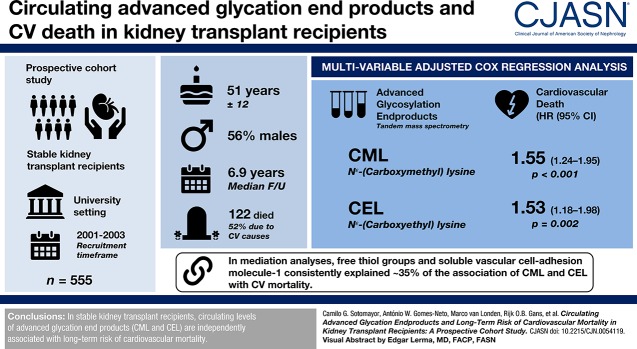
We included 555 kidney transplant recipients (age 51±12 years, 56% men). During a median followup of 6.9 years, 122 kidney transplant recipients died (52% deaths were due to cardiovascular causes). CML and CEL concentrations were directly associated with cardiovascular mortality (respectively, hazard ratio, 1.55; 95% confidence interval, 1.24 to 1.95; <0.001; and hazard ratio, 1.53; 95% confidence interval 1.18 to 1.98; =0.002), independent of age, diabetes, smoking status, body mass index, eGFR and proteinuria. Further adjustments, including cardiovascular history, did not materially change these findings. In mediation analyses, free thiol groups and soluble vascular cell adhesion molecule1 consistently explained approximately 35% of the association of CML and CEL with cardiovascular mortality.
In stable kidney transplant recipients, circulating levels of AGEs are independently associated with longterm risk of cardiovascular mortality.
This article contains a podcast at https://www.asn-online.org/media/podcast/CJASN/2019_09_17_CJN00540119.mp3.
在肾移植受者中,循环中升高的晚期糖基化终产物(AGEs)是形成增加和肾脏清除减少的结果。AGEs 触发了几种细胞内机制,最终导致心血管疾病过多。我们假设,在稳定的肾移植受者中,循环 AGEs 与心血管死亡的长期风险相关,并且这种关系是由炎症、氧化应激和内皮功能障碍生物标志物介导的。
设计、地点、参与者和测量:这是一项前瞻性队列研究,纳入了 2001 年至 2003 年在一所大学环境中招募的稳定肾移植受者。我们进行了多变量调整的 Cox 回归分析,以评估 AGEs(通过串联质谱法测量的羧甲基赖氨酸(CML)和 N[羧乙基]赖氨酸(CEL))与心血管死亡率的相关性。根据 Preacher 和 Hayes 的程序进行中介分析。
我们纳入了 555 名肾移植受者(年龄 51±12 岁,56%为男性)。在中位随访 6.9 年期间,有 122 名肾移植受者死亡(52%的死亡是由于心血管原因)。CML 和 CEL 浓度与心血管死亡率直接相关(分别为危险比,1.55;95%置信区间,1.24 至 1.95;<0.001;和危险比,1.53;95%置信区间,1.18 至 1.98;=0.002),独立于年龄、糖尿病、吸烟状况、体重指数、eGFR 和蛋白尿。进一步的调整,包括心血管病史,并没有改变这些发现。在中介分析中,游离巯基基团和可溶性血管细胞黏附分子 1 一致解释了 CML 和 CEL 与心血管死亡率之间关联的约 35%。
在稳定的肾移植受者中,循环 AGEs 水平与长期心血管死亡风险独立相关。