Papa Linda, Zonfrillo Mark R, Welch Robert D, Lewis Lawrence M, Braga Carolina F, Tan Ciara N, Ameli Neema J, Lopez Marco A, Haeussler Crystal A, Mendez Giordano Diego, Giordano Philip A, Ramirez Jose, Mittal Manoj K
Department of Emergency Medicine, Orlando Regional Medical Center, Orlando, Florida, USA.
Hasbro Children's Hospital, Providence, Rhode Island, USA.
BMJ Paediatr Open. 2019 Aug 25;3(1):e000473. doi: 10.1136/bmjpo-2019-000473. eCollection 2019.
To evaluate the ability of glial fibrillary acidic protein (GFAP) and ubiquitin C-terminal hydrolase (UCH-L1) to detect concussion in children and adult trauma patients with a normal mental status and assess biomarker concentrations over time as gradients of injury in concussive and non-concussive head and body trauma.
Large prospective cohort study.
Three level I trauma centres in the USA.
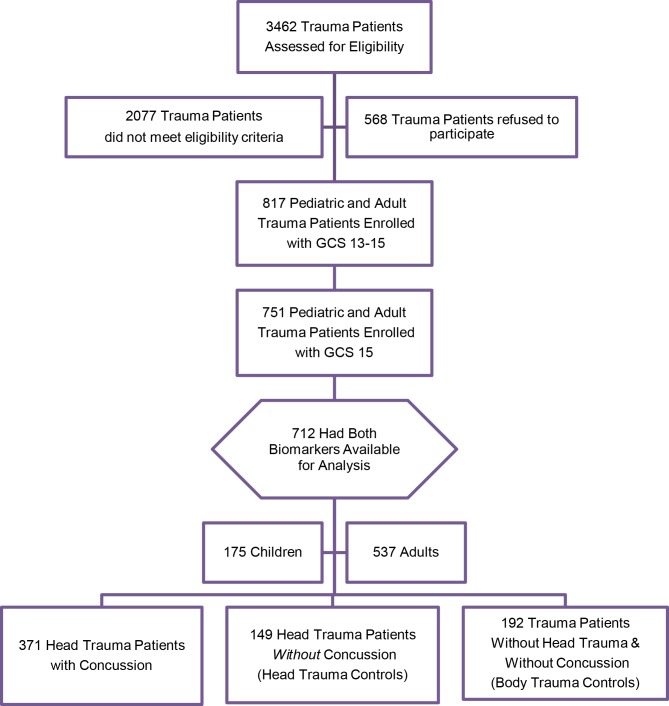
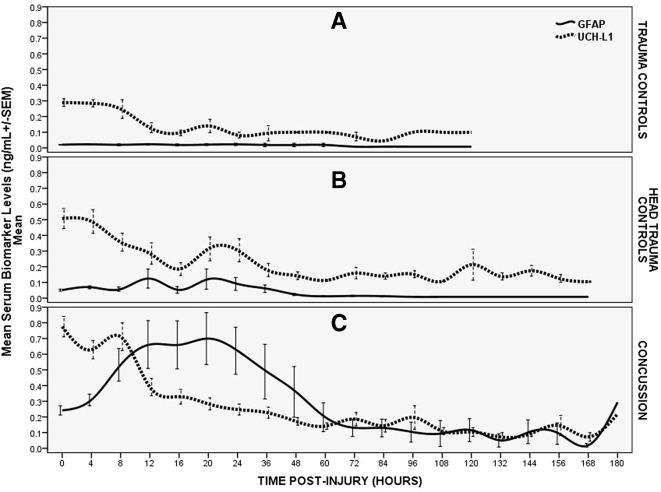
Paediatric and adult trauma patients of all ages, with and without head trauma, presenting with a normal mental status (Glasgow Coma Scale score of 15) within 4 hours of injury. Rigorous screening for concussive symptoms was conducted. Of 3462 trauma patients screened, 751 were enrolled and 712 had biomarker data. Repeated blood sampling was conducted at 4, 8, 12, 16, 24, 36, 48, 60, 72, 84, 96, 108, 120, 132, 144, 156, 168 and 180 hours postinjury in adults.
Detection of concussion and gradients of injury in children versus adults by comparing three groups of patients: (1) those with concussion; (2) those with head trauma without overt signs of concussion (non-concussive head trauma controls) and (3) those with peripheral (body) trauma without head trauma or concussion (non-concussive body trauma controls).
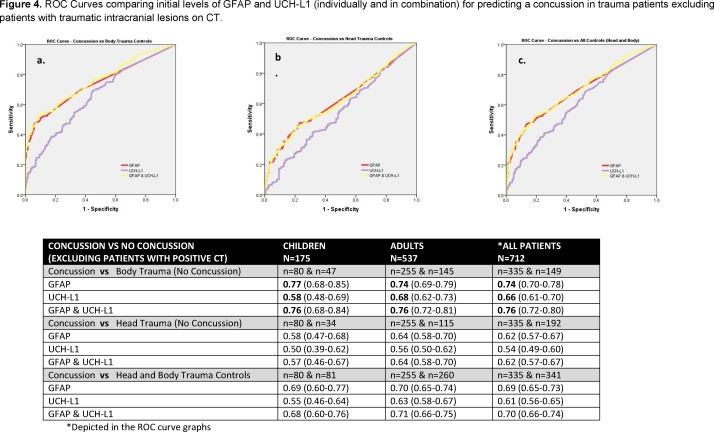
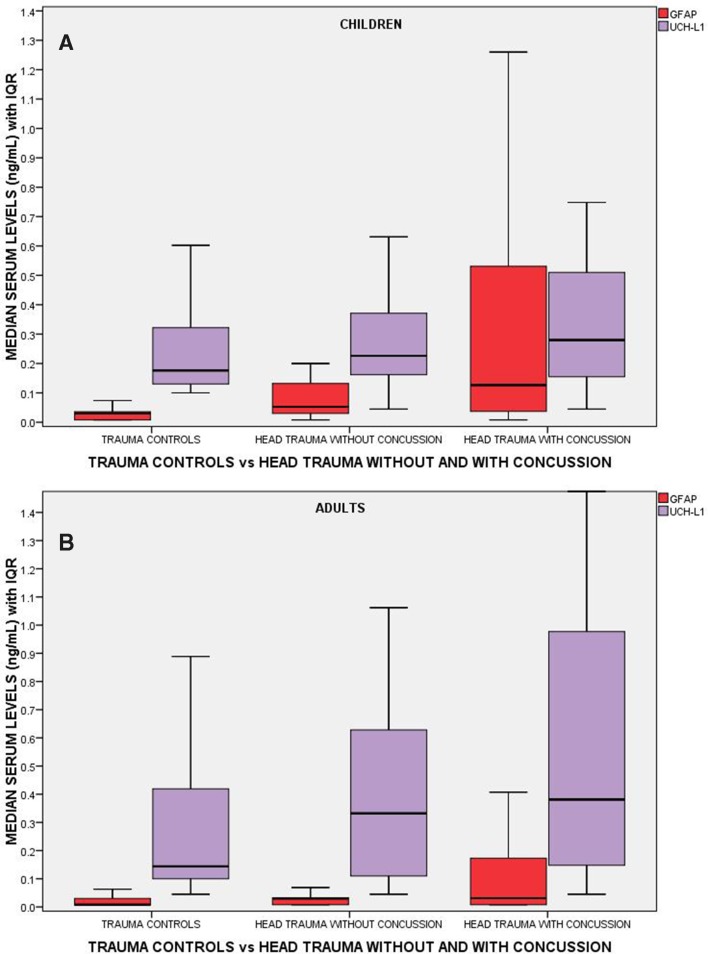
A total of 1904 samples from 712 trauma patients were analysed. Within 4 hours of injury, there were incremental increases in levels of both GFAP and UCH-L1 from non-concussive body trauma (lowest), to mild elevations in non-concussive head trauma, to highest levels in patients with concussion. In concussion patients, GFAP concentrations were significantly higher compared with body trauma controls (p<0.001) and with head trauma controls (p<0.001) in both children and adults, after controlling for multiple comparisons. However, for UCH-L1, there were no significant differences between concussion patients and head trauma controls (p=0.894) and between body trauma and head trauma controls in children. The AUC for initial GFAP levels to detect concussion was 0.80 (0.73-0.87) in children and 0.76 (0.71-0.80) in adults. This differed significantly from UCH-L1 with AUCs of 0.62 (0.53-0.72) in children and 0.69 (0.64-0.74) in adults.
In a cohort of trauma patients with normal mental status, GFAP outperformed UCH-L1 in detecting concussion in both children and adults. Blood levels of GFAP and UCH-L1 showed incremental elevations across three injury groups: from non-concussive body trauma, to non-concussive head trauma, to concussion. However, UCH-L1 was expressed at much higher levels than GFAP in those with non-concussive trauma, particularly in children. Elevations in both biomarkers in patients with non-concussive head trauma may be reflective of a subconcussive brain injury. This will require further study.
评估胶质纤维酸性蛋白(GFAP)和泛素C末端水解酶(UCH-L1)在精神状态正常的儿童和成人创伤患者中检测脑震荡的能力,并评估生物标志物浓度随时间的变化,作为脑震荡和非脑震荡性头部及身体创伤的损伤梯度。
大型前瞻性队列研究。
美国的三个一级创伤中心。
所有年龄段的儿科和成人创伤患者,有或无头部创伤,在受伤后4小时内精神状态正常(格拉斯哥昏迷量表评分为15分)。对脑震荡症状进行了严格筛查。在3462名接受筛查的创伤患者中,751名被纳入研究,712名有生物标志物数据。成年患者在受伤后4、8、12、16、24、36、48、60、72、84、96、108、120、132、144、156、168和180小时进行重复采血。
通过比较三组患者来检测儿童与成人的脑震荡及损伤梯度:(1)脑震荡患者;(2)有头部创伤但无明显脑震荡体征的患者(非脑震荡性头部创伤对照组);(3)有外周(身体)创伤但无头部创伤或脑震荡的患者(非脑震荡性身体创伤对照组)。
共分析了712名创伤患者的1904份样本。在受伤后4小时内,GFAP和UCH-L1的水平从非脑震荡性身体创伤(最低)逐渐升高,到非脑震荡性头部创伤时有轻度升高,在脑震荡患者中达到最高水平。在脑震荡患者中,在控制了多重比较后,儿童和成人的GFAP浓度与身体创伤对照组相比均显著更高(p<0.001),与头部创伤对照组相比也显著更高(p<0.001)。然而,对于UCH-L1,脑震荡患者与头部创伤对照组之间无显著差异(p=0.894),儿童的身体创伤与头部创伤对照组之间也无显著差异。儿童初始GFAP水平检测脑震荡的曲线下面积(AUC)为0.80(0.73 - 0.87),成人为0.76(0.71 - 0.80)。这与UCH-L1有显著差异,儿童UCH-L1的AUC为0.62(0.53 - 0.72),成人为0.69(0.64 - 0.74)。
在精神状态正常的创伤患者队列中,GFAP在检测儿童和成人脑震荡方面优于UCH-L1。GFAP和UCH-L1的血药浓度在三个损伤组中呈逐渐升高趋势:从非脑震荡性身体创伤,到非脑震荡性头部创伤,再到脑震荡。然而,在非脑震荡性创伤患者中,尤其是儿童,UCH-L1的表达水平比GFAP高得多。非脑震荡性头部创伤患者中两种生物标志物的升高可能反映了亚脑震荡性脑损伤。这需要进一步研究。