Department of Emergency Medicine, Orlando Health Orlando Regional Medical Center, 1335 Sligh Boul. 5th Floor, Orlando, FL, 32806, USA.
Department of Pharmacotherapy and Outcomes Science and Neurosurgery, Virginia Commonwealth University, Richmond, VA, USA.
Sci Rep. 2023 Jul 22;13(1):11833. doi: 10.1038/s41598-023-38804-4.
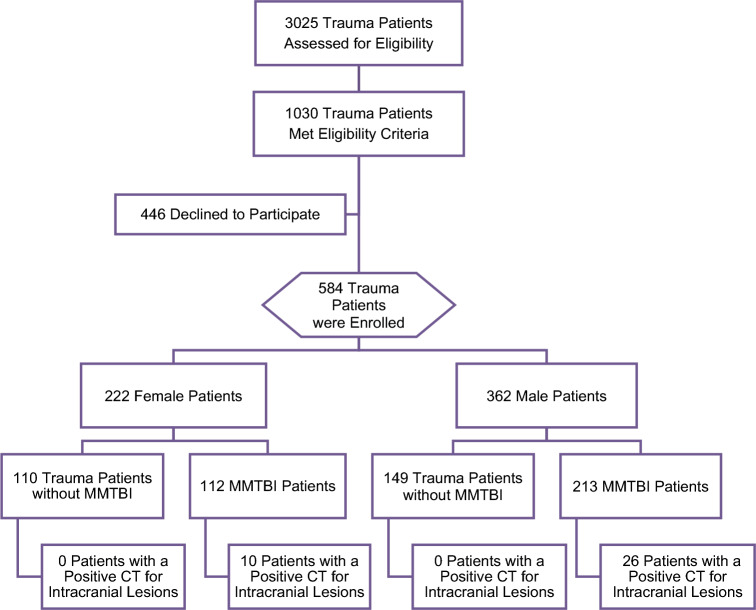
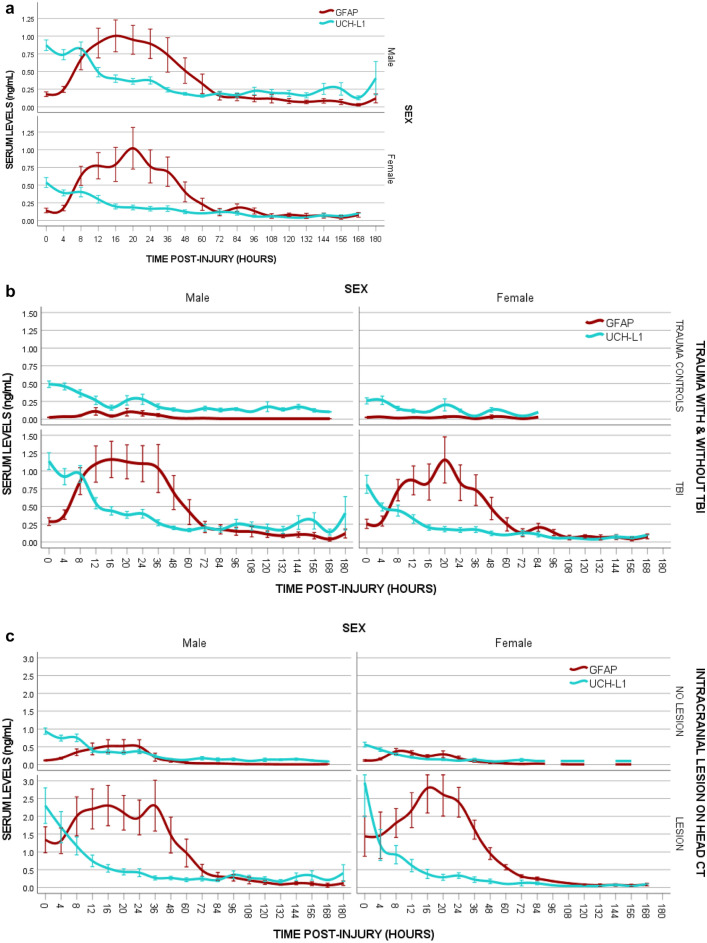
Glial Fibrillary Acidic Protein (GFAP) and Ubiquitin C-terminal hydrolase (UCH-L1) have been FDA-approved for clinical use in mild and moderate traumatic brain injury (TBI). Understanding sex differences in their diagnostic accuracy over time will help inform clinical practice. We sought to evaluate the sex differences in the temporal profile of GFAP and UCH-L1 in a large cohort of trauma patients presenting to the emergency department. To compare the biomarkers' diagnostic accuracy in male versus female patients for detecting mild TBI (MTBI), and traumatic intracranial lesions on head CT. This prospective cohort study enrolled female and male adult trauma patients presenting to a Level 1 Trauma Center. All patients underwent rigorous screening to determine whether or not they had experienced a MTBI. Of 3025 trauma patients assessed, 1030 met eligibility criteria and 446 declined. Initial blood samples were obtained in 584 patients enrolled within 4 h of injury. Repeated blood sampling was conducted at 4, 8, 12, 16, 24, 36, 48, 60, 72, 84, 96, 108, 120, 132, 144, 156, 168, and 180-h post-injury. The main outcomes included the diagnostic accuracy in detection of MTBI and traumatic intracranial lesions on head CT scan. A total of 1831 samples were drawn in 584 patients over 7 days, 362 (62%) were male and 222 (38%) were female. The pattern of elevation was similar in both sexes. Although the pattern of elevation was similar between male and female for both biomarkers, male patients had significantly higher concentrations of UCH-L1 compared to female patients at several timepoints post-injury, particularly within 24 h of injury. There were no significant differences in diagnostic accuracy for detecting MTBI or for detecting CT lesions between male and female patients at any timepoint for both GFAP and UCH-L1. Although patterns of GFAP and UCH-L1 release in trauma patients over a week post-injury was similar between the sexes, there were significantly higher concentrations of UCH-L1 in males at several timepoints post-injury. Despite this, the overall diagnostic accuracies of both GFAP and UCH-L1 over time for detecting MTBI and CT lesions were not significantly different between male and female trauma patients.
胶质纤维酸性蛋白(GFAP)和泛素 C 端水解酶(UCH-L1)已获得美国食品和药物管理局(FDA)批准,可用于轻度和中度创伤性脑损伤(TBI)的临床使用。了解其在诊断准确性方面随时间推移的性别差异,将有助于为临床实践提供信息。我们旨在评估在大量因创伤就诊急诊科的患者中,GFAP 和 UCH-L1 的时间分布是否存在性别差异。为了比较这些生物标志物在男性和女性患者中检测轻度 TBI(MTBI)和头部 CT 检查显示的创伤性颅内病变的诊断准确性。这项前瞻性队列研究纳入了成年女性和男性创伤患者,这些患者均在 1 级创伤中心就诊。所有患者均接受了严格的筛选,以确定他们是否发生了 MTBI。在评估的 3025 名创伤患者中,有 1030 名符合纳入标准,446 名拒绝参与。在受伤后 4 小时内,对 584 名入组患者进行了初始血液样本采集。在 4、8、12、16、24、36、48、60、72、84、96、108、120、132、144、156、168 和 180 小时时,重复采集血液样本。主要结局指标包括检测 MTBI 和头部 CT 扫描显示的创伤性颅内病变的诊断准确性。在 7 天内,对 584 名患者共抽取了 1831 份样本,其中 362 份(62%)为男性,222 份(38%)为女性。男女两性的升高模式相似。尽管两种生物标志物在男女两性的升高模式相似,但与女性患者相比,男性患者在受伤后多个时间点的 UCH-L1 浓度明显更高,尤其是在受伤后 24 小时内。在任何时间点,男性和女性患者的 GFAP 和 UCH-L1 对 MTBI 或 CT 病变的检测诊断准确性均无显著差异。尽管在受伤后一周内,男女两性创伤患者的 GFAP 和 UCH-L1 释放模式相似,但在受伤后多个时间点,男性患者的 UCH-L1 浓度明显更高。尽管如此,男性和女性创伤患者在多个时间点的 GFAP 和 UCH-L1 总体诊断准确性对于检测 MTBI 和 CT 病变并无显著差异。