Department of Computer Science, University of California, Irvine, Irvine, California, USA.
Department of Educational Psychology, University of Utah, Salt Lake City, Utah, USA.
J Am Med Inform Assoc. 2019 Dec 1;26(12):1493-1504. doi: 10.1093/jamia/ocz140.
Amid electronic health records, laboratory tests, and other technology, office-based patient and provider communication is still the heart of primary medical care. Patients typically present multiple complaints, requiring physicians to decide how to balance competing demands. How this time is allocated has implications for patient satisfaction, payments, and quality of care. We investigate the effectiveness of machine learning methods for automated annotation of medical topics in patient-provider dialog transcripts.
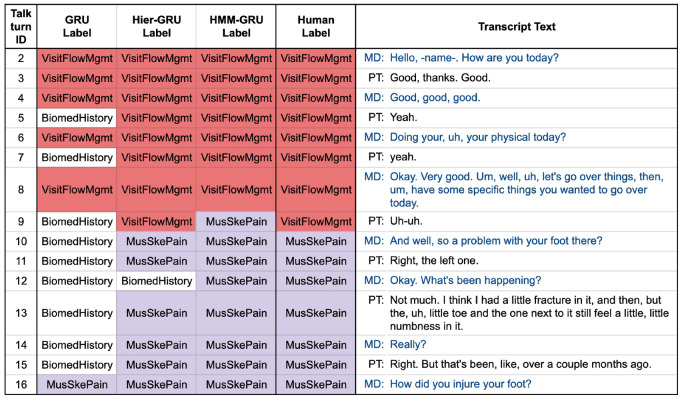
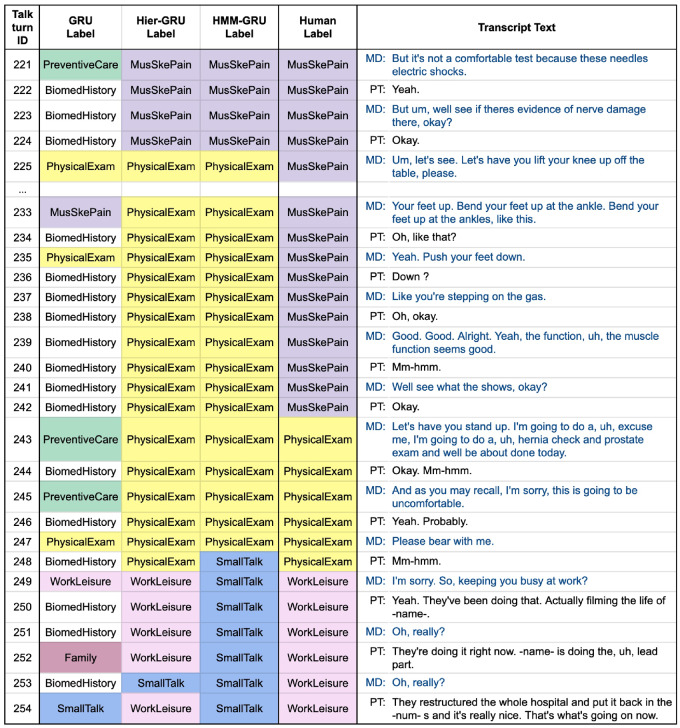
We used dialog transcripts from 279 primary care visits to predict talk-turn topic labels. Different machine learning models were trained to operate on single or multiple local talk-turns (logistic classifiers, support vector machines, gated recurrent units) as well as sequential models that integrate information across talk-turn sequences (conditional random fields, hidden Markov models, and hierarchical gated recurrent units).
Evaluation was performed using cross-validation to measure 1) classification accuracy for talk-turns and 2) precision, recall, and F1 scores at the visit level. Experimental results showed that sequential models had higher classification accuracy at the talk-turn level and higher precision at the visit level. Independent models had higher recall scores at the visit level compared with sequential models.
Incorporating sequential information across talk-turns improves the accuracy of topic prediction in patient-provider dialog by smoothing out noisy information from talk-turns. Although the results are promising, more advanced prediction techniques and larger labeled datasets will likely be required to achieve prediction performance appropriate for real-world clinical applications.
在电子健康记录、实验室测试和其他技术中,基于办公室的患者和提供者的沟通仍然是初级医疗保健的核心。患者通常会出现多种投诉,这要求医生决定如何平衡相互竞争的需求。如何分配这段时间对患者满意度、支付和医疗质量都有影响。我们研究了机器学习方法在预测患者与医生对话记录中医疗主题方面的有效性。
我们使用了 279 次初级保健就诊的对话记录来预测对话轮次的主题标签。不同的机器学习模型被训练用于操作单个或多个本地对话轮次(逻辑分类器、支持向量机、门控循环单元),以及跨对话轮次序列集成信息的序列模型(条件随机场、隐马尔可夫模型和分层门控循环单元)。
使用交叉验证进行评估,以衡量 1)对话轮次的分类准确性,以及 2)就诊水平的精确性、召回率和 F1 得分。实验结果表明,序列模型在对话轮次水平上具有更高的分类准确性,在就诊水平上具有更高的精确性。与序列模型相比,独立模型在就诊水平上具有更高的召回率。
跨对话轮次整合序列信息可以通过平滑对话轮次中的噪声信息来提高患者与医生对话中主题预测的准确性。尽管结果很有希望,但可能需要更先进的预测技术和更大的标记数据集来实现适合实际临床应用的预测性能。