Department of Nutritional Sciences, College of Health and Human Development, The Pennsylvania State University, University Park, PA, USA.
Program in International and Community Nutrition, Department of Nutrition, University of California, Davis, Davis, CA, USA.
J Nutr. 2020 Feb 1;150(2):411-418. doi: 10.1093/jn/nxz225.
Model-based compartmental analysis has been used to describe and quantify whole-body vitamin A metabolism and estimate total body stores (TBS) in animals and humans.
We applied compartmental modeling and a super-child design to estimate retinol kinetic parameters and TBS for young children in Bangladesh, Guatemala, and the Philippines.
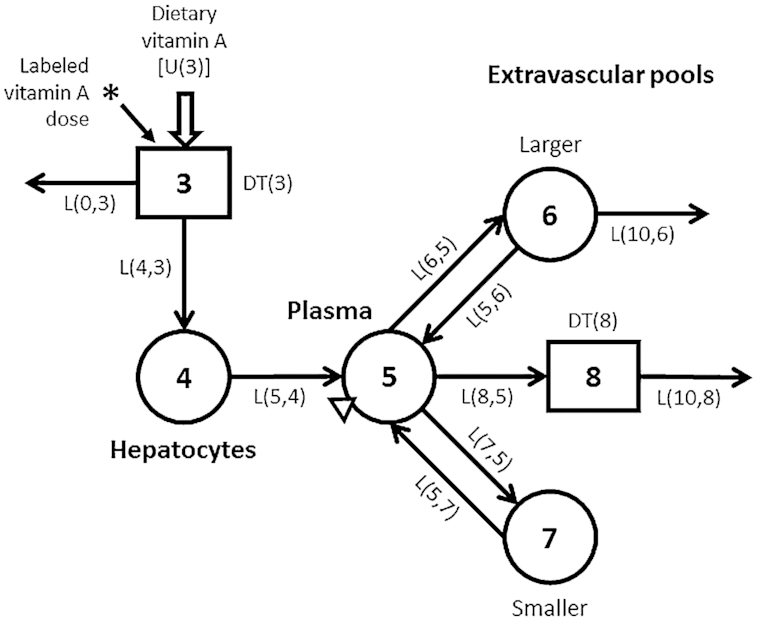
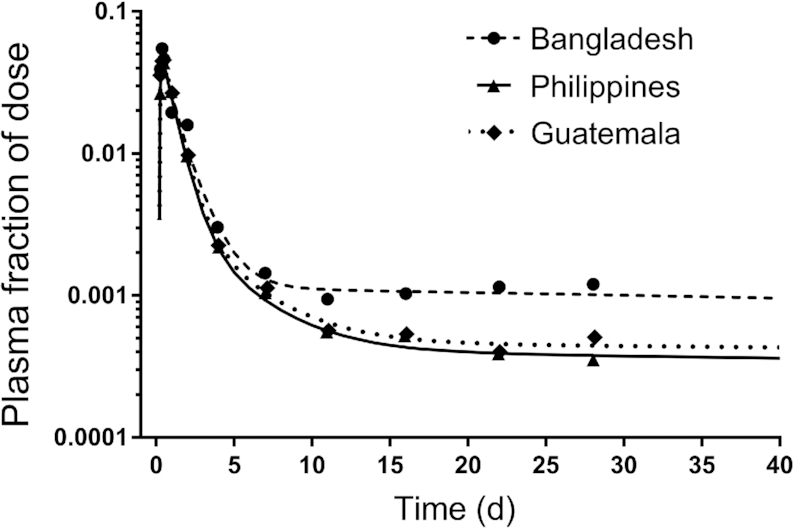
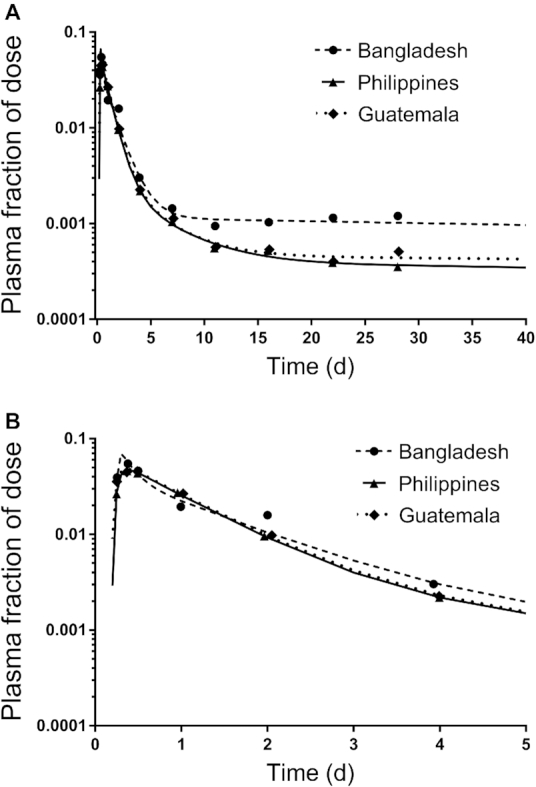
Children ingested [13C10]retinyl acetate and 1 or 2 blood samples were collected from each child from 6 h to 28 d after dosing. Temporal data for fraction of dose in plasma [13C10]retinol were modeled using WinSAAM software and a 6-component model with vitamin A intake included as weighted data.
Model-predicted TBS was 198, 533, and 1062 μmol for the Bangladeshi (age, 9-17 mo), Filipino (12-18 mo), and Guatemalan children (35-65 mo). Retinol kinetics were similar for Filipino and Guatemalan groups and generally faster for Bangladeshi children, although fractional transfer of plasma retinol to a larger exchangeable storage pool was the same for the 3 groups. Recycling to plasma from that pool was ∼2.5 times faster in the Bangladeshi children compared with the other groups and the recycling number was 2-3 times greater. Differences in kinetics between groups are likely related to differences in vitamin A stores and intakes (geometric means: 352, 727, and 764 μg retinol activity equivalents/d for the Bangladeshi, Filipino, and Guatemalan children, respectively).
By collecting 1 or 2 blood samples from each child to generate a composite plasma tracer data set with a minimum of 5 children/time, group TBS and retinol kinetics can be estimated in children by compartmental analysis; inclusion of vitamin A intake data increases confidence in model predictions. The super-child modeling approach is an effective technique for comparing vitamin A status among children from different populations. These trials were registered at www.clinicaltrials.gov as NCT03000543 (Bangladesh), NCT03345147 (Guatemala), and NCT03030339 (Philippines).
基于模型的房室分析已被用于描述和量化动物和人体的整体维生素 A 代谢,并估计全身储存量(TBS)。
我们应用房室建模和超级儿童设计来估计孟加拉国、危地马拉和菲律宾的幼儿视黄醇动力学参数和 TBS。
儿童摄入 [13C10]视黄基乙酸酯,每个儿童从给药后 6 小时到 28 天采集 1 或 2 份血样。使用 WinSAAM 软件和包含维生素 A 摄入量作为加权数据的 6 分量模型对血浆 [13C10]视黄醇中剂量分数的时间数据进行模型拟合。
模型预测的孟加拉国(9-17 月龄)、菲律宾(12-18 月龄)和危地马拉儿童(35-65 月龄)的 TBS 分别为 198、533 和 1062μmol。菲律宾和危地马拉儿童的视黄醇动力学相似,而孟加拉国儿童的视黄醇动力学通常更快,尽管 3 组间血浆视黄醇向更大的可交换储存池的分数转移是相同的。与其他两组相比,该池从血浆中再循环的速度快 2.5 倍,再循环次数多 2-3 倍。组间动力学的差异可能与维生素 A 储存量和摄入量的差异有关(几何平均值:孟加拉国、菲律宾和危地马拉儿童分别为 352、727 和 764μg视黄醇当量/d)。
通过从每个儿童收集 1 或 2 份血样,生成一个由至少 5 个儿童/时间组成的复合血浆示踪剂数据集,通过房室分析可以估算儿童的群体 TBS 和视黄醇动力学;纳入维生素 A 摄入量数据可提高模型预测的可信度。超级儿童建模方法是比较来自不同人群的儿童维生素 A 状况的有效技术。这些试验在 www.clinicaltrials.gov 上注册,编号分别为 NCT03000543(孟加拉国)、NCT03345147(危地马拉)和 NCT03030339(菲律宾)。