Engle-Stone Reina, Miller Jody C, Reario Maria Fatima Dolly, Arnold Charles D, Stormer Ame, Lafuente Eleanore, Oxley Anthony, Capanzana Mario V, Cabanilla Carl Vincent D, Ford Jennifer Lynn, Clark Adam, Velavan Thirumalaisamy P, Brown Kenneth H, Lietz Georg, Haskell Marjorie J
Institute for Global Nutrition, Department of Nutrition, University of California, Davis, Davis, CA, USA.
Helen Keller International, Malate, Manila, Philippines.
Curr Dev Nutr. 2022 Jul 25;6(8):nzac115. doi: 10.1093/cdn/nzac115. eCollection 2022 Aug.
Young children exposed to high-dose vitamin A supplements (VAS) and vitamin A (VA)-fortified foods may be at risk of high VA intake and high VA total body stores (TBS).
TBS and estimated liver VA concentration were compared among children with adequate or high VA intake and different timing of exposure to VAS, and associations between estimated liver VA concentrations and biomarkers of VA toxicity were examined.
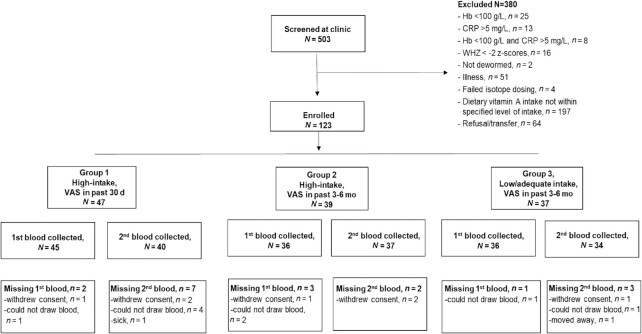
Children 12-18 mo of age ( = 123) were selected for 3 groups: ) retinol intake >600 µg/d and VAS within the past mo, ) retinol intake >600 µg/d and VAS in the past 3-6 mo, and ) VA intake 200-500 µg retinol activity equivalents (RAE)/d and VAS in the past 3-6 mo. Dietary intake data were collected to measure VA intakes from complementary foods, breast milk, and low-dose, over-the-counter supplements. TBS were assessed by retinol isotope dilution, and VA toxicity biomarkers were measured. Main outcomes were compared by group.
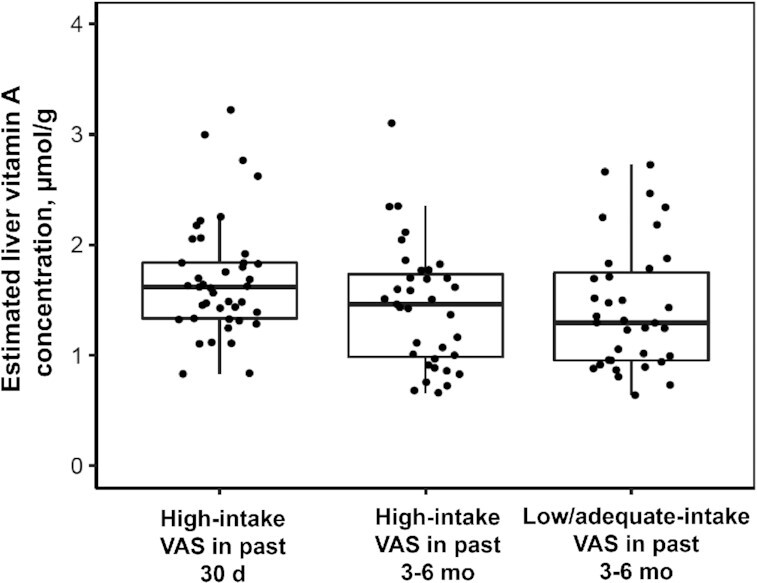
Mean (95% CI) VA intakes excluding VAS were 1184 (942, 1426), 980 (772, 1187), and 627 (530, 724) µg RAE/d, in groups 1-3, respectively; mean VA intake was higher in groups 1 and 2 compared with group 3 ( < 0.05). Geometric mean (GM) (95% CI) TBS were 589 (525, 661), 493 (435, 559), and 466 (411, 528) µmol, respectively. GM TBS and GM liver VA concentrations were higher in group 1 compared with group 3 (liver VA concentration: 1.62 vs. 1.33 µmol/g; < 0.05). Plasma retinyl ester and 4-oxo-retinoic acid concentrations and serum markers of bone turnover and liver damage did not indicate VA toxicity.
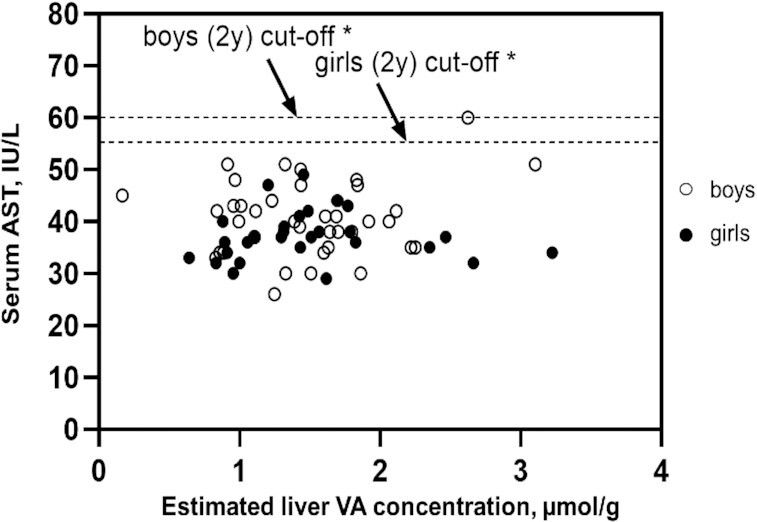
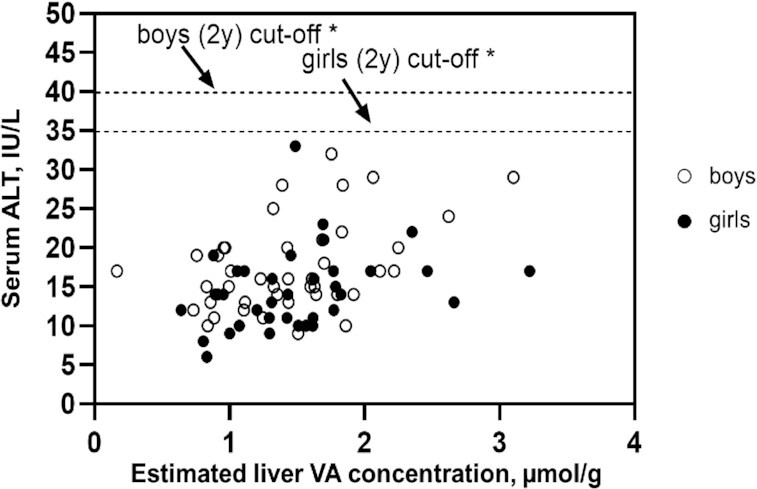
In this sample, most children had retinol intakes above the Tolerable Upper Intake Level (UL) and liver VA concentrations above the proposed cutoff for "hypervitaminosis A" (>1 µmol/g liver). There was no evidence of chronic VA toxicity, suggesting that the liver VA cutoff value should be re-evaluated. This trial was registered at www.clinicaltrials.gov as NCT03030339.
接触高剂量维生素A补充剂(VAS)和维生素A(VA)强化食品的幼儿可能面临VA摄入量过高和全身VA储备(TBS)过高的风险。
比较VA摄入量充足或较高且接触VAS时间不同的儿童的TBS和估计的肝脏VA浓度,并检查估计的肝脏VA浓度与VA毒性生物标志物之间的关联。
选择12至18月龄的儿童(n = 123)分为3组:(1)视黄醇摄入量>600μg/d且在过去1个月内服用VAS;(2)视黄醇摄入量>600μg/d且在过去3至6个月内服用VAS;(3)VA摄入量为200 - 500视黄醇活性当量(RAE)/d且在过去3至6个月内服用VAS。收集饮食摄入数据以测量来自辅食、母乳和低剂量非处方补充剂的VA摄入量。通过视黄醇同位素稀释评估TBS,并测量VA毒性生物标志物。按组比较主要结局。
第1 - 3组不包括VAS的平均(95%CI)VA摄入量分别为1184(942,1426)、980(772,1187)和627(530,724)μg RAE/d;第1组和第2组的平均VA摄入量高于第3组(P<0.05)。几何平均(GM)(95%CI)TBS分别为589(525,661)、493(435,559)和466(411,528)μmol。第1组的GM TBS和GM肝脏VA浓度高于第3组(肝脏VA浓度:1.62对1.33μmol/g;P<0.05)。血浆视黄酯和4 - 氧代视黄酸浓度以及骨转换和肝损伤的血清标志物未表明存在VA毒性。
在该样本中,大多数儿童的视黄醇摄入量高于可耐受最高摄入量水平(UL),且肝脏VA浓度高于提议的“维生素A过多症”临界值(>1μmol/g肝脏)。没有慢性VA毒性的证据,表明肝脏VA临界值应重新评估。该试验在www.clinicaltrials.gov上注册,注册号为NCT03030339。