Balestro Elisabetta, Cocconcelli Elisabetta, Giraudo Chiara, Polverosi Roberta, Biondini Davide, Lacedonia Donato, Bazzan Erica, Mazzai Linda, Rizzon Giulia, Lococo Sara, Turato Graziella, Tinè Mariaenrica, Cosio Manuel G, Saetta Marina, Spagnolo Paolo
Department of Cardiac, Thoracic, Vascular Sciences and Public Health, University of Padova and Padova City Hospital, 35128 Padova, Italy.
Institute of Radiology, Department of Medicine, University of Padova, 35128 Padova, Italy.
J Clin Med. 2019 Sep 15;8(9):1469. doi: 10.3390/jcm8091469.
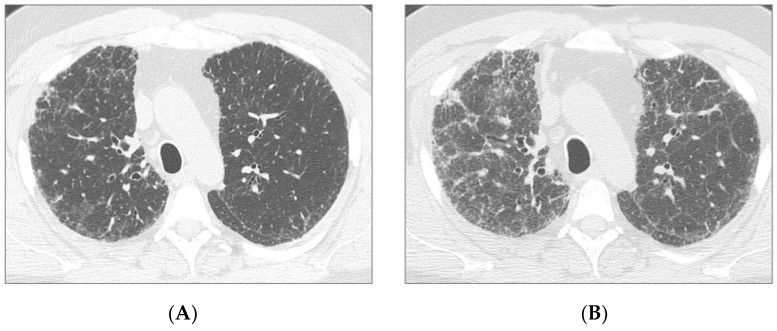
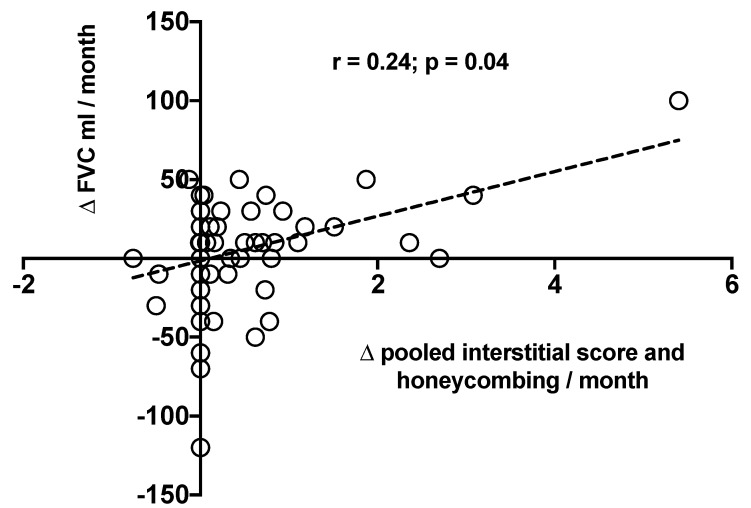
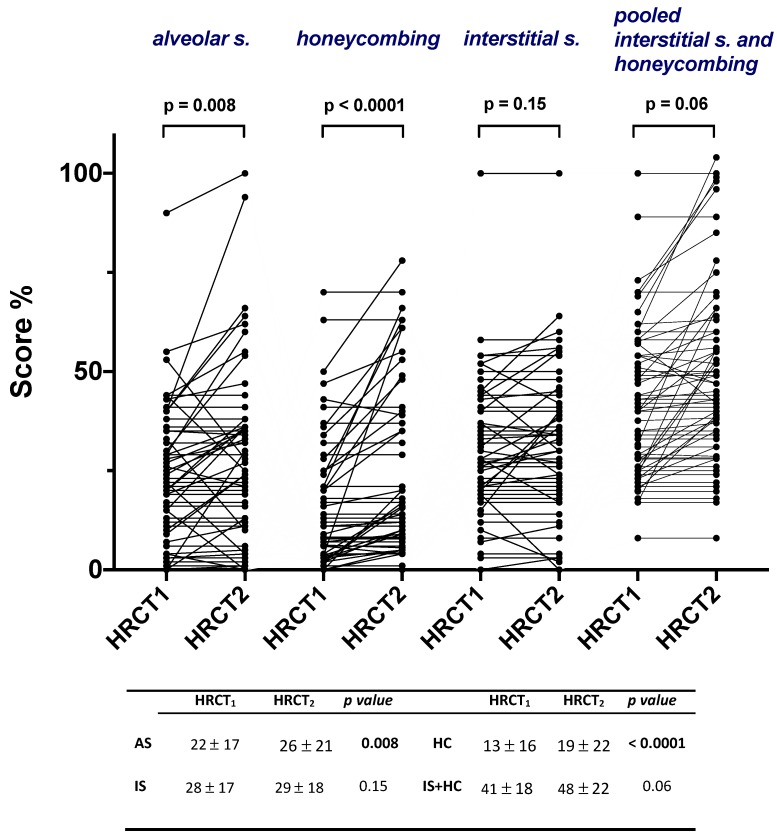
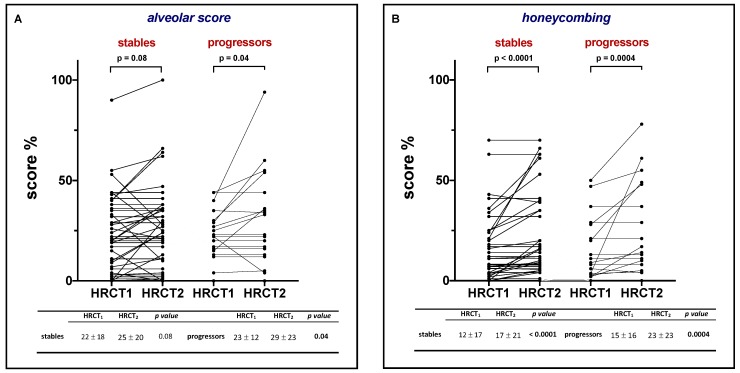
Antifibrotic treatment slows down functional decline and disease progression in idiopathic pulmonary fibrosis (IPF). High-resolution computed tomography (HRCT) is useful to diagnose IPF; however, little is known about whether and to what extent HRCT changes reflect functional changes during antifibrotic therapy. The aim of this study was, therefore, to assess HRCT change over time after 1 year of treatment and to evaluate whether these changes correlate with functional decline over the same period of time. Sixty-eight IPF patients on antifibrotic treatment (i.e., pirfenidone or nintedanib) were functionally categorized as stable or progressors based on whether (or not) they had a decline in forced vital capacity (FVC) >5% predicted/year, and their HRCT were scored blindly and independently by two expert thoracic radiologists at treatment initiation (HRCT1) and after 1 year of treatment (HRCT2). Ground glass opacities (Alveolar Score, AS), reticulations (Interstitial Score, IS) and honeycombing (HC) were quantified and correlated with FVC decline between HRCT1 and HRCT2. At treatment initiation, HRCT scores were similar in both stable patients and progressors. After one year of treatment, in the entire population, AS and HC increased significantly, while IS did not. However, when stratified by the rate of functional decline, in stable patients, HC increased significantly while AS and IS did not. On the other hand, among progressors AS and HC increased significantly whereas IS did not. In the entire population, the combined score of fibrosis (IS + HC) correlated significantly with FVC decline. In conclusion, IPF patients on antifibrotic treatment exhibit different patterns of HRCT change over time based on their rate of functional decline. HRCT data should be integrated to lung function data when assessing response to antifibrotic treatment in patients with IPF.
抗纤维化治疗可减缓特发性肺纤维化(IPF)的功能衰退和疾病进展。高分辨率计算机断层扫描(HRCT)有助于诊断IPF;然而,关于HRCT变化是否以及在何种程度上反映抗纤维化治疗期间的功能变化,人们知之甚少。因此,本研究的目的是评估治疗1年后HRCT随时间的变化,并评估这些变化是否与同一时期的功能衰退相关。68例接受抗纤维化治疗(即吡非尼酮或尼达尼布)的IPF患者,根据其预测的用力肺活量(FVC)下降是否>5%/年,在功能上分为稳定型或进展型,其HRCT由两名专业胸放射科专家在治疗开始时(HRCT1)和治疗1年后(HRCT2)进行盲法独立评分。对磨玻璃影(肺泡评分,AS)、网状影(间质评分,IS)和蜂窝状影(HC)进行量化,并与HRCT1和HRCT2之间的FVC下降情况相关联。在治疗开始时,稳定型患者和进展型患者的HRCT评分相似。治疗一年后,在整个人群中,AS和HC显著增加,而IS没有。然而,按功能衰退率分层时,在稳定型患者中,HC显著增加,而AS和IS没有。另一方面,在进展型患者中,AS和HC显著增加,而IS没有。在整个人群中,纤维化综合评分(IS + HC)与FVC下降显著相关。总之,接受抗纤维化治疗的IPF患者根据其功能衰退率表现出不同模式的HRCT随时间变化。在评估IPF患者对抗纤维化治疗的反应时,应将HRCT数据与肺功能数据相结合。