Ahmad Gulfam, Chami Belal, El Kazzi Mary, Wang Xiaosuo, Moreira Maria Tereza S, Hamilton Natasha, Maw Aung Min, Hambly Thomas W, Witting Paul K
Redox Biology Group, Discipline of Pathology, Faculty of Medicine and Health, Charles Perkins Centre, The University of Sydney, Sydney, NSW 2006, Australia.
Discipline of Oral Pathology, Faculty of Medicine and Health, Charles Perkins Centre, The University of Sydney, Sydney, NSW 2006, Australia.
Antioxidants (Basel). 2019 Sep 18;8(9):414. doi: 10.3390/antiox8090414.
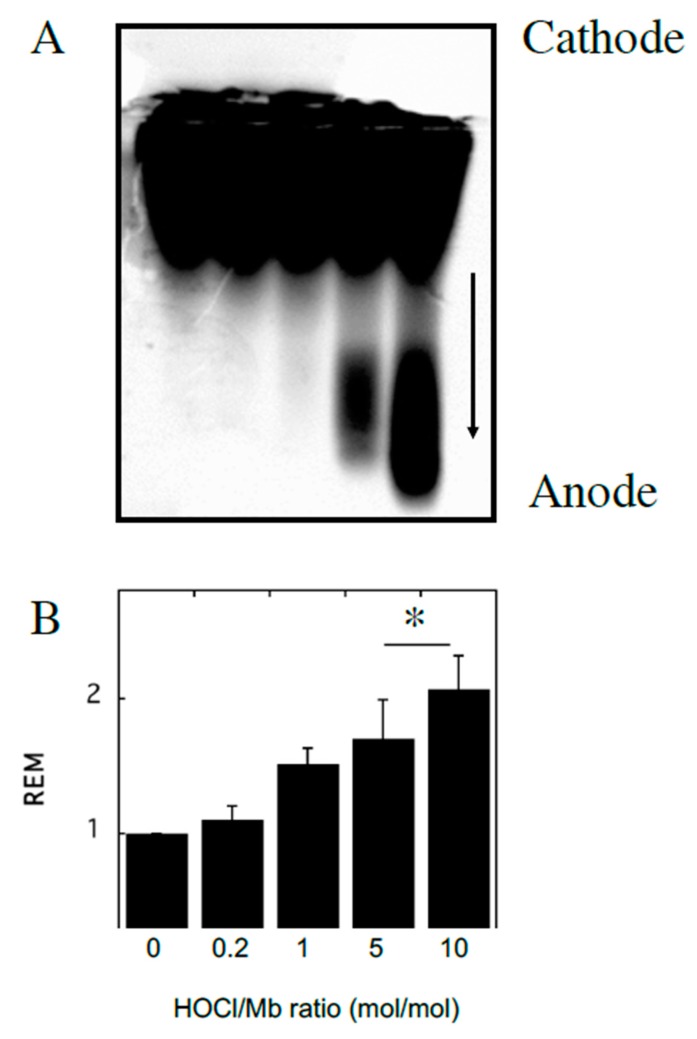
Activated neutrophils release myeloperoxidase that produces the potent oxidant hypochlorous acid (HOCl). Exposure of the oxygen transport protein horse heart myoglobin (hhMb) to HOCl inhibits Iron III (Fe(III))-heme reduction by cytochrome 5 to oxygen-binding Iron II (Fe(II))Mb. Pathological concentrations of HOCl yielded myoglobin oxidation products of increased electrophoretic mobility and markedly different UV/Vis absorbance. Mass analysis indicated HOCl caused successive mass increases of 16 a.m.u., consistent serial addition of molecular oxygen to the protein. By contrast, parallel analysis of protein chlorination by quantitative mass spectrometry revealed a comparatively minor increase in the 3-chlorotyrosine/tyrosine ratio. Pre-treatment of hhMb with HOCl affected the peroxidase reaction between the hemoprotein and HO as judged by a HOCl dose-dependent decrease in spin-trapped tyrosyl radical detected by electron paramagnetic resonance (EPR) spectroscopy and the rate constant of 2,2'-azino-bis(3-ethylbenzothiazoline-6-sulphonic acid (ABTS) oxidation. By contrast, Mb catalase-like antioxidant activity remained unchanged under the same conditions. Notably, HOCl-modification of Mb decreased the rate of ferric-to-ferrous Mb reduction by a cytochrome b5 reductase system. Taken together, these data indicate oxidizing HOCl promotes Mb oxidation but not chlorination and that oxidized Mb shows altered Mb peroxidase-like activity and diminished rates of one-electron reduction by cytochrome b5 reductase, possibly affecting oxygen storage and transport however, Mb-catalase-like antioxidant activity remains unchanged.
活化的中性粒细胞释放髓过氧化物酶,该酶可产生强效氧化剂次氯酸(HOCl)。氧转运蛋白马心脏肌红蛋白(hhMb)暴露于HOCl会抑制细胞色素5将铁III(Fe(III))-血红素还原为氧结合铁II(Fe(II))Mb。HOCl的病理浓度会产生电泳迁移率增加且紫外/可见吸收明显不同的肌红蛋白氧化产物。质谱分析表明,HOCl导致质量连续增加16个原子质量单位,这与分子氧连续添加到蛋白质上一致。相比之下,通过定量质谱对蛋白质氯化的平行分析显示,3-氯酪氨酸/酪氨酸比率的增加相对较小。通过电子顺磁共振(EPR)光谱检测到的自旋捕获酪氨酸自由基的HOCl剂量依赖性降低以及2,2'-联氮-双(3-乙基苯并噻唑啉-6-磺酸)(ABTS)氧化的速率常数判断,用HOCl预处理hhMb会影响血红蛋白与HO之间的过氧化物酶反应。相比之下,在相同条件下,Mb的过氧化氢酶样抗氧化活性保持不变。值得注意的是,Mb的HOCl修饰降低了细胞色素b5还原酶系统将三价铁还原为二价铁Mb的速率。综上所述,这些数据表明氧化性HOCl促进Mb氧化而非氯化,并且氧化后的Mb显示出改变的Mb过氧化物酶样活性以及细胞色素b5还原酶单电子还原速率降低,这可能会影响氧的储存和运输,然而,Mb的过氧化氢酶样抗氧化活性保持不变。