Kitti Thawatchai, Seng Rathanin, Thummeepak Rapee, Boonlao Chalermchai, Jindayok Thanyasiri, Sitthisak Sutthirat
Department of Microbiology and Parasitology, Faculty of Oriental Medicine, Chiang Rai College, Bangkok, Thailand.
Department of Microbiology and Immunology, Faculty of Tropical Medicine, Mahidol University, Bangkok, Thailand.
J Glob Infect Dis. 2019 Jul-Sep;11(3):112-117. doi: 10.4103/jgid.jgid_118_18.
Methicillin-resistant coagulase-negative staphylococci (MR-CoNS) are multidrug-resistant bacteria that are difficult to treat because of their ability to form biofilms.
In the present study, we evaluated the antibiotic-resistant phenotypes, biofilm-forming ability, and biofilm associated genes of 55 clinical MR-CoNS isolates obtained from two hospitals in Thailand.
MALDI-TOF-MS and gene sequencing were performed to determine the species of all isolates. Biofilm production was determined using Congo red agar (CRA) and the microtiter plate (MTP) assay. Biofilm-associated genes were characterized using polymerase chain reaction (PCR).
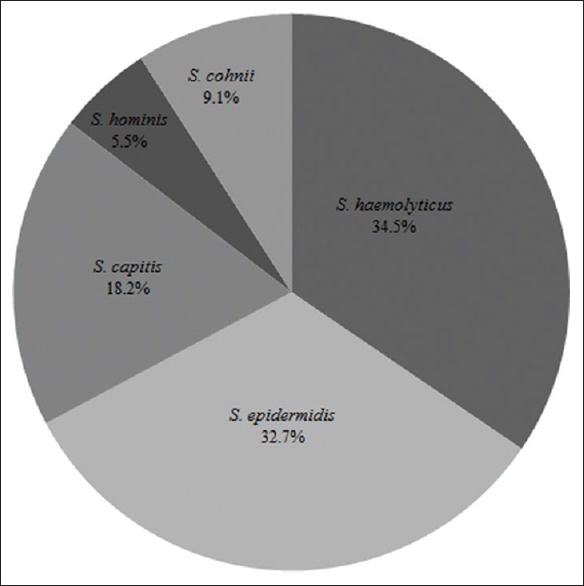
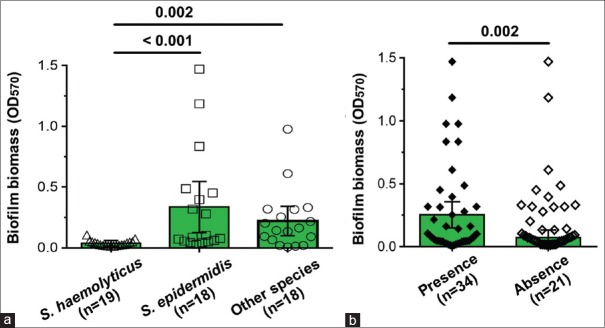
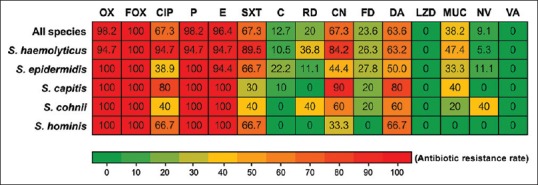
Among the 55 MR-CoNS isolates, five species were identified as (34.5%), (32.7%), (18.2%), (9.1%), and (5.5%). The antimicrobial susceptibility pattern of MR-CoNS isolates indicated high resistance to cefoxitin (100%), penicillin (98.2%), erythromycin (96.4%), ciprofloxacin (67.3%), sulfamethoxazole/trimethoprim (67.3%), gentamicin (67.3%), and clindamycin (63.6%). All the isolates were susceptible to vancomycin and linezolid. The biofilm production was detected in 87.3% isolates through the CRA method and in 38.1% isolates through the MTP assay. The prevalence rates of AD, , A, and were 18.2%, 12.7%, 47.3%, and 27.3%, respectively. There were significant differences in the presence of these biofilm-associated genes among the MR-CoNS isolates. Moreover, quantitative biofilm formation was significantly different among MR-CoNS species.
The present study revealed that biofilm-associated genes are important for biofilm biomass in MR-CoNS isolates, and the findings of this study are essential for finding new strategies to control biofilm formation and prevent the spread of MR-CoNS infectious diseases.
耐甲氧西林凝固酶阴性葡萄球菌(MR-CoNS)是多重耐药菌,因其具有形成生物膜的能力而难以治疗。
在本研究中,我们评估了从泰国两家医院获得的55株临床MR-CoNS分离株的抗生素耐药表型、生物膜形成能力及生物膜相关基因。
采用基质辅助激光解吸电离飞行时间质谱(MALDI-TOF-MS)和基因测序确定所有分离株的种类。使用刚果红琼脂(CRA)和微量滴定板(MTP)试验测定生物膜形成情况。采用聚合酶链反应(PCR)对生物膜相关基因进行鉴定。
在55株MR-CoNS分离株中,鉴定出5个菌种,分别为[具体菌种1](34.5%)、[具体菌种2](32.7%)、[具体菌种3](18.2%)、[具体菌种4](9.1%)和[具体菌种5](5.5%)。MR-CoNS分离株的抗菌药物敏感性模式显示,对头孢西丁(100%)、青霉素(98.2%)、红霉素(96.4%)、环丙沙星(67.3%)、磺胺甲恶唑/甲氧苄啶(67.3%)、庆大霉素(67.3%)和克林霉素(63.6%)高度耐药。所有分离株对万古霉素和利奈唑胺敏感。通过CRA方法在87.3%的分离株中检测到生物膜形成,通过MTP试验在38.1%的分离株中检测到生物膜形成。AD、[具体基因1]、A和[具体基因2]的流行率分别为18.2%、12.7%、47.3%和27.3%。在MR-CoNS分离株中,这些生物膜相关基因的存在情况存在显著差异。此外,MR-CoNS菌种之间的生物膜定量形成也存在显著差异。
本研究表明,生物膜相关基因对MR-CoNS分离株中的生物膜生物量很重要,本研究结果对于寻找控制生物膜形成和预防MR-CoNS传染病传播的新策略至关重要。