Muhammad Nasiru, Adamu Mohammed D, Mpyet Caleb, Bounce Catey, Maishanu Nuhu M, Jabo Aliyu M, Rabiu Muhammad M, Bascaran Covadonga, Isiyaku Sunday, Foster Allen
Department of Ophthalmology, Usmanu Danfodiyo University Teaching Hospital, Sokoto, Nigeria.
Department of Ophthalmology, University of Jos, Jos, Nigeria.
Middle East Afr J Ophthalmol. 2019 Aug 26;26(2):101-106. doi: 10.4103/meajo.MEAJO_113_17. eCollection 2019 Apr-Jun.
This study was undertaken to ascertain the current magnitude and causes of blindness and visual impairment in persons aged 50 years and over and to assess the impact of a 10-year eye care program in Sokoto State, Nigeria.
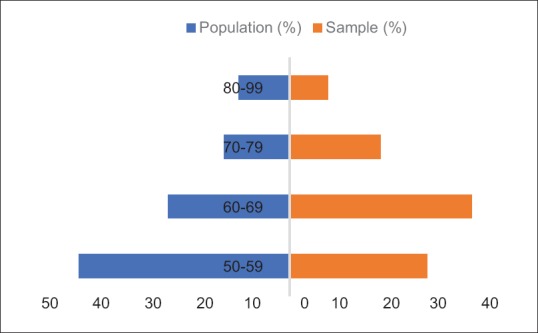
A rapid assessment of avoidable blindness (RAAB) survey (in persons 50 years and over) was conducted in 2016. Participants were selected in Wurno health zone using a two-stage cluster randomized sampling with probability proportional to size. Operational definitions were based on RAAB and World Health Organization eye examination record definitions. Eye care program documents were reviewed and data from a baseline survey undertaken in 2005 were reanalyzed.
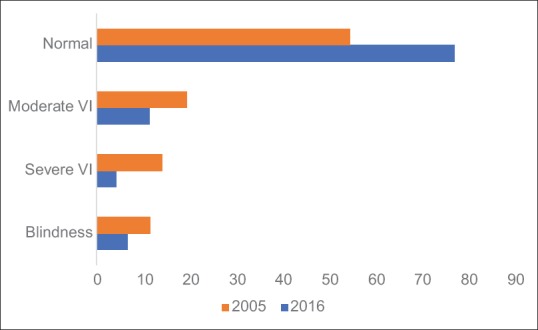
A response of 89.1% (2405 of 2700 participants) was obtained in the 2016 survey. With available correction, the unadjusted prevalence of blindness was 7.7% (95% confidence interval [CI]: 6.4, 8.9). The odds of blindness were 1.8 times higher in females than males (95% CI: 1.3, 2.4; < 0.001). Major causes of blindness were cataract (48.9%) corneal disease (20.1%), glaucoma (10.3%), and uncorrected refractive error/aphakia (8.7%). The age- and sex-adjusted prevalence of blindness has declined from 11.6% (95% CI: 7.4, 17.0) in 2005 to 6.8% (95% CI: 5.6, 8.0%) in 2016.
The blindness prevalence is high, and the major causes are avoidable in the health zone. The findings suggest that investments in the program over the last 10 years might have led to almost a halving in the prevalence of blindness in th e population. However, the small sample size of persons 50+ years from Wurno zone in the 2005 survey necessitate caution when comparing the 2005 and the 2016 surveys.
本研究旨在确定50岁及以上人群失明和视力损害的当前程度及原因,并评估尼日利亚索科托州一项为期10年的眼保健项目的影响。
2016年对50岁及以上人群进行了可避免失明快速评估(RAAB)调查。在伍尔诺健康区采用两阶段整群随机抽样,抽样概率与规模成比例选取参与者。操作定义基于RAAB和世界卫生组织眼部检查记录定义。审查了眼保健项目文件,并重新分析了2005年进行的基线调查数据。
2016年调查的应答率为89.1%(2700名参与者中的2405名)。在可获得矫正的情况下,未经调整的失明患病率为7.7%(95%置信区间[CI]:6.4,8.9)。女性失明几率比男性高1.8倍(95%CI:1.3,2.4;<0.001)。失明的主要原因是白内障(48.9%)、角膜疾病(20.1%)、青光眼(10.3%)以及未矫正的屈光不正/无晶状体(8.7%)。经年龄和性别调整后的失明患病率已从2005年的11.6%(95%CI:7.4,17.0)降至2016年的6.8%(95%CI:5.6,8.0%)。
该健康区失明患病率较高,且主要原因是可避免的。研究结果表明,过去10年对该项目的投入可能使人群失明患病率几乎减半。然而,2005年调查中伍尔诺区50岁及以上人群的样本量较小,在比较2005年和2016年调查时需谨慎。