Sasidharanpillai Sarita, Govindan Aparna, Ajithkumar Kidangazhi Yathmana, Mahadevan Saranya T, Bindu Valiyaveettil, Khader Anza, Sathi Puthen Parambath
Department of Dermatology and Venereology, Govt. Medical College, Kozhikode, Kerala, India.
Department of Pathology, Govt. Medical College, Kozhikode, Kerala, India.
Indian Dermatol Online J. 2019 Aug 28;10(5):542-546. doi: 10.4103/idoj.IDOJ_426_18. eCollection 2019 Sep-Oct.
An umbrella term, acquired dermal macular hyperpigmentation (ADMH), has been proposed to denote conditions including ashy dermatosis, erythema dyschromicum perstans, lichen planus pigmentosus, and idiopathic macular eruptive pigmentation.
To classify the patients manifesting ADMH on the basis of histology.
In this retrospective, cross-sectional study, histology specimens of patients of ADMH, who underwent skin biopsy in our institution from 1.1 2015 to 31.12.2017, were included after obtaining ethical clearance.
The histology specimens of patients of ADMH were reviewed by the pathologist and classified. Clinical features of individual patient were collected from previous records and the data analyzed.
Pearson's Chi-square test was used to determine significance of association between age of onset and duration of pigmentation with histology type.
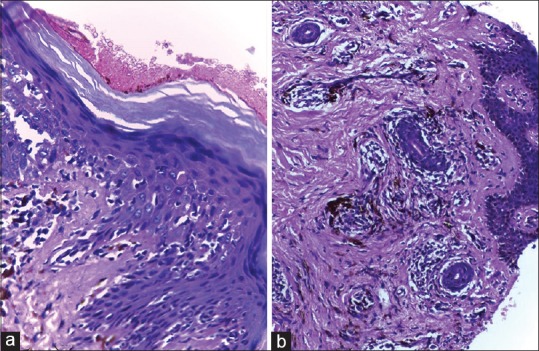
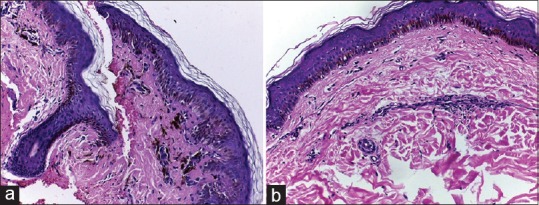
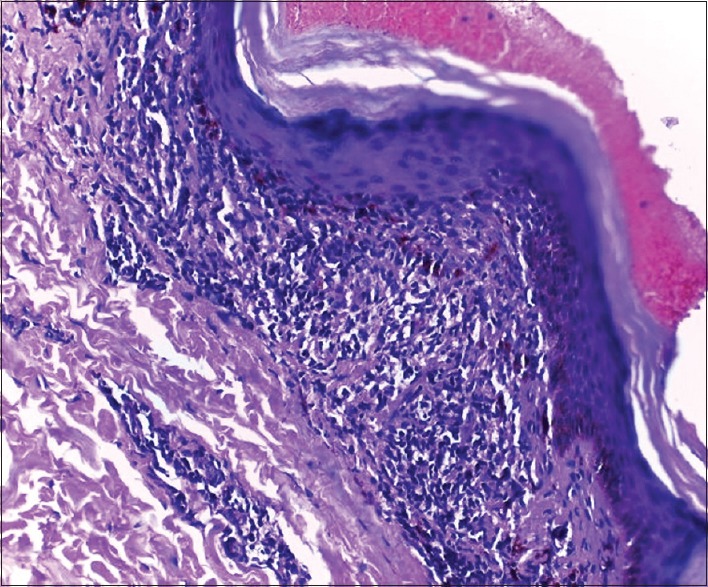
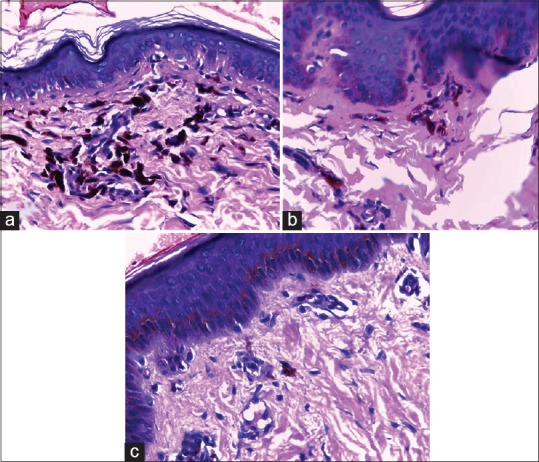
Three patterns of histology were identified in the study group (17 males and 13 females). Type 1: Basal cell degeneration and moderate to dense inflammation (12 patients, 40%), type 2: Significant pigment incontinence and sparse inflammation without basal cell degeneration, (12 patients, 40%), and type 3: sparse inflammation without basal cell degeneration or significant pigment incontinence (six patients, 20%). Statistically significant association was noted between age of onset of pigmentation and histology type ( value, 0.02).
Main limitation was the small sample size.
Prospective studies evaluating the clinical progression and dermoscopy features and analyzing serial biopsies of ADMH patients may confirm whether the histology patterns observed represent different stages of same disease process or are different entities.
有人提出用“获得性皮肤斑片状色素沉着(ADMH)”这一统称来指代包括灰皮病、持久性色素异常性红斑、色素性扁平苔藓和特发性斑疹性色素沉着在内的多种病症。
根据组织学对表现为ADMH的患者进行分类。
在这项回顾性横断面研究中,纳入了2015年1月1日至2017年12月31日期间在本机构接受皮肤活检的ADMH患者的组织学标本,并获得了伦理许可。
病理学家对ADMH患者的组织学标本进行复查并分类。从既往记录中收集每位患者的临床特征并进行数据分析。
采用Pearson卡方检验确定发病年龄和色素沉着持续时间与组织学类型之间关联的显著性。
在研究组(17名男性和13名女性)中确定了三种组织学模式。模式1:基底细胞变性和中度至重度炎症(12例患者,40%),模式2:明显的色素失禁和稀疏炎症,无基底细胞变性(12例患者,40%),模式3:稀疏炎症,无基底细胞变性或明显色素失禁(6例患者,20%)。色素沉着发病年龄与组织学类型之间存在统计学显著关联(P值,0.02)。
主要局限性是样本量小。
评估ADMH患者临床进展和皮肤镜特征并分析系列活检的前瞻性研究,可能会证实观察到的组织学模式是代表同一疾病过程的不同阶段还是不同的实体。