Department of Urology, The Affiliated Huai'an No. 1 People's Hospital of Nanjing Medical University, Huai'an, Jiangsu 223300, P.R. China.
State Key Laboratory of Reproductive Medicine, Center for Global Health, School of Public Health, Nanjing Medical University, Nanjing, Jiangsu 211166, P.R. China.
Int J Mol Med. 2019 Nov;44(5):1952-1962. doi: 10.3892/ijmm.2019.4347. Epub 2019 Sep 23.
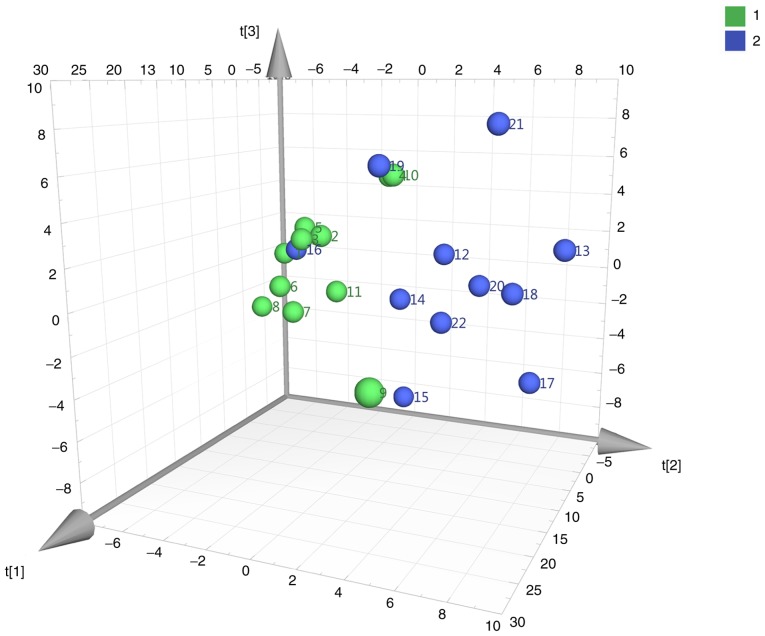
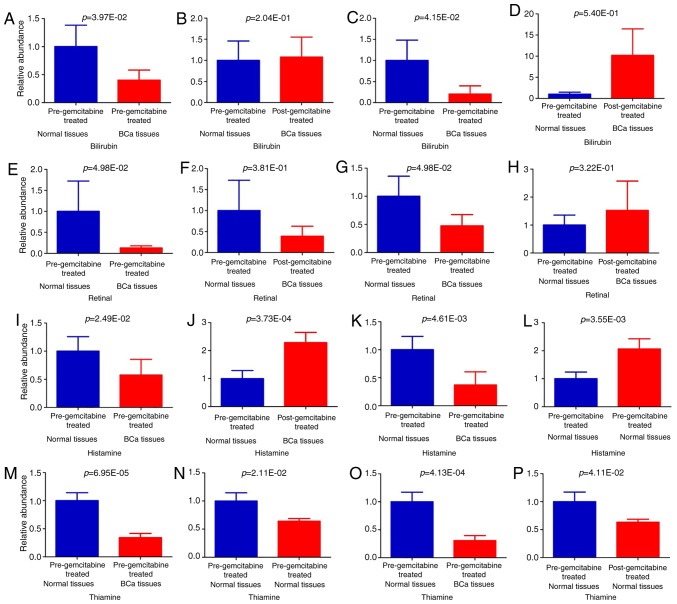
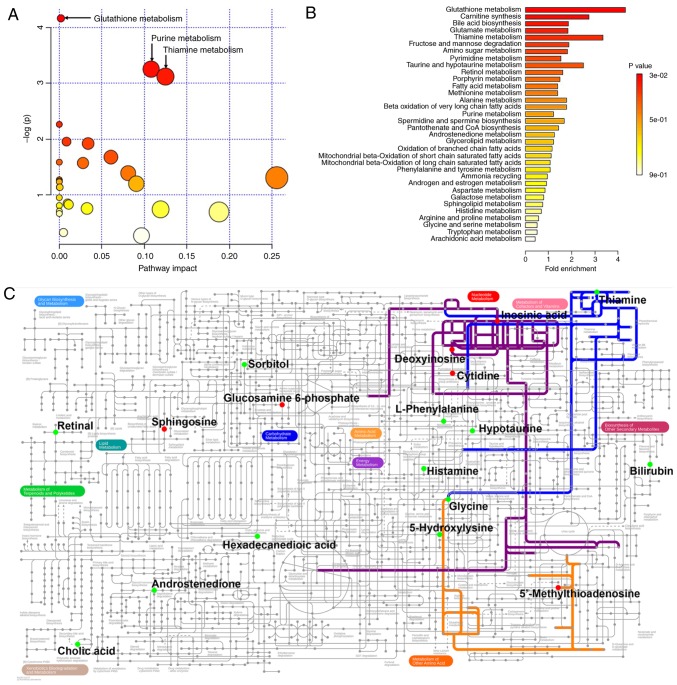
Bladder cancer (BCa) is a common urinary tract malignancy with frequent recurrences after initial resection. Submucosal injection of gemcitabine prior to transurethral resection of bladder tumor (TURBT) may prevent recurrence of urothelial cancer. However, the underlying mechanism remains unknown. In the present study, ultra‑performance liquid chromatography Q‑Exactive mass spectrometry was used to profile tissue metabolites from 12 BCa patients. The 48 samples included pre‑ and post‑gemcitabine treatment BCa tissues, as well as adjacent normal tissues. Principal component analysis (PCA) revealed that the metabolic profiles of pre‑gemcitabine BCa tissues differed significantly from those of pre‑gemcitabine normal tissues. A total of 34 significantly altered metabolites were further analyzed. Pathway analysis using MetaboAnalyst identified three metabolic pathways closely associated with BCa, including glutathione, purine and thiamine metabolism, while glutathione metabolism was also identified by the enrichment analysis using MetaboAnalyst. In search of the possible targets of gemcitabine, metabolite profiles were compared between the pre‑gemcitabine normal and post‑gemcitabine BCa tissues. Among the 34 metabolites associated with BCa, the levels of bilirubin and retinal recovered in BCa tissues treated with gemcitabine. When comparing normal bladder tissues with and without gemcitabine treatment, among the 34 metabolites associated with BCa, it was observed that histamine change may be associated with the prevention of relapse, whereas thiamine change may be involved in possible side effects. Therefore, by employing a hypothesis‑free tissue‑based metabolomics study, the present study investigated the metabolic signatures of BCa and found that bilirubin and retinal may be involved in the mechanism underlying the biomolecular action of submucosal injection of gemcitabine in urothelial BCa.
膀胱癌(BCa)是一种常见的泌尿系统恶性肿瘤,在初次切除后常复发。在经尿道膀胱肿瘤切除术(TURBT)前行吉西他滨黏膜下注射可能预防尿路上皮癌的复发。然而,其潜在机制尚不清楚。本研究采用超高效液相色谱 Q-Exactive 质谱法分析 12 例 BCa 患者的组织代谢产物。48 个样本包括吉西他滨治疗前后的 BCa 组织以及相邻的正常组织。主成分分析(PCA)显示,吉西他滨治疗前 BCa 组织的代谢谱与吉西他滨治疗前正常组织的代谢谱有显著差异。进一步分析了 34 种显著改变的代谢物。使用 MetaboAnalyst 进行的途径分析确定了与 BCa 密切相关的三个代谢途径,包括谷胱甘肽、嘌呤和硫胺素代谢,而谷胱甘肽代谢也通过 MetaboAnalyst 的富集分析得到鉴定。为了寻找吉西他滨的可能靶点,将吉西他滨治疗前正常组织和吉西他滨治疗前 BCa 组织的代谢谱进行了比较。在与 BCa 相关的 34 种代谢物中,胆红素和视黄醇在吉西他滨治疗的 BCa 组织中恢复。在比较有和没有吉西他滨治疗的正常膀胱组织时,在与 BCa 相关的 34 种代谢物中,组胺的变化可能与预防复发有关,而硫胺素的变化可能与可能的副作用有关。因此,本研究采用无假设的基于组织的代谢组学研究方法,研究了 BCa 的代谢特征,发现胆红素和视黄醇可能参与了吉西他滨黏膜下注射在尿路上皮 BCa 中的生物分子作用机制。