Guangdong Traditional Medical and Sports Injury Rehabilitation Research Institute, Guangdong Second Provincial General Hospital, Guangzhou, Guangdong 510317, P.R. China.
Department of Medical Ultrasonics, The Third Affiliated Hospital, Sun Yat‑sen University, Guangzhou, Guangdong 510630, P.R. China.
Mol Med Rep. 2019 Nov;20(5):4175-4185. doi: 10.3892/mmr.2019.10661. Epub 2019 Sep 10.
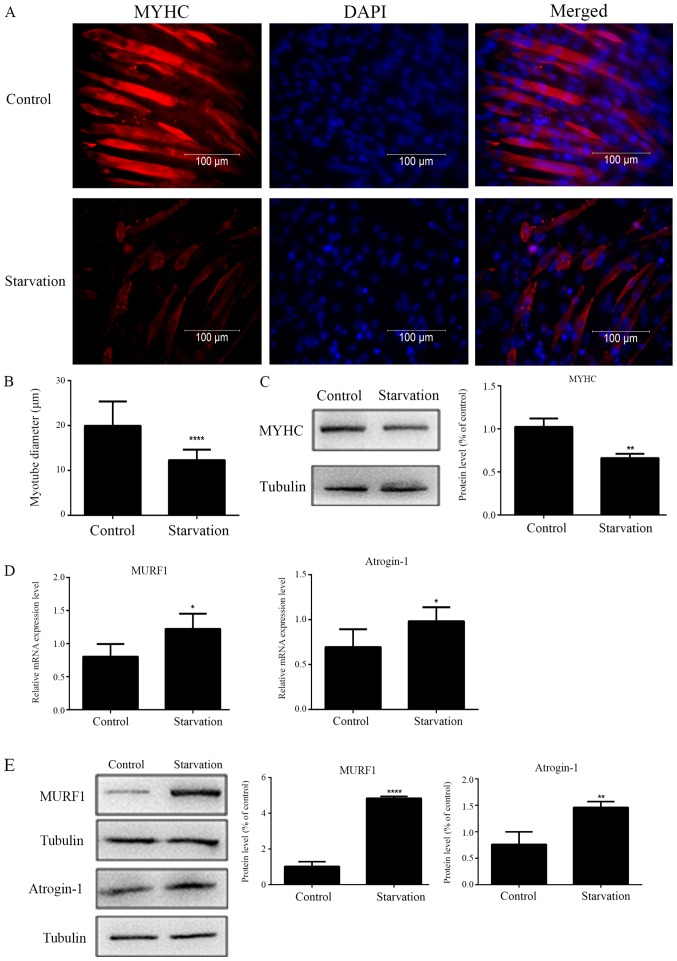
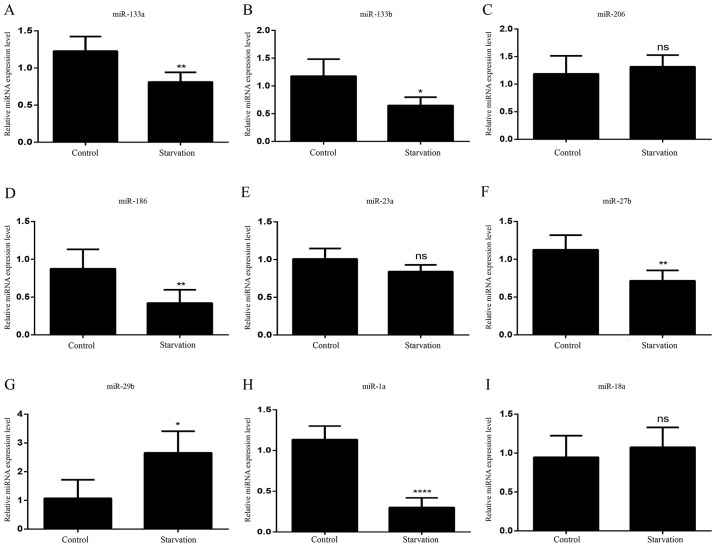
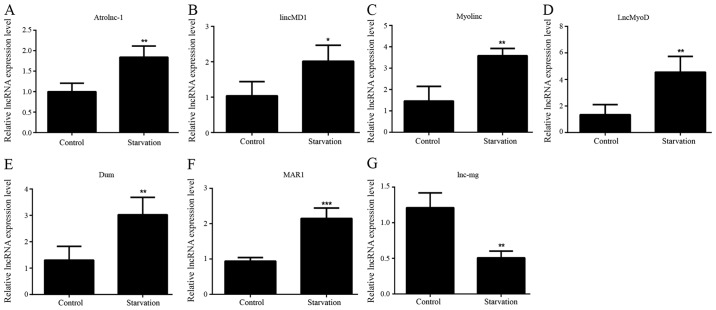
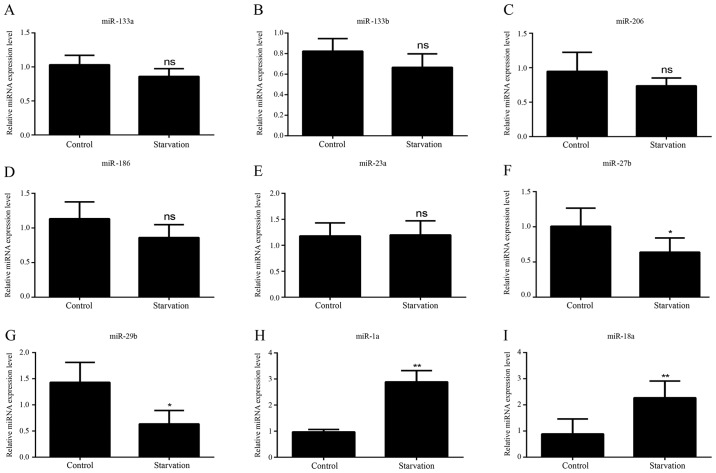
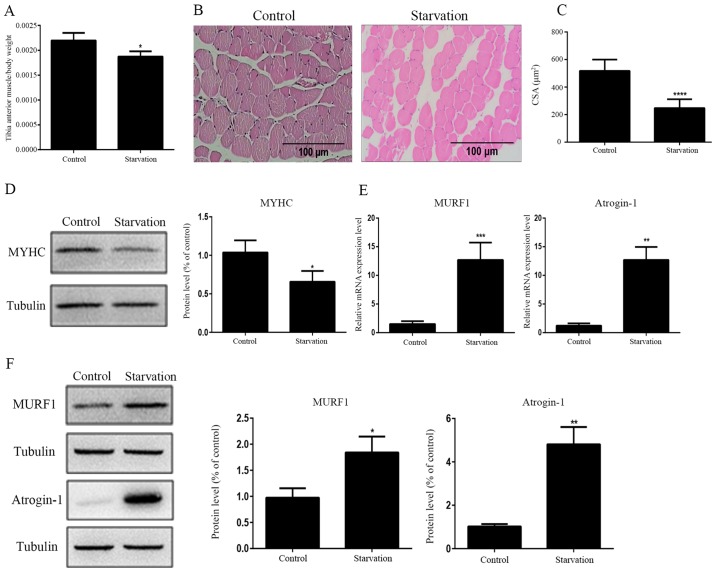
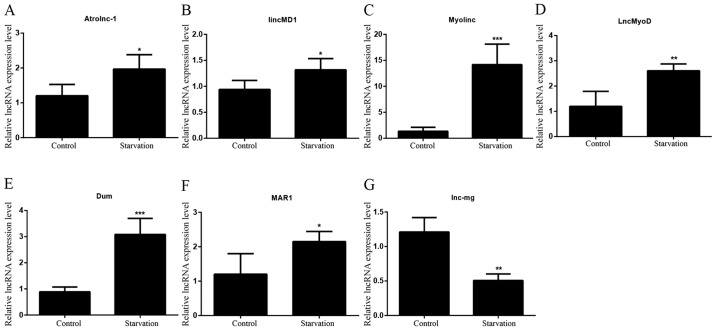
Starvation or severe deprivation of nutrients, which is commonly seen in surgical patients, can result in catabolic changes in skeletal muscles, such as muscle atrophy. Therefore, it is important to elucidate the underlying molecular regulatory mechanisms during skeletal muscle atrophy. In the present study, muscular atrophy was induced by starvation and the results demonstrated that myosin heavy chain was decreased, whereas muscle RING finger protein 1 and atrogin‑1 were increased, both in vitro and in vivo. The impact of starvation on the expression patterns of long non‑coding RNAs (lncRNAs) and microRNAs (miRNAs) was next determined. The expression patterns of miR‑23a, miR‑206 and miR‑27b in the starved mice exhibited similar trends as those in starved C2C12 cells in vitro, whereas the expression patterns of six other miRNAs (miR‑18a, miR‑133a, miR‑133b, miR‑186, miR‑1a and miR‑29b) differed between the in vivo and the in vitro starvation models. The present study indicated that in vitro expression of the selected miRNAs was not completely consistent with that in vivo. By contrast, lncRNAs showed excellent consistency in their expression patterns in both the in vitro and in vivo starvation models; six of the lncRNAs (Atrolnc‑1, long intergenic non‑protein coding RNA of muscle differentiation 1, Myolinc, lncRNA myogenic differentiation 1, Dum and muscle anabolic regulator 1) were significantly elevated in starved tissues and cells, while lnc‑mg was significantly decreased, compared with the control groups. Thus, lncRNAs involved in muscle atrophy have the potential to be developed as diagnostic tools.
饥饿或严重缺乏营养,这在外科患者中很常见,可导致骨骼肌发生分解代谢变化,如肌肉萎缩。因此,阐明骨骼肌萎缩过程中的潜在分子调节机制非常重要。在本研究中,通过饥饿诱导肌肉萎缩,结果表明,肌球蛋白重链减少,而肌肉环指蛋白 1 和萎缩基因 1 在体外和体内均增加。接下来确定了饥饿对长链非编码 RNA(lncRNA)和 microRNA(miRNA)表达模式的影响。饥饿小鼠中 miR-23a、miR-206 和 miR-27b 的表达模式与体外饥饿 C2C12 细胞的表达模式相似,而另外 6 种 miRNA(miR-18a、miR-133a、miR-133b、miR-186、miR-1a 和 miR-29b)的表达模式在体内和体外饥饿模型之间存在差异。本研究表明,体外选择的 miRNA 表达与体内不完全一致。相比之下,lncRNA 在体外和体内饥饿模型中的表达模式具有很好的一致性;六种 lncRNA(Atrolnc-1、肌肉分化 1 的长基因间非蛋白编码 RNA、Myolinc、lncRNA 肌肉分化 1、Dum 和肌肉合成代谢调节剂 1)在饥饿组织和细胞中显著上调,而 lnc-mg 与对照组相比显著下调。因此,参与肌肉萎缩的 lncRNA 有可能被开发为诊断工具。