Arazi Hamid, Taati Behzad, Rafati Sajedi Forough, Suzuki Katsuhiko
Department of Exercise Physiology, Faculty of Sports Sciences, University of Guilan, Rasht 4199843653, Iran.
Department of Sport Sciences, Faculty of Humanities Sciences, Islamic Azad University, Rasht Branch, Rasht 4147654919, Iran.
Antioxidants (Basel). 2019 Sep 20;8(10):418. doi: 10.3390/antiox8100418.
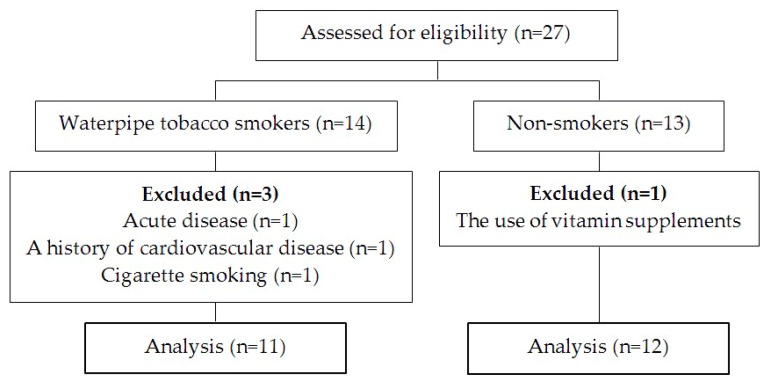
Waterpipe tobacco (WPT) smoking is a public health problem with similar or even stronger effects than cigarette smoking. Although it appears to be associated with extensive oxidative stress, there is a limited number of studies on the oxidative effects of WPT smoking in stressful conditions. We, therefore, compared the responses of salivary flow rate (SFR), uric acid (UA) concentration, and peroxidase (POX) and 2,2-diphenyl-1-picryl-hydrazyl-hydrate (DPPH) activities between WPT smokers and non-smokers following a bout of exhaustive aerobic exercise (AE). Twenty-three sedentary young women (age: 22.95 ± 2.83 years) participated in this study, including 11 smokers (7.00 ± 1.41 uses/week) and 12 non-smokers. All participants were required to perform the Bruce protocol treadmill test at an initial gradient of 10% at 1.7 mph, with increases of these parameters every 3 min until exhaustion. Unstimulated saliva samples were collected before, immediately after, and 1 hour after AE. WPT smokers showed lower SFR compared with non-smokers at all time points ( < 0.05). In comparison to WPT smokers, a larger increase in POX activity (approximately 23% vs. 14%; = 0.009) and a smaller decline in DPPH activity (approximately -8% vs. -15%; = 0.004) were found in non-smokers compared with WPT smokers. While these changes were slowly compensated within 1 hour after exhaustion, the activity of both markers was different from the pre-exercise values ( < 0.001). There was also a trend for UA concentration in non-smokers to be higher during the recovery period, with no significant difference between the groups ( > 0.05). It seems that WPT smoking is associated with negative effects on important human antioxidants and a diminished antioxidative response following acute exercise.
水烟吸食是一个公共卫生问题,其影响与卷烟吸食相似,甚至更强。尽管水烟吸食似乎与广泛的氧化应激有关,但关于在压力条件下水烟吸食的氧化作用的研究数量有限。因此,我们比较了一组力竭性有氧运动(AE)后水烟吸食者和非吸食者的唾液流速(SFR)、尿酸(UA)浓度、过氧化物酶(POX)和2,2-二苯基-1-苦基肼基水合物(DPPH)活性的反应。23名久坐不动的年轻女性(年龄:22.95±2.83岁)参与了本研究,其中包括11名吸烟者(每周吸食7.00±1.41次)和12名非吸烟者。所有参与者都被要求在初始坡度为10%、速度为1.7英里/小时的条件下进行布鲁斯方案跑步机测试,每隔3分钟增加这些参数,直至力竭。在运动前、运动后即刻和运动后1小时收集未刺激的唾液样本。在所有时间点,水烟吸食者的SFR均低于非吸烟者(P<0.05)。与水烟吸食者相比,非吸烟者的POX活性增加幅度更大(约23%对14%;P = 0.009),DPPH活性下降幅度更小(约-8%对-15%;P = 0.004)。虽然这些变化在力竭后1小时内缓慢得到补偿,但两种标志物的活性均与运动前值不同(P<0.001)。非吸烟者在恢复期间的UA浓度也有升高趋势,但两组之间无显著差异(P>0.05)。水烟吸食似乎与对人体重要抗氧化剂的负面影响以及急性运动后抗氧化反应减弱有关。