Unidad de Protección de Cultivos, Escuela Técnica Superior de Ingeniería Agronómica, Alimentaria y de Biosistemas, Universidad Politécnica de Madrid (ETSIAAB-UPM), Av. Puerta de Hierro 2, 28040, Madrid, Spain.
CREAF, Universitat Autònoma de Barcelona, Cerdanyola del Vallès, 08193, Barcelona, Spain.
Sci Rep. 2019 Sep 24;9(1):13770. doi: 10.1038/s41598-019-50255-4.
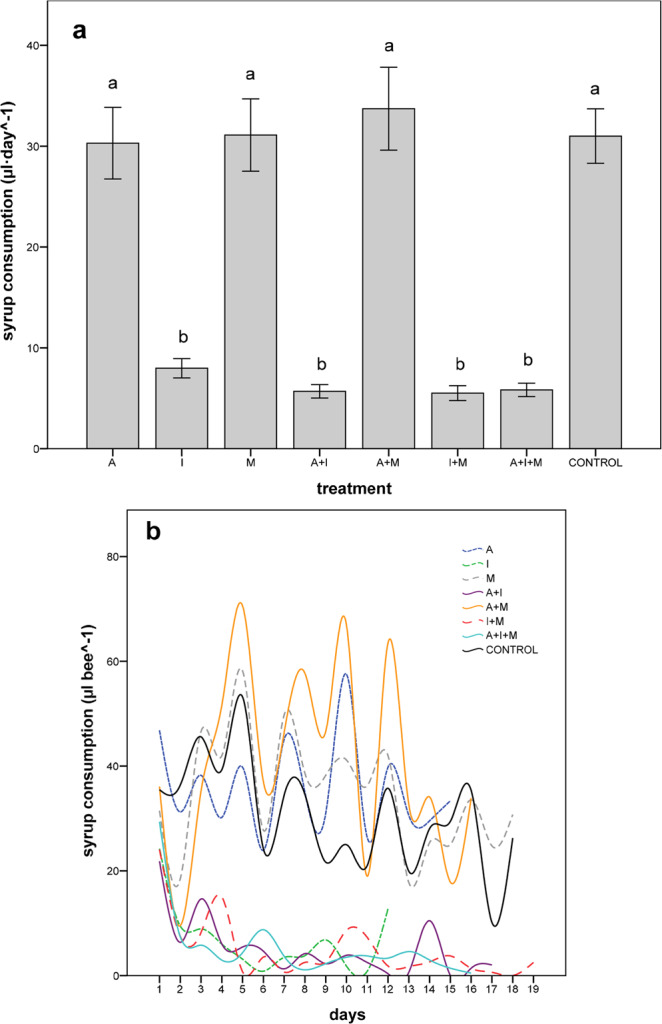
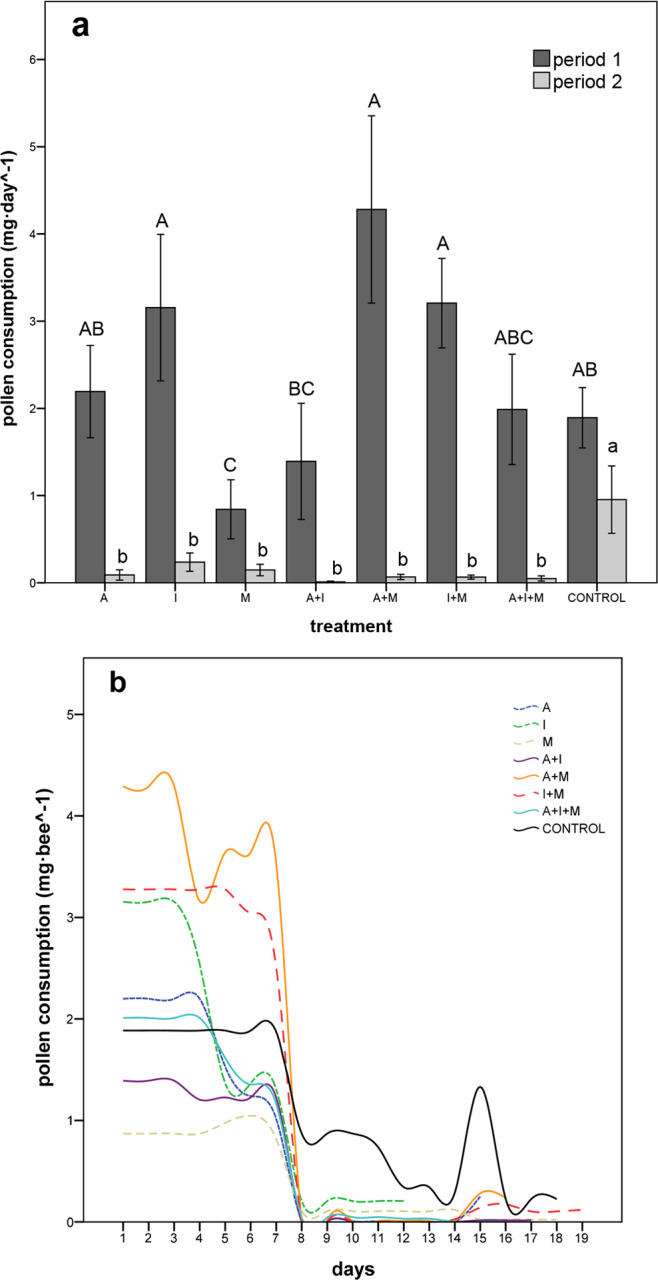
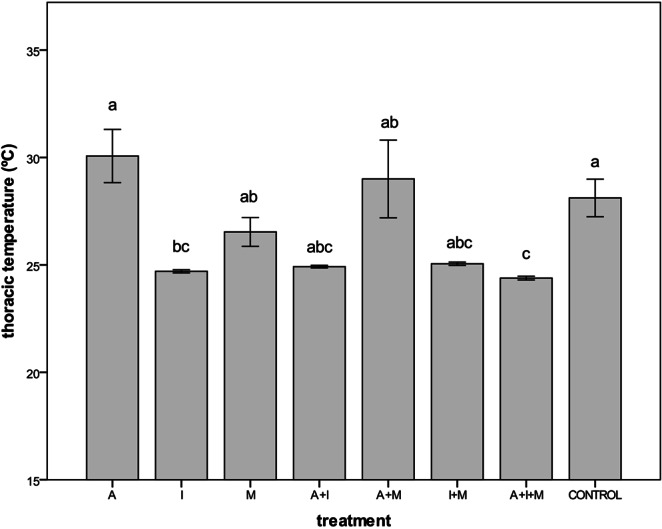
Pesticide use is one of the main causes of pollinator declines in agricultural ecosystems. Traditionally, most laboratory studies on bee ecotoxicology test acute exposure to single compounds. However, under field conditions, bees are often chronically exposed to a variety of chemicals, with potential synergistic effects. We studied the effects of field-realistic concentrations of three pesticides measured in pollen and nectar of commercial melon fields on the solitary bee Osmia bicornis L. We orally exposed females of this species throughout their life span to 8 treatments combining two neonicotinoid insecticides (acetamiprid, imidacloprid) and a triazole fungicide (myclobutanil) via pollen and sugar syrup. We measured pollen and syrup consumption, longevity, ovary maturation and thermogenesis. Pesticide intake was three orders of magnitude higher via syrup than pollen. At the tested concentrations, no synergistic effects emerged, and we found no effects on longevity and ovary maturation. However, all treatments containing imidacloprid resulted in suppressed syrup consumption and drastic decreases in thoracic temperature and bee activity. Our results have important implications for pesticide regulation. If we had measured only lethal effects we would have wrongly concluded that the pesticide combinations containing imidacloprid were safe to O. bicornis. The incorporation of tests specifically intended to detect sublethal effects in bee risk assessment schemes should be an urgent priority. In this way, the effects of pesticide exposure on the dynamics of bee populations in agroecosystems will be better assessed.
农药使用是农业生态系统中传粉媒介减少的主要原因之一。传统上,大多数关于蜜蜂生态毒理学的实验室研究都测试了单一化合物的急性暴露。然而,在野外条件下,蜜蜂经常长期接触各种化学物质,存在潜在的协同效应。我们研究了商业甜瓜田中花粉和花蜜中三种农药的田间实际浓度对独居蜜蜂 Osmia bicornis L. 的影响。我们通过花粉和糖溶液在该物种雌性的整个生命周期中对其进行 8 种处理的口服暴露,这些处理结合了两种新烟碱类杀虫剂(噻虫胺、吡虫啉)和一种三唑类杀菌剂(戊唑醇)。我们测量了花粉和糖浆的消耗、寿命、卵巢成熟和生热。通过糖浆摄入的农药摄入量比花粉高三个数量级。在测试的浓度下,没有出现协同作用,并且我们没有发现对寿命和卵巢成熟的影响。然而,所有含有吡虫啉的处理都导致糖浆消耗减少,以及胸部温度和蜜蜂活动急剧下降。我们的研究结果对农药监管具有重要意义。如果我们只测量了致死效应,我们就会错误地得出结论,含有吡虫啉的农药组合对 O. bicornis 是安全的。在蜜蜂风险评估计划中纳入专门旨在检测亚致死效应的测试应成为当务之急。这样,就可以更好地评估农药暴露对农业生态系统中蜜蜂种群动态的影响。