Janz Philip, Dawe Sharon, Wyllie Melissa
School of Applied Psychology, Griffith University, Mount Gravatt, QLD, Australia.
Front Psychol. 2019 Sep 10;10:2052. doi: 10.3389/fpsyg.2019.02052. eCollection 2019.
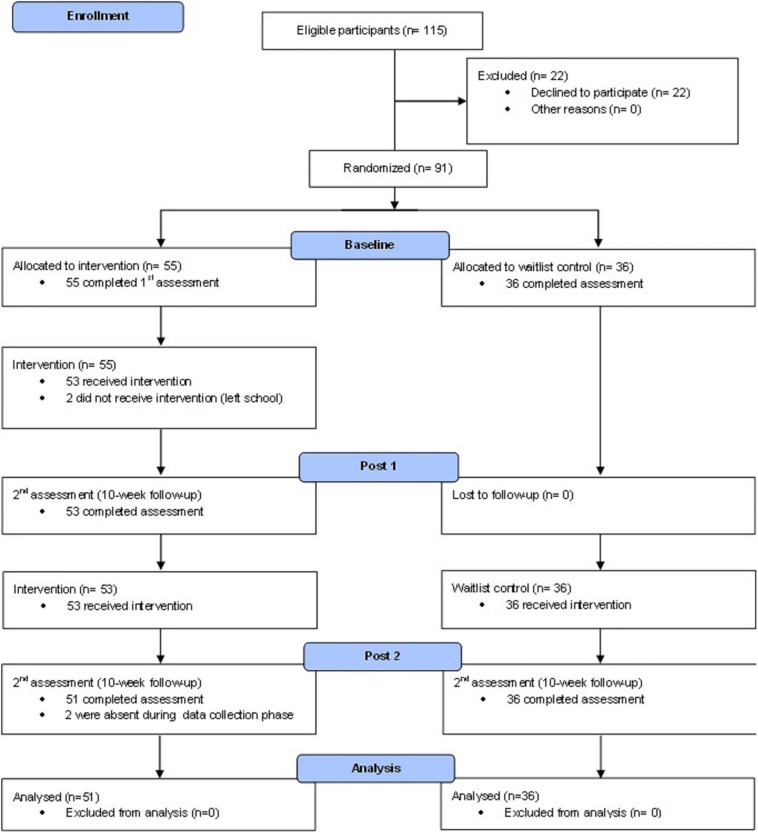
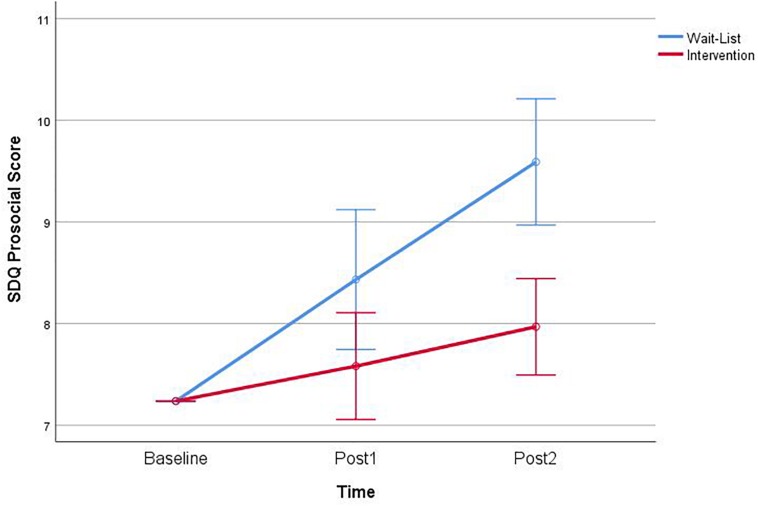
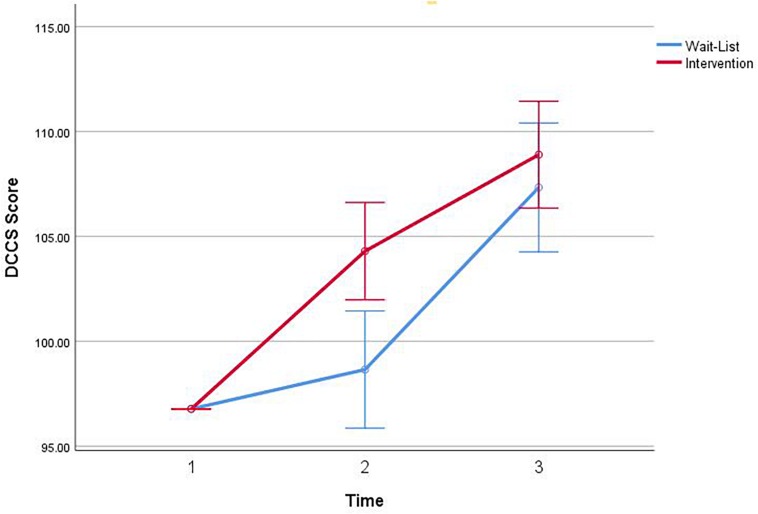
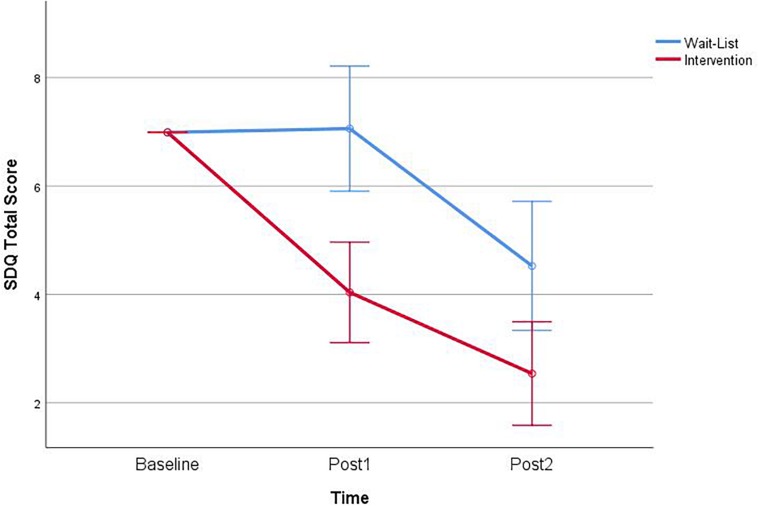
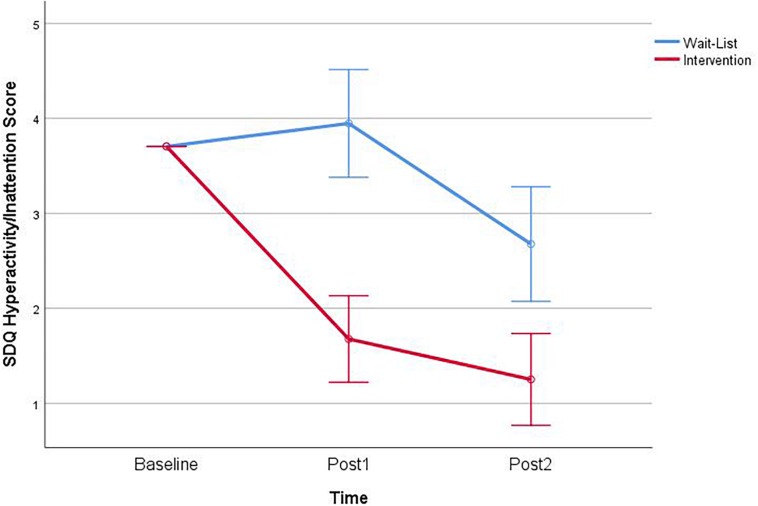
There is a growing evidence base for mindfulness-based interventions in educational settings. Notably, there has been little investigation of the potential benefits of classroom-based mindfulness programs in children in the early school years (Preparatory/Kindergarten, Grades 1 and 2) despite early childhood being a period characterized by the development of self-regulation and executive functions. The present study investigated the effects of a mindfulness program that was embedded within a school curriculum. This waitlist controlled trial investigated the effects of a mindfulness program, CalmSpace, delivered by classroom teachers across two school terms. A total of 55 students, = 76.4 months, = 8.62, were allocated to participate in CalmSpace in Terms 3 and 4. Thirty-six students in the waitlist control condition, = 80.53 months, = 13.04, participated in the intervention in Term 4. The start of Term 3 served as baseline (Time 1), and measures were obtained at the end of Term 3 (Time 2) and the end of Term 4 (Time 3). Direct measures of executive functioning using the Flanker Inhibitory Control and Attention Test (Flanker Task) and Dimensional Change Card Sort Task (DCCS) from the National Institute of Health Toolkit were obtained. Teachers' report of children's behavior was also obtained using the Strengths and Difficulties Questionnaire (Teacher version) at the beginning and at the end of Term 3, and at the end of Term 4. Children who received the CalmSpace program showed improvements on the DCCS relative to waitlist control at Time 2 (Cohen's = 0.48) and Time 3 (Cohen's = 1.10). Similar results were found on the Flanker Task with greater improvements found at Time 2 (Cohen's = 0.77) and Time 3 (Cohen's = 1.33). Teachers reported improvements for those receiving CalmSpace at Time 2 on total SDQ scores, Emotional Symptoms, Conduct Problems, Hyperactivity/Attention (Cohen's = 0.32, 0.14, 0.46, 0.30, 0.33, and 0.53, respectively) compared to waitlist control and at Time 3 (Cohen's = 0.85, 0.37, 0.48, and 0.90, respectively). The findings demonstrate that implementing the CalmSpace program can lead to improvements in EF and attention for young children. Despite limitations, this study provides promising evidence that the inclusion of focused, targeted mindfulness activities throughout the day may represent a value-added component to the regular school curriculum that can result in benefits for the students.
在教育环境中,基于正念的干预措施的证据基础正在不断扩大。值得注意的是,尽管幼儿期是自我调节和执行功能发展的时期,但对于早期学年(预备班/幼儿园、一年级和二年级)儿童的课堂正念项目的潜在益处却鲜有研究。本研究调查了嵌入学校课程中的正念项目的效果。这项等待名单对照试验调查了由课堂教师在两个学期实施的正念项目“平静空间”(CalmSpace)的效果。共有55名学生(平均年龄=76.4个月,标准差=8.62)被分配在第三学期和第四学期参加“平静空间”项目。36名处于等待名单对照条件的学生(平均年龄=80.53个月,标准差=13.04)在第四学期参加了该干预。第三学期开始时作为基线(时间1),并在第三学期末(时间2)和第四学期末(时间3)进行测量。使用美国国立卫生研究院工具包中的侧翼抑制控制和注意力测试(侧翼任务)和维度变化卡片分类任务(DCCS)对执行功能进行直接测量。还使用优势与困难问卷(教师版)在第三学期开始和结束时以及第四学期结束时获取教师对儿童行为的报告。接受“平静空间”项目的儿童在时间2(科恩d=0.48)和时间3(科恩d=1.10)时,相对于等待名单对照,在DCCS上表现出改善。在侧翼任务上也发现了类似的结果,在时间2(科恩d=0.77)和时间3(科恩d=1.33)时有更大的改善。教师报告称,与等待名单对照相比,接受“平静空间”项目的儿童在时间2时,在SDQ总分、情绪症状、行为问题、多动/注意力方面有所改善(科恩d分别为0.32、0.14、0.46、0.30、0.33和0.53),在时间3时(科恩d分别为0.85、0.37、0.48和0.90)。研究结果表明,实施“平静空间”项目可以改善幼儿的执行功能和注意力。尽管存在局限性,但本研究提供了有前景的证据,即全天纳入有针对性的正念活动可能是常规学校课程中一个有价值的补充成分,能给学生带来益处。