Porter Bárbara, Oyanadel Cristian, Sáez-Delgado Fabiola, Andaur Ana, Peñate Wenceslao
Departamento de Psicología, Facultad de Ciencias Sociales, Universidad de Concepción, 4030000 Concepción, Chile.
Centro de Investigación en Educación y Desarrollo y Facultad de Educación, Departamento Fundamentos de la Pedagogía, Universidad Católica de la Santísima Concepción, 4030000 Concepción, Chile.
Eur J Investig Health Psychol Educ. 2022 Aug 22;12(8):1220-1243. doi: 10.3390/ejihpe12080085.
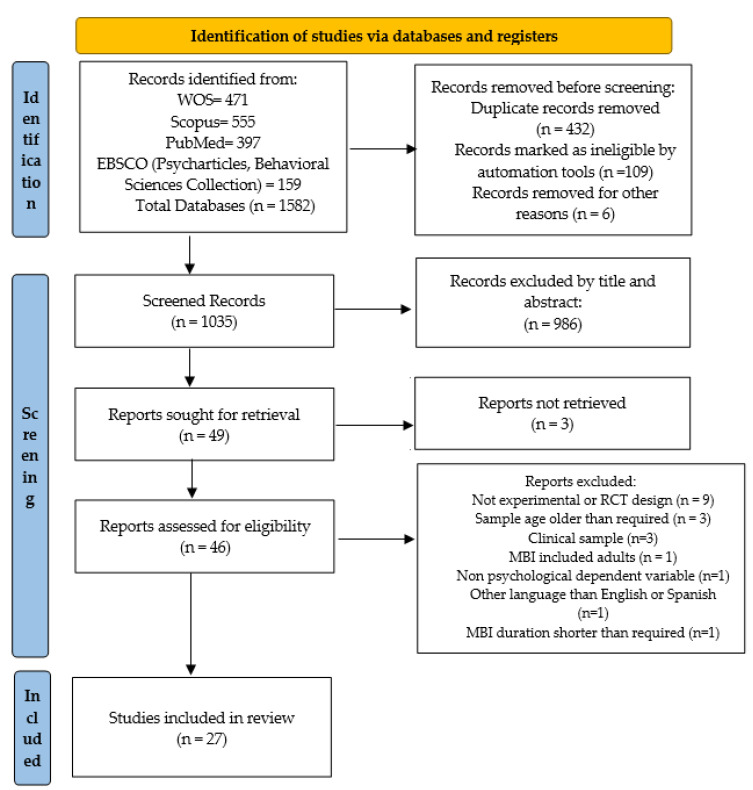
Human development implies deep changes in cognitive, attentional, emotional, and behavioral skills. Therefore, Mindfulness-Based Interventions (MBIs) should be adapted in terms of dose, frequency, kind of exercises, assessment methods, and expected effects regarding the abilities and limitations of each developmental period. The present review seeks to describe and compare MBIs characteristics, assessment methods, and effects in youth between 3 and 18 years old considering four developmental periods. A systematic review was carried out including experimental primary studies published during the last five years. Results show that the frequency of the sessions and program duration varies widely. Differences were observed in instructors' training and in assessment strategies. Discrepancies were observed regarding the effects of MBIs both within and between periods in cognitive, socio-emotional, symptoms, and mindfulness variables. Consistency was observed in prosocial behaviors for preschoolers, and in emotional and behavioral problems and hyperactivity in ages between preschool and early adolescence. Nevertheless, it was impossible to compare most results and determine consistency or discrepancy due to the lack of studies. Regarding mindfulness, it is defined and assessed in different ways in each period. Orientations are suggested to move from a compartmentalized view of isolated MBIs, towards an integrative perspective that allows tracing developmental trajectories for mindfulness and other key cognitive and socioemotional skills for children and adolescents.
人类发展意味着认知、注意力、情感和行为技能的深刻变化。因此,基于正念的干预措施(MBIs)应根据每个发育阶段的能力和局限性,在剂量、频率、练习类型、评估方法和预期效果方面进行调整。本综述旨在描述和比较考虑四个发育阶段的3至18岁青少年的MBIs特征、评估方法和效果。进行了一项系统综述,纳入了过去五年发表的实验性初步研究。结果表明,课程频率和项目持续时间差异很大。在教师培训和评估策略方面观察到差异。在认知、社会情感、症状和正念变量方面,MBIs在各阶段内和各阶段之间的效果存在差异。在学龄前儿童的亲社会行为以及学龄前至青春期早期的情绪和行为问题及多动方面观察到了一致性。然而,由于缺乏研究,无法比较大多数结果并确定一致性或差异。关于正念,在每个阶段都有不同的定义和评估方式。建议从孤立的MBIs的分隔观点转向综合观点,以便能够追踪儿童和青少年正念以及其他关键认知和社会情感技能的发展轨迹。