Caplain Sophie, Chenuc Gaelle, Blancho Sophie, Marque Sébastien, Aghakhani Nozar
Psychopathology and Neuropsychology Laboratory, University Paris 8, Saint-Denis, France.
Capionis Research, Bordeaux, France.
Front Neurol. 2019 Sep 4;10:929. doi: 10.3389/fneur.2019.00929. eCollection 2019.
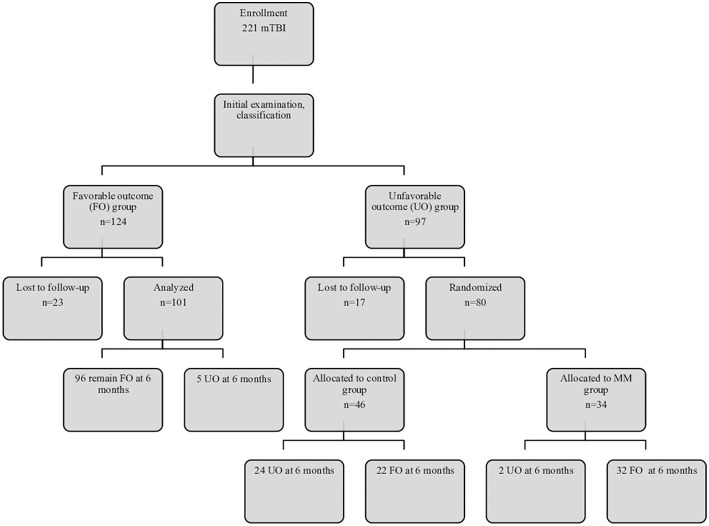
Unfavorable outcomes (UO) occur in 15-20% of patients with mild traumatic brain injury (mTBI). Early identification of patients at risk of UO is crucial for suitable management to be initiated, increasing the chances of full recovery. We previously developed a prognostic tool for early identification (8-21 days after the injury) of patients likely to develop UO. Patients whose initial risk factors indicate UO are at risk of developing post-concussion syndrome (PCS). In the present study, we examined the beneficial effects of early multidimensional management (MM) on prognosis. We used our prognostic tool to classify 221 mTBI patients into a UO (97) group or a favorable outcome (FO) group (124). We randomized the UO patients into two subgroups: a group that underwent MM (involving psychoeducation and cognitive rehabilitation) (34) and a control group with no specific treatment other than psychoeducation (46). At 6 months, these two groups were compared to assess the impact of MM. Among the followed-up patients initially classified as having FO (101), 95% had FO at 6 months and only five had PCS [as defined by the Diagnostic and Statistical Manual of Mental Disorders (DSM)-IV classification]. Among the followed-up MM patients, 94% did not have PCS 6 months after injury, whereas 52% of the control patients had PCS. The effect of MM on the recovery of patients at 6 months, once adjusted for the main confounding factors, was significant ( < 0.001). These results show that the initiation of MM after early identification of at-risk mTBI patients can considerably improve their outcomes. The study was registered at ClinicalTrials.gov (NCT03811626).
15%至20%的轻度创伤性脑损伤(mTBI)患者会出现不良后果(UO)。早期识别有UO风险的患者对于启动适当的治疗至关重要,这会增加完全康复的机会。我们之前开发了一种用于早期识别(受伤后8至21天)可能发生UO的患者的预后工具。初始风险因素表明有UO的患者有发生脑震荡后综合征(PCS)的风险。在本研究中,我们研究了早期多维管理(MM)对预后的有益影响。我们使用我们的预后工具将221例mTBI患者分为UO组(97例)或良好结局(FO)组(124例)。我们将UO患者随机分为两个亚组:接受MM(包括心理教育和认知康复)的组(34例)和除心理教育外无特定治疗的对照组(46例)。在6个月时,比较这两组以评估MM的影响。在最初分类为具有FO的随访患者中(101例),95%在6个月时具有FO,只有5例患有PCS[根据《精神疾病诊断与统计手册》(DSM)-IV分类定义]。在随访的MM患者中,94%在受伤后6个月没有PCS,而对照组患者中有52%患有PCS。一旦对主要混杂因素进行调整,MM对患者6个月时恢复的影响是显著的(<0.001)。这些结果表明,在早期识别有风险的mTBI患者后启动MM可以显著改善他们的结局。该研究已在ClinicalTrials.gov注册(NCT03811626)。