Hoarau Marie, Koebke Karl J, Chen Zhan, Marsh E Neil G
Department of Chemistry, University of Michigan, Ann Arbor, MI, United States.
Department of Biological Chemistry, University of Michigan, Ann Arbor, MI, United States.
Front Mol Biosci. 2019 Aug 27;6:73. doi: 10.3389/fmolb.2019.00073. eCollection 2019.
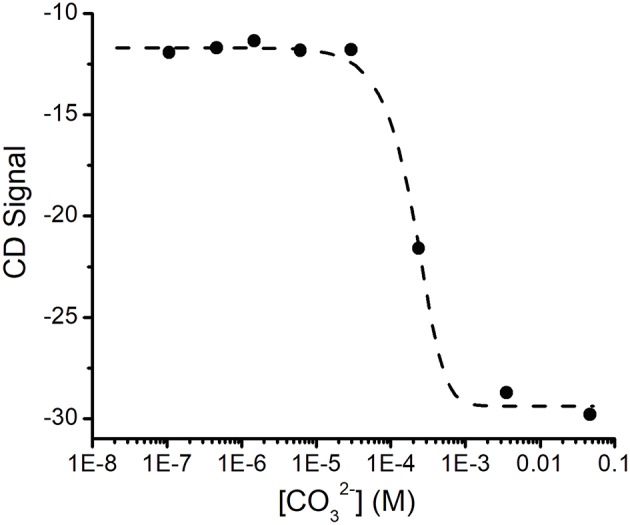
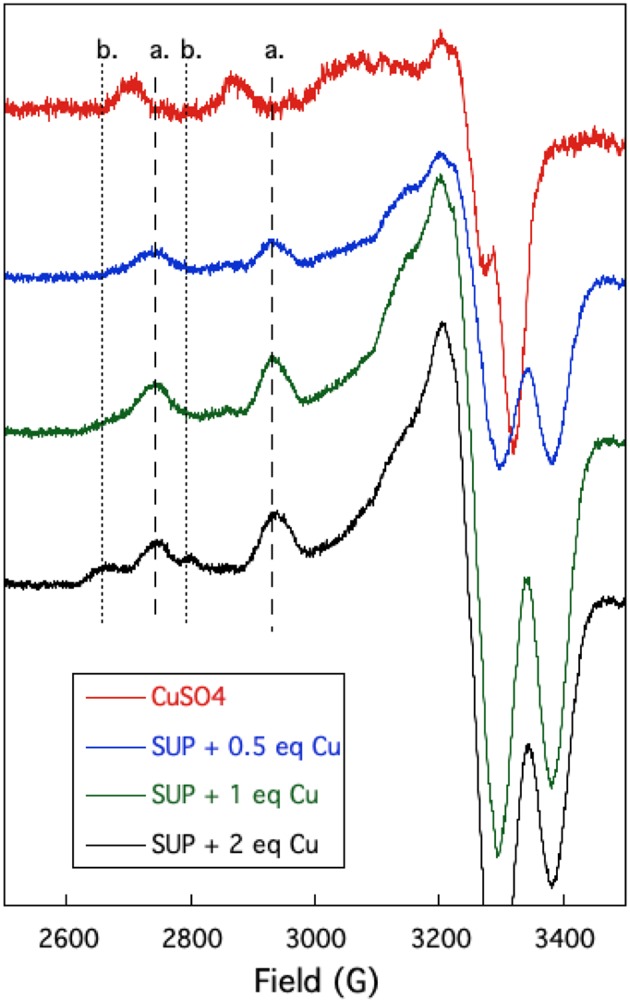
The design of metal-binding sites in proteins that combine high affinity with high selectivity for the desired metal ion remains a challenging goal. Recently, a protein designed to display femtomolar affinity for , dubbed "Super Uranyl-binding Protein" (SUP), was described, with potential applications for removing in water. Although it discriminated most metal ions present in seawater, the protein showed a surprisingly high affinity for Cu ions. Here, we have investigated Cu binding to SUP using a combination of electron paramagnetic resonance, fluorescence and circular dichroism spectroscopies. Our results provide evidence for two Cu binding sites on SUP that are distinct from the binding site, but one of which interferes with binding. They further suggest that in solution the protein's secondary structure changes significantly in response to binding ; in contrast, the crystal structures of the apo- and holo-protein are almost superimposable. These results provide insights for further improving the selectivity of SUP for , paving the way toward protein-based biomaterials for decontamination and/or recovery of uranium.
设计出对所需金属离子具有高亲和力和高选择性的蛋白质中的金属结合位点仍然是一个具有挑战性的目标。最近,有一种对铀酰离子显示出飞摩尔亲和力的蛋白质,被称为“超级铀酰结合蛋白”(SUP),它具有去除水中铀酰离子的潜在应用价值。尽管它能区分海水中存在的大多数金属离子,但该蛋白质对铜离子表现出惊人的高亲和力。在这里,我们结合电子顺磁共振、荧光和圆二色光谱法研究了铜与SUP的结合。我们的结果证明SUP上有两个与铀酰离子结合位点不同的铜结合位点,但其中一个会干扰铀酰离子的结合。结果还表明,在溶液中,该蛋白质的二级结构会因结合铀酰离子而发生显著变化;相比之下,脱辅基蛋白和全蛋白的晶体结构几乎可以重叠。这些结果为进一步提高SUP对铀酰离子的选择性提供了见解,为基于蛋白质的铀去污和/或回收生物材料铺平了道路。