Chaturvedi Santosh K, Manche Gowda Shayanth, Ahmed Helal Uddin, Alosaimi Fahad D, Andreone Nicola, Bobrov Alexey, Bulgari Viola, Carrà Giuseppe, Castelnuovo Gianluca, de Girolamo Giovanni, Gondek Tomasz, Jovanovic Nikola, Kamala Thummala, Kiejna Andrzej, Lalic Nebojsa, Lecic-Tosevski Dusica, Minhas Fareed, Mutiso Victoria, Ndetei David, Rabbani Golam, Somruk Suntibenchakul, Srikanta Sathyanarayana, Taj Rizwan, Valentini Umberto, Vukovic Olivera, Wölwer Wolfgang, Cimino Larry, Nouwen Arie, Lloyd Cathy, Sartorius Norman
Department of Psychiatry, National Institute of Mental Health and Neuro-Sciences, Bangalore, India.
Child Adolescent and Family Psychiatry, National Institute of Mental Health, Dhaka, Bangladesh.
Gen Psychiatr. 2019 Aug 9;32(4):e100076. doi: 10.1136/gpsych-2019-100076. eCollection 2019.
Anxiety disorder, one of the highly disabling, prevalent and common mental disorders, is known to be more prevalent in persons with type 2 diabetes mellitus (T2DM) than the general population, and the comorbid presence of anxiety disorders is known to have an impact on the diabetes outcome and the quality of life. However, the information on the type of anxiety disorder and its prevalence in persons with T2DM is limited.
To assess the prevalence and correlates of anxiety disorder in people with type 2 diabetes in different countries.
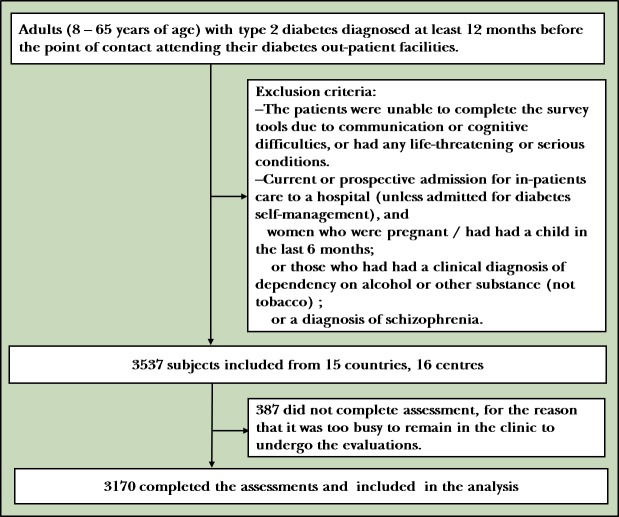
People aged 18-65 years with diabetes and treated in outpatient settings were recruited in 15 countries and underwent a psychiatric interview with the Mini-International Neuropsychiatric Interview. Demographic and medical record data were collected.
A total of 3170 people with type 2 diabetes (56.2% women; with mean (SD) duration of diabetes 10.01 (7.0) years) participated. The overall prevalence of anxiety disorders in type 2 diabetic persons was 18%; however, 2.8% of the study population had more than one type of anxiety disorder. The most prevalent anxiety disorders were generalised anxiety disorder (8.1%) and panic disorder (5.1%). Female gender, presence of diabetic complications, longer duration of diabetes and poorer glycaemic control (HbA1c levels) were significantly associated with comorbid anxiety disorder. A higher prevalence of anxiety disorders was observed in Ukraine, Saudi Arabia and Argentina with a lower prevalence in Bangladesh and India.
Our international study shows that people with type 2 diabetes have a high prevalence of anxiety disorders, especially women, those with diabetic complications, those with a longer duration of diabetes and poorer glycaemic control. Early identification and appropriate timely care of psychiatric problems of people with type 2 diabetes is warranted.
焦虑症是一种极具致残性、普遍且常见的精神障碍,已知2型糖尿病(T2DM)患者中焦虑症的患病率高于普通人群,且焦虑症的合并存在会对糖尿病结局和生活质量产生影响。然而,关于T2DM患者焦虑症类型及其患病率的信息有限。
评估不同国家2型糖尿病患者焦虑症的患病率及其相关因素。
在15个国家招募年龄在18 - 65岁、在门诊接受治疗的糖尿病患者,并采用迷你国际神经精神访谈进行精神科访谈。收集人口统计学和医疗记录数据。
共有3170名2型糖尿病患者(女性占56.2%;糖尿病平均(标准差)病程为10.01(7.0)年)参与研究。2型糖尿病患者中焦虑症的总体患病率为18%;然而,2.8%的研究人群患有不止一种类型的焦虑症。最常见的焦虑症类型为广泛性焦虑症(8.1%)和惊恐障碍(5.1%)。女性、存在糖尿病并发症、糖尿病病程较长以及血糖控制较差(糖化血红蛋白水平)与合并焦虑症显著相关。乌克兰、沙特阿拉伯和阿根廷的焦虑症患病率较高,而孟加拉国和印度的患病率较低。
我们的国际研究表明,2型糖尿病患者焦虑症的患病率较高,尤其是女性、患有糖尿病并发症的患者、糖尿病病程较长以及血糖控制较差的患者。有必要对2型糖尿病患者的精神问题进行早期识别和及时适当的护理。