Internal Medicine, Soma Central Hospital, Soma, Fukushima, Japan.
Department of Economics, Rikkyo University, Toshima-ku, Tokyo, Japan.
PLoS One. 2019 Sep 25;14(9):e0218835. doi: 10.1371/journal.pone.0218835. eCollection 2019.
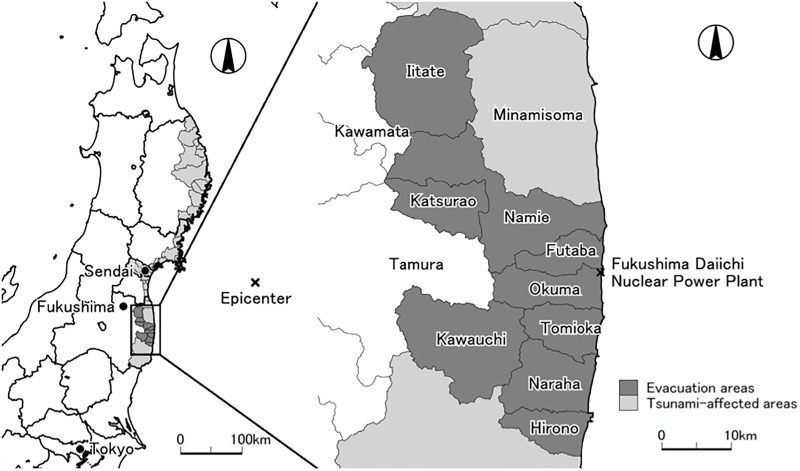
Though mass evacuation may increase the need for long-term care (LTC) services, how the need for LTC services increases and how the public LTC system affects it is not well understood. We evaluated changes in public LTC benefits for the people living in the mandatory evacuation areas established after the 2011 Fukushima nuclear disaster and examined the roles of the universal LTC insurance system in Japan.
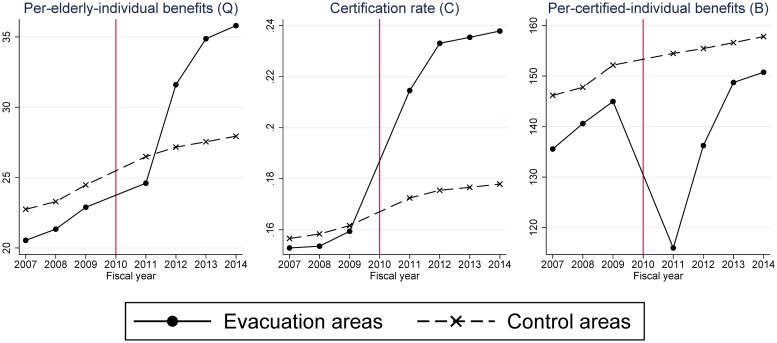
In order to evaluate the effect of the mandatory evacuation on LTC benefits, we examined the trends of LTC benefits in the Fukushima evacuation group and the nationwide non-evacuation group. We first decomposed per-elderly-individual benefits at the municipality level into the LTC certification rate and per-certified-individual benefits, and then implemented difference-in-differences analysis using these variables as outcomes.
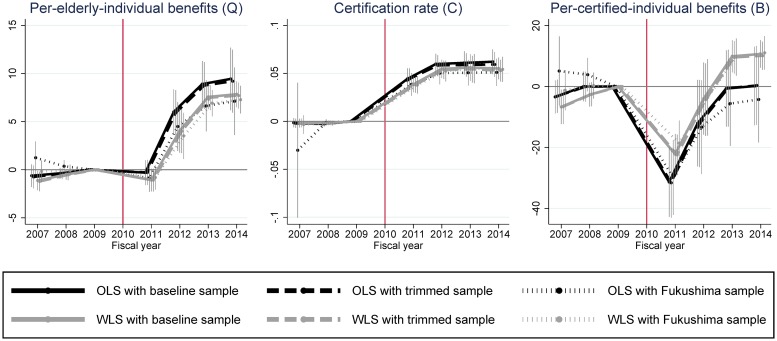
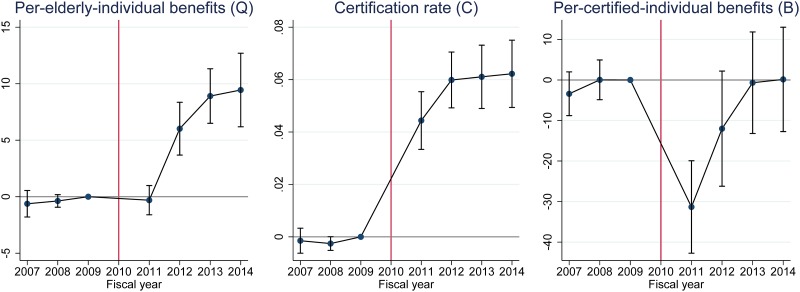
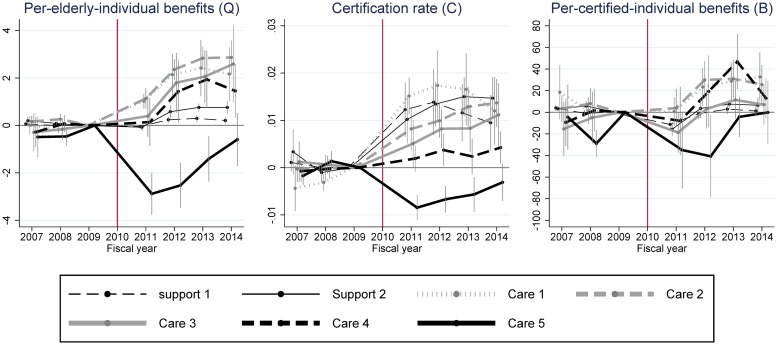
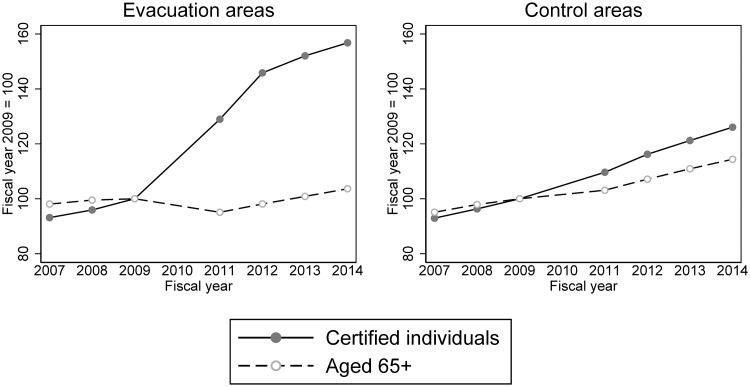
Per-elderly-individual benefits significantly increased from 2012 onward in the evacuation group, and this was explained by an increase in the certification rate rather than in per-certified-individual benefits. Increases in per-elderly-individual benefits and the certification rate in the post-disaster period were observed in all but the highest care level, and the corresponding outcomes for the highest care level decreased immediately after the disaster. We also found that the increase in the certification rate had been mostly realized by an increase in the number of certified individuals.
The increase in LTC benefits can be associated with the impact of the increase in the number of people newly certified to receive LTC benefits after the mandatory evacuation. In order to cope with the increase in utilization of long-term care and associated costs after disasters in aging societies, both formal long-term care services and social support for informal care for evacuees should be considered important.
尽管大规模疏散可能会增加长期护理(LTC)服务的需求,但人们对 LTC 服务需求的增长方式以及公共 LTC 系统如何对此产生影响了解甚少。我们评估了 2011 年福岛核灾难后建立的强制疏散区居民的公共 LTC 福利变化情况,并研究了日本全民 LTC 保险制度的作用。
为了评估强制疏散对 LTC 福利的影响,我们考察了福岛疏散组和全国非疏散组老年人个人福利的变化趋势。我们首先将市町村一级的老年人个人福利分解为 LTC 认证率和每个认证者的福利,然后使用这些变量作为结果进行差分分析。
从 2012 年开始,疏散组的老年人个人福利显著增加,这是由认证率的增加而不是每个认证者的福利增加所解释的。在灾难后时期,所有但最高护理水平的福利都有所增加,而最高护理水平的对应福利则在灾难后立即下降。我们还发现,认证率的增加主要是通过增加认证人数来实现的。
LTC 福利的增加可能与强制疏散后新认证接受 LTC 福利人数的增加有关。为了应对老龄化社会灾难后长期护理利用和相关成本的增加,正式的长期护理服务和对疏散者的非正式护理的社会支持都应被视为重要的。