Department of General Internal Medicine, Hiroshima University Hospital, Hiroshima, Japan.
Department of Community-Based Medical System, Graduate School of Biomedical and Health Sciences, Hiroshima University, Hiroshima, Japan.
BMC Geriatr. 2022 Mar 1;22(1):168. doi: 10.1186/s12877-022-02864-4.
Most older people with disabilities or illnesses continue to use long-term care (LTC) services for the rest of their lives. However, disasters can cause a discontinuation of LTC services, which usually means tragic outcomes of affected persons. In view of the recent progression of population aging and the increase in natural disasters, this study focuses on the impact of disasters on older people's discontinuation of LTC services, and those more risk of such discontinuation than others. However, current evidence is scarce.
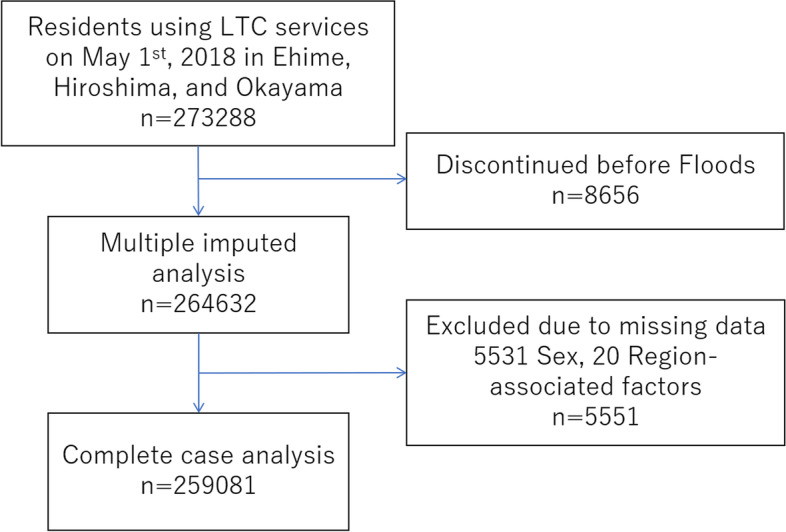
We conducted a retrospective cohort study with 259,081 subjects, 2,762 of whom had been affected by disaster and 256,319 who had not been affected during the 2018 Japan Floods. The sample in the three most disaster-affected prefectures was drawn from the Long-term Care Insurance Comprehensive Database and included older people certified with care-need level. The observation period was two months before the disaster and five months after it. We calculated the hazard ratio (HR) of municipality-certified subjects affected by the disaster versus those who were not. Subgroup analyses were conducted for categories of individual-, facility- and region-associated factors.
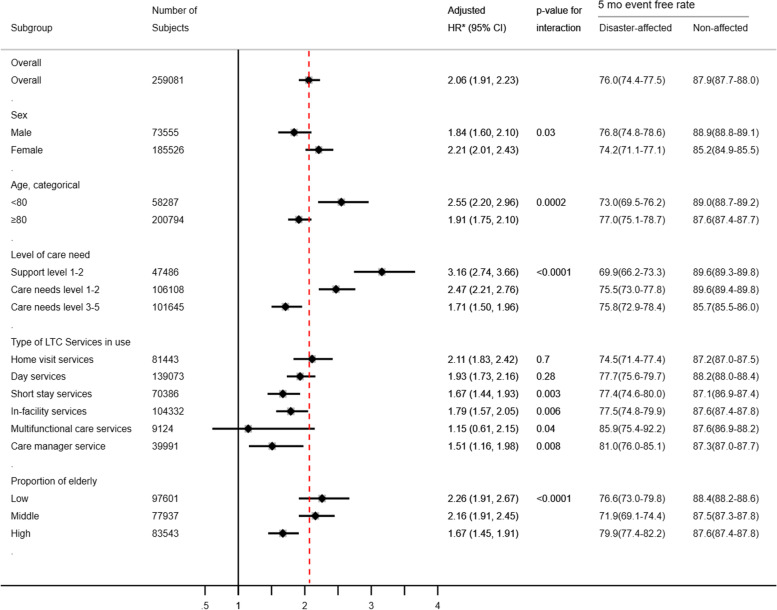
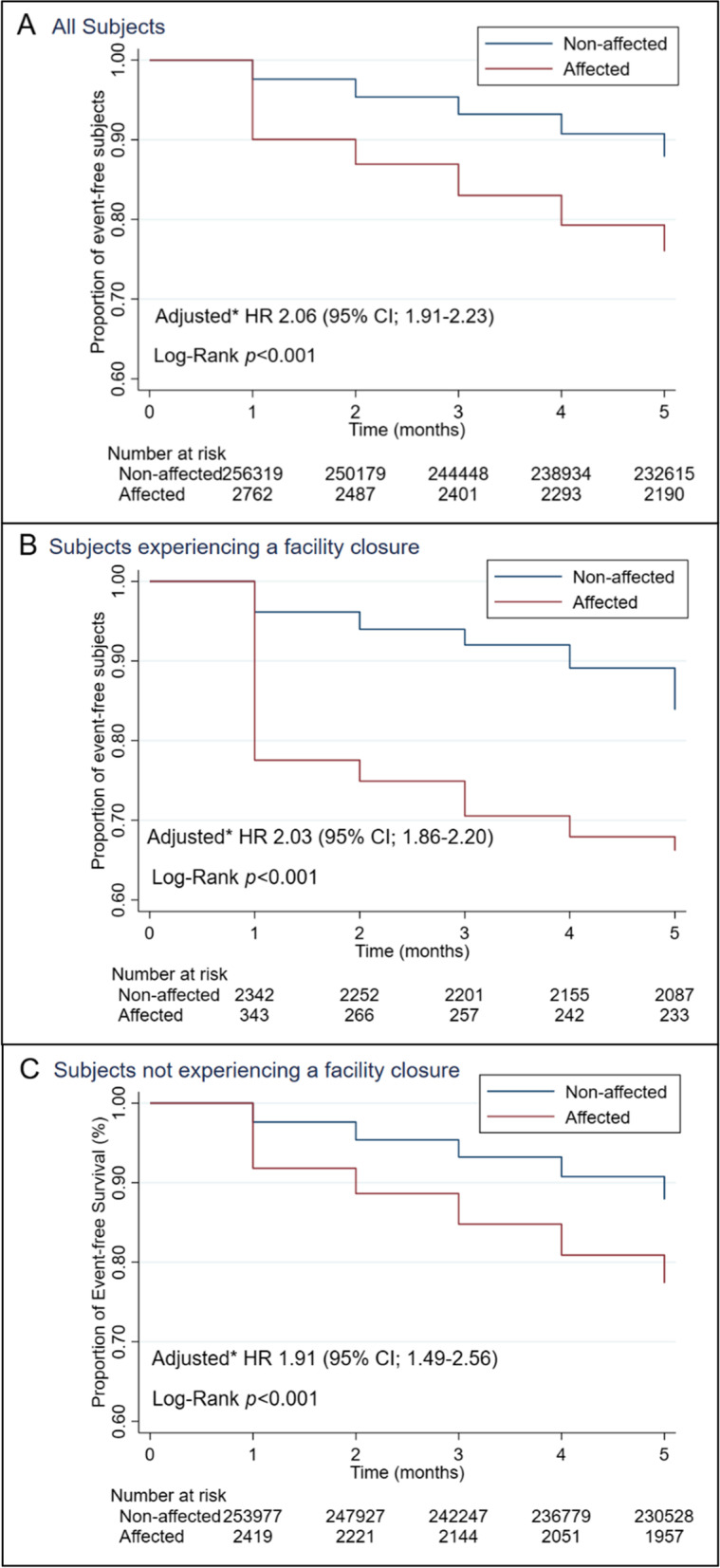
Affected persons were twice as likely to discontinue LTC services than those who were not affected (adjusted HR, 2.06 95% CI, 1.91-2.23). 34% of affected persons whose facilities were closed discontinued their LTC services at five months after the disaster. A subgroup analysis showed that the risk of discontinuing LTC services for affected persons compared to those who were not affected in the relatively younger subgroup (age < 80: adjusted HR, 2.55; 95% CI, 2.20-2.96 vs. age ≥ 80 : 1.91; 1.75-2.10), and the subgroup requiring a lower level of care (low: 3.16; 2.74-3.66 vs. high: 1.71; 1.50-1.96) were more likely to discontinue than the older and higher care level subgroups.
A natural disaster has a significant effect on the older people's discontinuation of LTC services. The discontinuations are supposedly caused by affected persons' death, hospitalization, forced relocation of individuals, or the service provider's incapacity. Accordingly, it is important to recognize the risk of disasters and take measures to avoid discontinuation to protect older persons' quality of life.
大多数有残疾或疾病的老年人在其余生中仍继续使用长期护理(LTC)服务。但是,灾难可能会导致 LTC 服务中断,这通常意味着受影响者的悲惨结局。鉴于人口老龄化的最近进展和自然灾害的增加,本研究侧重于灾难对老年人停止使用 LTC 服务的影响,以及与其他人相比,哪些人更容易停止使用。然而,目前的证据还很缺乏。
我们进行了一项回顾性队列研究,共有 259081 名受试者,其中 2762 名受试者受到了灾害的影响,256319 名受试者没有受到影响。受灾最严重的三个县的样本取自长期护理保险综合数据库,并包括经认证需要护理的老年人。观察期为灾害前两个月和灾害后五个月。我们计算了受灾市认证的老年人与未受灾的老年人之间的危害比(HR)。进行了个体、设施和区域相关因素类别的亚组分析。
受灾者停止使用 LTC 服务的可能性是未受灾者的两倍(调整后的 HR,2.06;95%CI,1.91-2.23)。5 个月后,34%的设施关闭的受灾者停止了他们的 LTC 服务。亚组分析显示,与未受灾者相比,年龄较小(<80 岁:调整后的 HR,2.55;95%CI,2.20-2.96 与年龄较大(≥80 岁:1.91;1.75-2.10),以及护理水平较低(低:3.16;2.74-3.66 与高:1.71;1.50-1.96)的受灾者更有可能停止使用 LTC 服务。
自然灾害对老年人停止使用 LTC 服务有重大影响。停止服务可能是由于受灾者死亡、住院、个人被迫搬迁或服务提供商丧失能力所致。因此,重要的是要认识到灾害的风险,并采取措施避免停止服务,以保护老年人的生活质量。