Hass Ralf, von der Ohe Juliane, Ungefroren Hendrik
Biochemistry and Tumor Biology Lab, Department of Obstetrics and Gynecology, Hannover Medical School, 30625 Hannover, Germany.
First Department of Medicine, University Hospital Schleswig-Holstein, Campus Lübeck, 23538 Lübeck, Germany.
Cancers (Basel). 2019 Sep 25;11(10):1432. doi: 10.3390/cancers11101432.
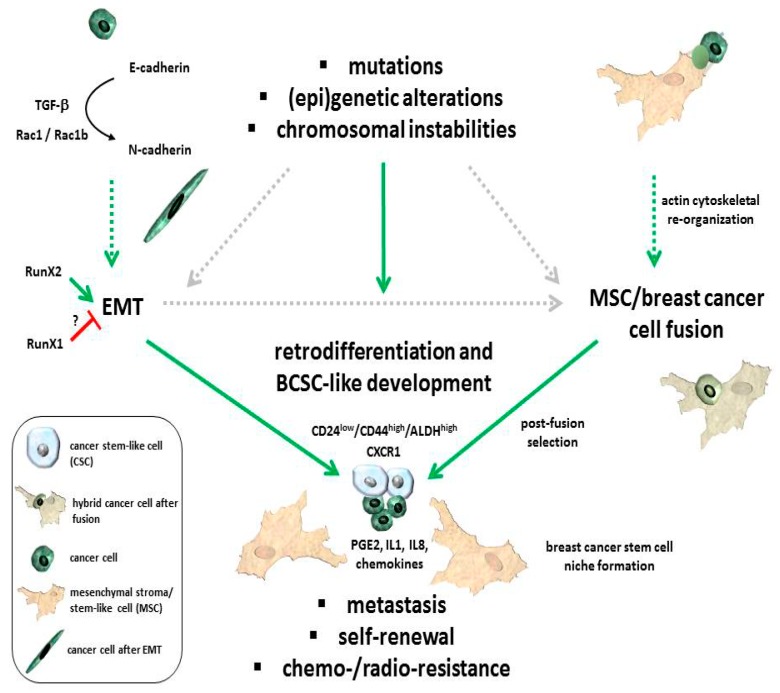
Solid tumors comprise of maturated cancer cells and self-renewing cancer stem-like cells (CSCs), which are associated with various other nontumorigenic cell populations in the tumor microenvironment. In addition to immune cells, endothelial cells, fibroblasts, and further cell types, mesenchymal stroma/stem-like cells (MSC) represent an important cell population recruited to tumor sites and predominantly interacting with the different cancer cells. Breast cancer models were among the first to reveal distinct properties of CSCs, however, the cellular process(es) through which these cells are generated, maintained, and expanded within neoplastic tissues remains incompletely understood. Here, we discuss several possible scenarios that are not mutually exclusive but may even act synergistically: fusion of cancer cells with MSC to yield hybrid cells and/or the induction of epithelial-mesenchymal transition (EMT) in breast cancer cells by MSC, which can relay signals for retrodifferentiation and eventually, the generation of breast CSCs (BCSCs). In either case, the consequences may be promotion of self-renewal capacity, tumor cell plasticity and heterogeneity, an increase in the cancer cells' invasive and metastatic potential, and the acquisition of resistance mechanisms towards chemo- or radiotherapy. While specific signaling mechanisms involved in each of these properties remain to be elucidated, the present review article focusses on a potential involvement of cancer cell fusion and EMT in the development of breast cancer stem cells.
实体瘤由成熟癌细胞和具有自我更新能力的癌症干细胞样细胞(CSCs)组成,这些细胞与肿瘤微环境中的各种其他非致瘤细胞群体相关。除了免疫细胞、内皮细胞、成纤维细胞和其他细胞类型外,间充质基质/干细胞样细胞(MSC)是被招募到肿瘤部位并主要与不同癌细胞相互作用的重要细胞群体。乳腺癌模型是最早揭示CSCs独特特性的模型之一,然而,这些细胞在肿瘤组织中产生、维持和扩增的细胞过程仍未完全了解。在这里,我们讨论几种并非相互排斥甚至可能协同作用的可能情况:癌细胞与MSC融合产生杂交细胞和/或MSC诱导乳腺癌细胞发生上皮-间质转化(EMT),这可以传递逆向分化信号并最终产生乳腺癌症干细胞(BCSCs)。在任何一种情况下,结果可能是促进自我更新能力、肿瘤细胞可塑性和异质性,增加癌细胞的侵袭和转移潜力,以及获得对化疗或放疗的耐药机制。虽然参与这些特性的具体信号机制仍有待阐明,但本综述文章重点关注癌细胞融合和EMT在乳腺癌干细胞发展中的潜在作用。