City University of Hong Kong ShenZhen Research Institute, ShenZhen, China.
Department of Biomedical Sciences, City University of Hong Kong, Hong Kong, China.
Semin Cell Dev Biol. 2020 May;101:12-19. doi: 10.1016/j.semcdb.2019.08.001. Epub 2019 Sep 25.
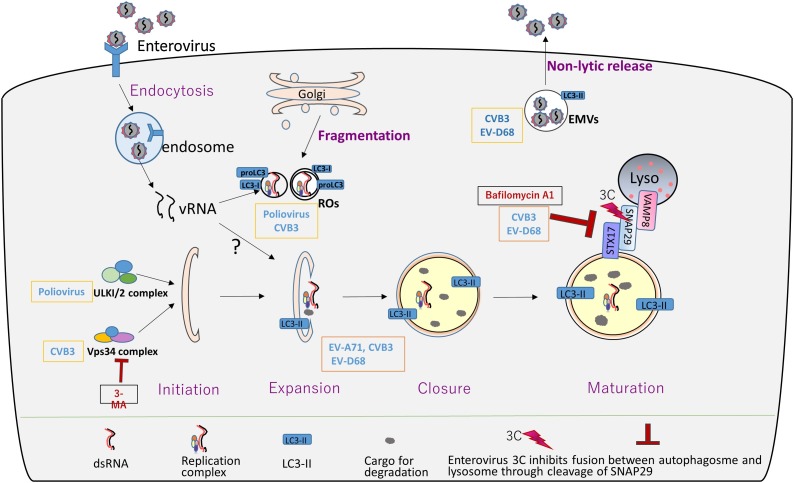
Autophagy, an evolutional conserved lysosomal degradation process, has been implicated to play an important role in cellular defense against a variety of microbial infection. Interestingly, numerous studies found that some pathogens, especially positive-single-strand RNA viruses, actually hijacked autophagy machinery to promote virus infection within host cells, facilitating different stages of viral life cycle, from replication, assembly to egress. Enterovirus, a genus of positive-strand RNA virus, can cause various human diseases and is one of main public health threat globally, yet no effective clinical intervention is available for enterovirus infection. Here we summarized recent literature on how enteroviruses regulate and utilize autophagy process to facilitate their propagation in the host cells. The studies on the interplay between enterovirus and autophagy not only shed light on the molecular mechanisms underlying how enterovirus hijacks cellular components and pathway for its own benefits, but also provide therapeutic option against enterovirus infection.
自噬是一种进化上保守的溶酶体降解过程,它在细胞抵抗各种微生物感染方面发挥着重要作用。有趣的是,许多研究发现,一些病原体,特别是正单链 RNA 病毒,实际上劫持了自噬机制,以促进病毒在宿主细胞内的感染,从而促进病毒生命周期的不同阶段,从复制、组装到出芽。肠道病毒是正链 RNA 病毒的一个属,可引起多种人类疾病,是全球主要的公共卫生威胁之一,但目前尚无有效的临床干预措施用于肠道病毒感染。在这里,我们总结了最近关于肠道病毒如何调节和利用自噬过程来促进其在宿主细胞中繁殖的文献。关于肠道病毒和自噬之间相互作用的研究不仅揭示了肠道病毒劫持细胞成分和途径为自身利益服务的分子机制,还为对抗肠道病毒感染提供了治疗选择。