Department of Nephrology, Huaihe Hospital of Henan University, Kaifeng, China.
Department of Urology, Huaihe Hospital of Henan University, Kaifeng, China.
J Cell Mol Med. 2021 Dec;25(23):10798-10813. doi: 10.1111/jcmm.14558. Epub 2019 Sep 30.
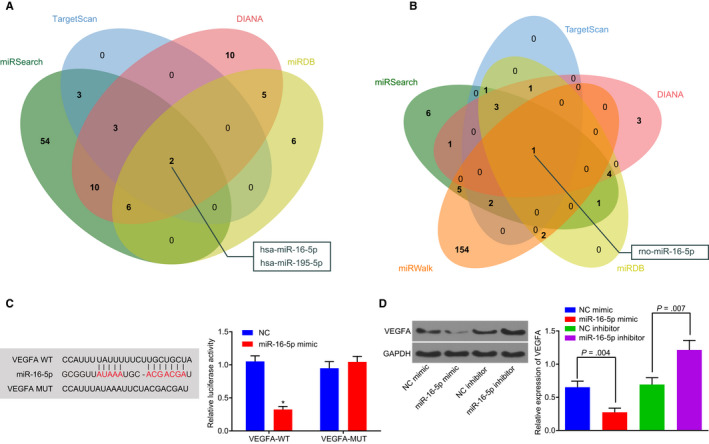
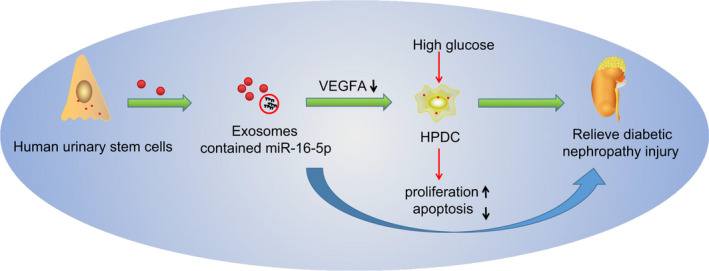
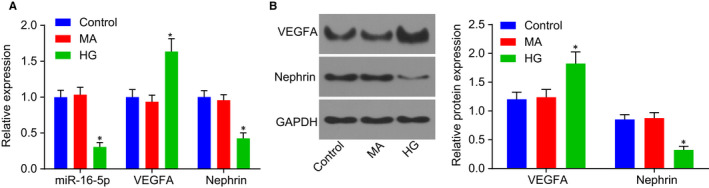
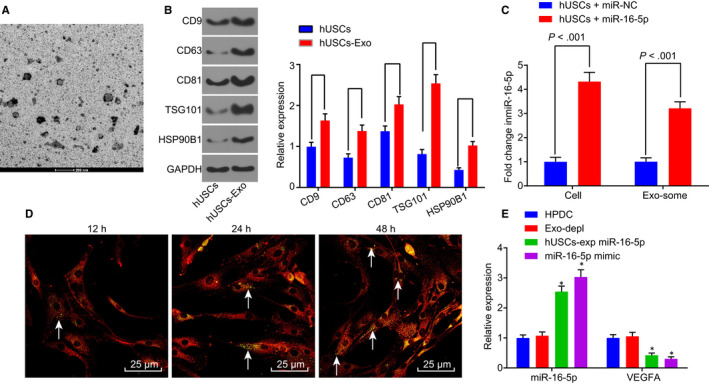
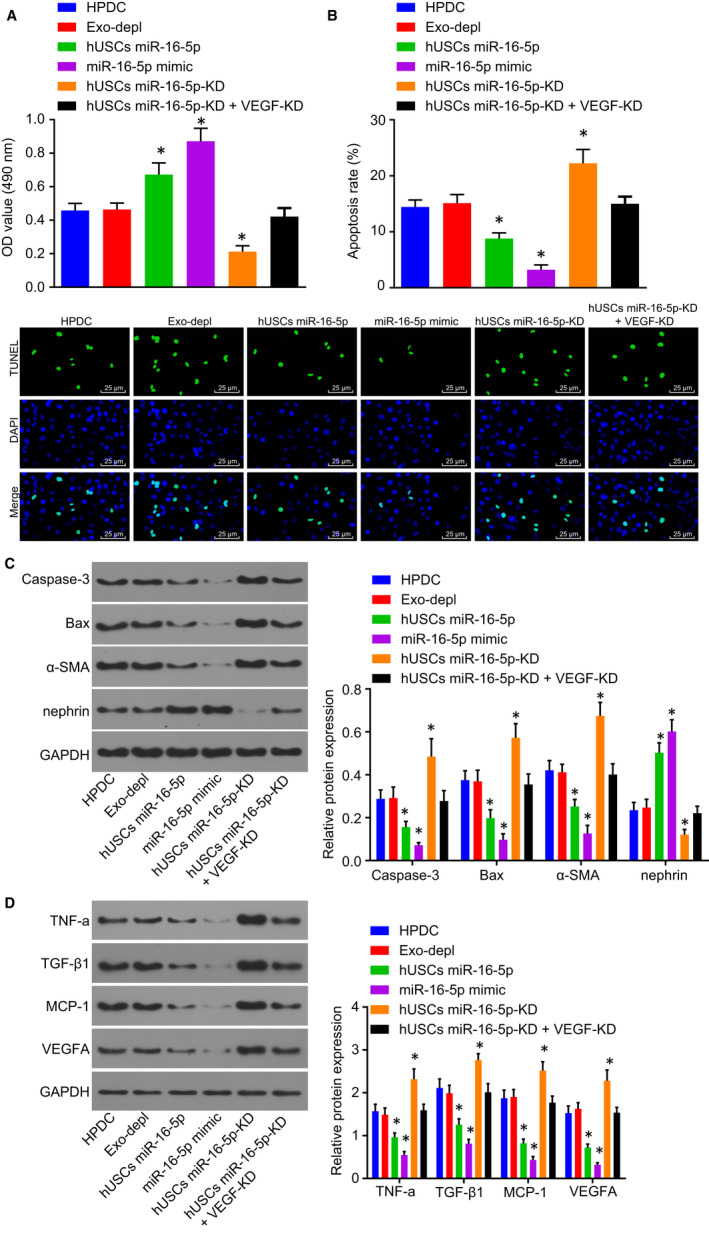
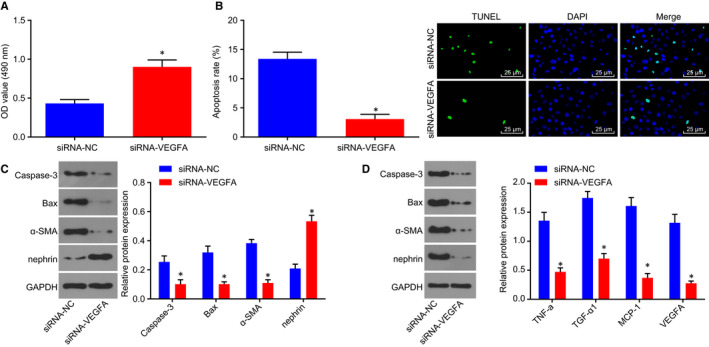
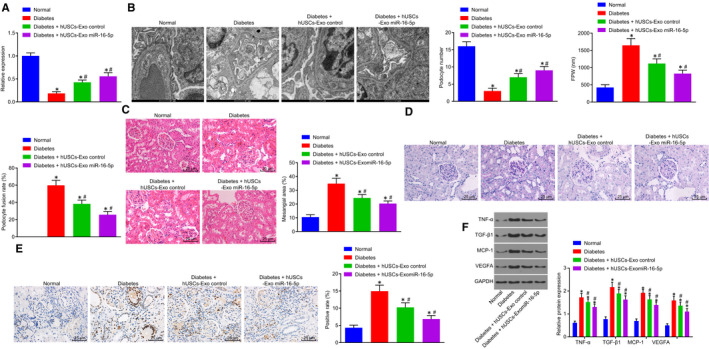
Diabetic nephropathy (DN) remains one of the severe complications associated with diabetes mellitus. It is worthwhile to uncover the underlying mechanisms of clinical benefits of human urine-derived stem cells (hUSCs) in the treatment of DN. At present, the clinical benefits associated with hUSCs in the treatment of DN remains unclear. Hence, our study aims to investigate protective effect of hUSC exosome along with microRNA-16-5p (miR-16-5p) on podocytes in DN via vascular endothelial growth factor A (VEGFA). Initially, miR-16-5p was predicated to target VEGFA based on data retrieved from several bioinformatics databases. Notably, dual-luciferase report gene assay provided further verification confirming the prediction. Moreover, our results demonstrated that high glucose (HG) stimulation could inhibit miR-16-5p and promote VEGFA in human podocytes (HPDCs). miR-16-5p in hUSCs was transferred through the exosome pathway to HG-treated HPDCs. The viability and apoptosis rate of podocytes after HG treatment together with expression of the related factors were subsequently determined. The results indicated that miR-16-5p secreted by hUSCs could improve podocyte injury induced by HG. In addition, VEGA silencing could also ameliorate HG-induced podocyte injury. Finally, hUSC exosomes containing overexpressed miR-16-5p were injected into diabetic rats via tail vein, followed by qualification of miR-16-5p and observation on the changes of podocytes, which revealed that overexpressed miR-16-5p in hUSCs conferred protective effects on HPDCs in diabetic rats. Taken together, the present study revealed that overexpressed miR-16-5p in hUSC exosomes could protect HPDCs induced by HG and suppress VEGFA expression and podocytic apoptosis, providing fresh insights for novel treatment of DN.
糖尿病肾病(DN)仍然是与糖尿病相关的严重并发症之一。揭示人尿源性干细胞(hUSC)治疗 DN 的临床获益的潜在机制是值得的。目前,hUSC 治疗 DN 的临床获益尚不清楚。因此,我们的研究旨在通过血管内皮生长因子 A(VEGFA)研究 hUSC 外泌体及其携带的 microRNA-16-5p(miR-16-5p)对 DN 足细胞的保护作用。最初,基于从几个生物信息学数据库中检索到的数据,预测 miR-16-5p 靶向 VEGFA。值得注意的是,双荧光素酶报告基因检测进一步验证了这一预测。此外,我们的结果表明,高葡萄糖(HG)刺激可抑制人足细胞(HPDC)中的 miR-16-5p 并促进 VEGFA。hUSC 中的 miR-16-5p 通过外泌体途径转移到 HG 处理的 HPDC 中。随后测定 HG 处理后足细胞的活力和凋亡率以及相关因子的表达。结果表明,hUSC 分泌的 miR-16-5p 可改善 HG 诱导的足细胞损伤。此外,沉默 VEGA 也可以改善 HG 诱导的足细胞损伤。最后,通过尾静脉向糖尿病大鼠注射含有过表达 miR-16-5p 的 hUSC 外泌体,鉴定 miR-16-5p 并观察足细胞的变化,结果表明,hUSC 中过表达的 miR-16-5p 对糖尿病大鼠的 HPDC 具有保护作用。综上所述,本研究揭示了 hUSC 外泌体中过表达的 miR-16-5p 可保护 HG 诱导的 HPDC,并抑制 VEGFA 表达和足细胞凋亡,为糖尿病的新型治疗提供了新的思路。