National Center for Cell Science, S.P Pune University, Pune-411007, Maharashtra, India.
Cells. 2019 Sep 27;8(10):1155. doi: 10.3390/cells8101155.
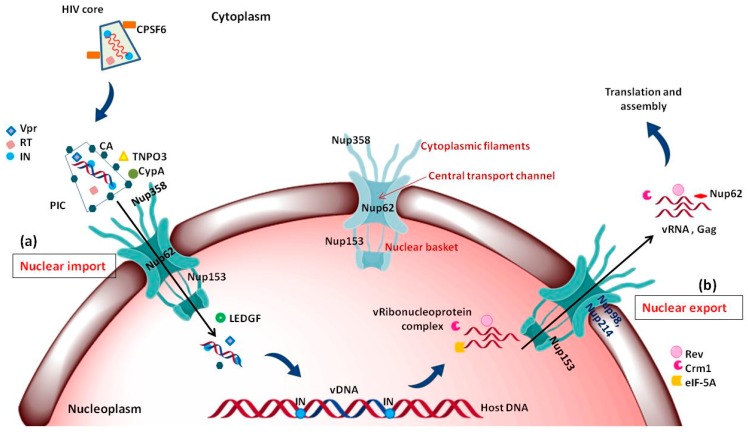
The complex nature and structure of the human immunodeficiency virus has rendered the cure for HIV infections elusive. The advances in antiretroviral treatment regimes and the development of highly advanced anti-retroviral therapy, which primarily targets the HIV enzymes, have dramatically changed the face of the HIV epidemic worldwide. Despite this remarkable progress, patients treated with these drugs often witness inadequate efficacy, compound toxicity and non-HIV complications. Considering the limited inventory of druggable HIV proteins and their susceptibility to develop drug resistance, recent attempts are focussed on targeting HIV-host interactomes that are essential for viral reproduction. Noticeably, unlike other viruses, HIV subverts the host nuclear pore complex to enter into and exit through the nucleus. Emerging evidence suggests a crucial role of interactions between HIV-1 proteins and host nucleoporins that underlie the import of the pre-integration complex into the nucleus and export of viral RNAs into the cytoplasm during viral replication. Nevertheless, the interaction of HIV-1 with nucleoporins has been poorly described and the role of nucleoporins during nucleocytoplasmic transport of HIV-1 still remains unclear. In this review, we highlight the advances and challenges in developing a more effective antiviral arsenal by exploring critical host-HIV interactions with a special focus on nuclear pore complex (NPC) and nucleoporins.
人类免疫缺陷病毒的复杂性质和结构使得治愈 HIV 感染变得难以捉摸。抗逆转录病毒治疗方案的进展和高度先进的抗逆转录病毒疗法的发展,主要针对 HIV 酶,极大地改变了全球 HIV 流行的面貌。尽管取得了这一显著进展,但接受这些药物治疗的患者往往会出现疗效不足、毒性复合和非 HIV 并发症。考虑到可成药的 HIV 蛋白数量有限及其对产生耐药性的易感性,最近的尝试集中在针对 HIV 宿主相互作用组,这对于病毒繁殖至关重要。值得注意的是,与其他病毒不同,HIV 会颠覆宿主核孔复合物,以进入和通过细胞核。新出现的证据表明,HIV-1 蛋白与宿主核孔蛋白之间的相互作用在整合前复合物进入细胞核和病毒 RNA 在外周质中输出到细胞质的病毒复制过程中起着关键作用。然而,HIV-1 与核孔蛋白的相互作用描述得很少,核孔蛋白在 HIV-1 的核质转运过程中的作用仍不清楚。在这篇综述中,我们强调了通过探索关键的宿主- HIV 相互作用来开发更有效的抗病毒武器库的进展和挑战,特别关注核孔复合物(NPC)和核孔蛋白。