State Key Laboratory of Precision Measurement Technology & Instruments, Department of Precision Instrument, Tsinghua University, Beijing 100084, China.
Sensors (Basel). 2019 Sep 27;19(19):4208. doi: 10.3390/s19194208.
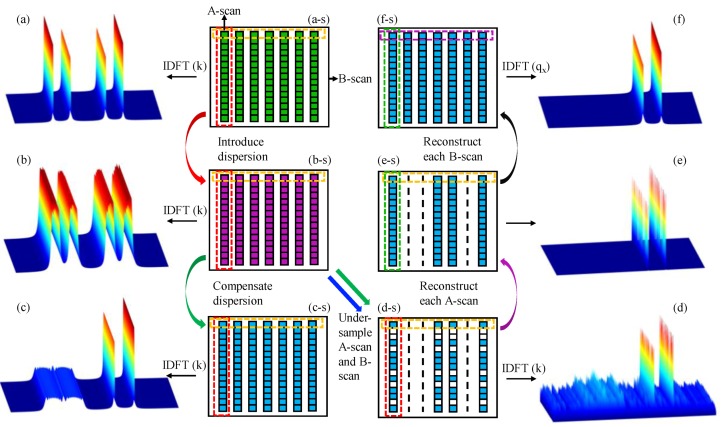
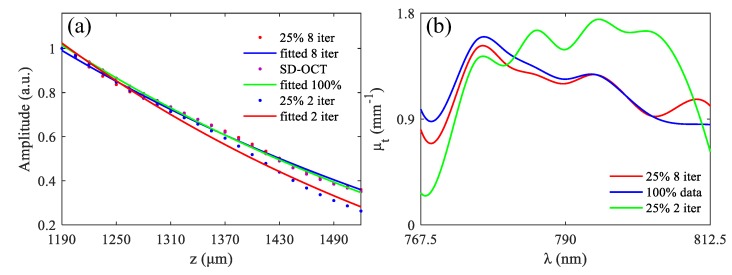
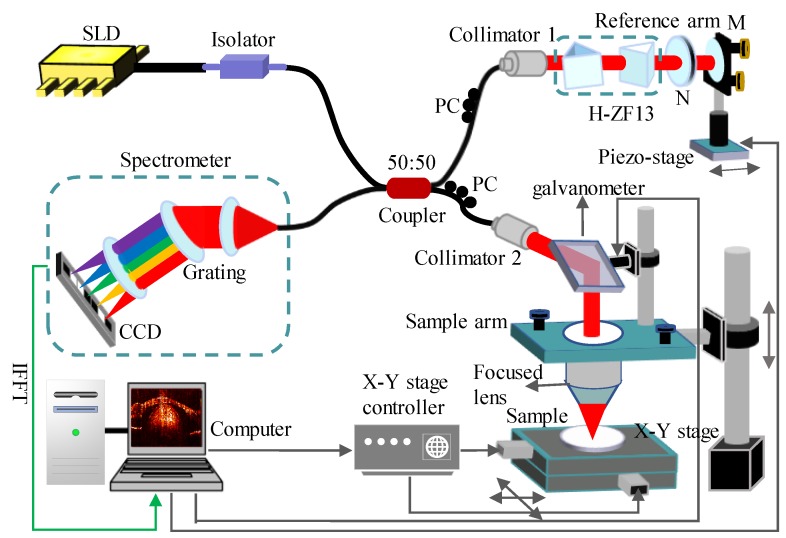
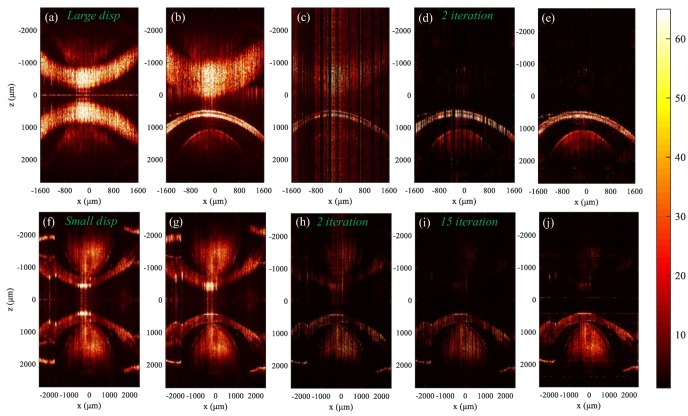
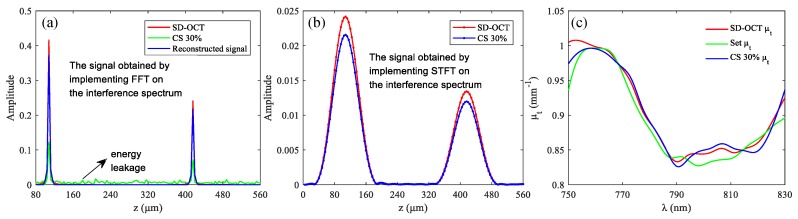
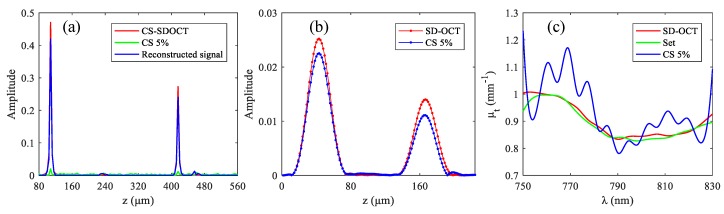
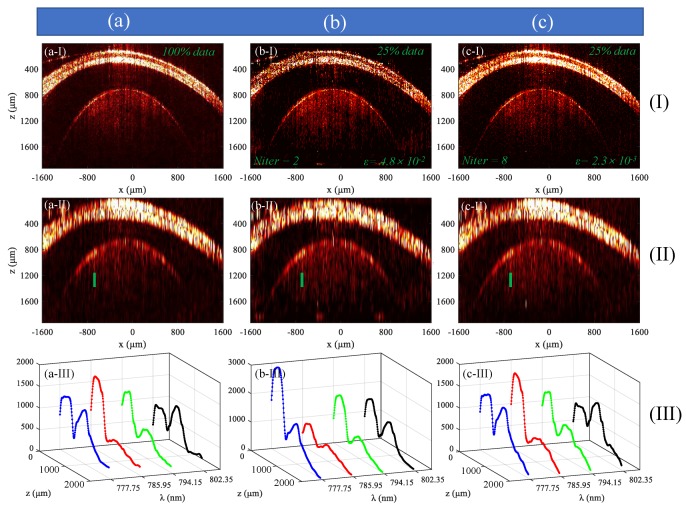
In this paper, a full depth 2D CS-SDOCT approach is proposed, which combines two-dimensional (2D) compressive sensing spectral-domain optical coherence tomography (CS-SDOCT) and dispersion encoding (ED) technologies, and its applications in structural imaging and functional sensing of bio-tissues are studied. Specifically, by introducing a large dispersion mismatch between the reference arm and sample arm in SD-OCT system, the reconstruction of the under-sampled A-scan data and the removal of the conjugated images can be achieved simultaneously by only two iterations. The under-sampled B-scan data is then reconstructed using the classic CS reconstruction algorithm. For a 5 mm × 3.2 mm fish-eye image, the conjugated image was reduced by 31.4 dB using 50% × 50% sampled data (250 depth scans and 480 spectral sampling points per depth scan), and all A-scan data was reconstructed in only 1.2 s. In addition, we analyze the application performance of the CS-SDOCT in functional sensing of locally homogeneous tissue. Simulation and experimental results show that this method can correctly reconstruct the extinction coefficient spectrum under reasonable iteration times. When 8 iterations were used to reconstruct the A-scan data in the imaging experiment of fisheye, the extinction coefficient spectrum calculated using 50% × 50% data was approximately consistent with that obtained with 100% data.
本文提出了一种全深度二维压缩光谱域光学相干断层扫描(CS-SDOCT)方法,它结合了二维(2D)压缩感知光谱域光学相干断层扫描(CS-SDOCT)和色散编码(ED)技术,并研究了其在生物组织结构成像和功能传感中的应用。具体来说,通过在 SD-OCT 系统中引入参考臂和样品臂之间的大色散失配,可以通过仅两次迭代同时实现对欠采样 A 扫描数据的重建和共轭像的去除。然后使用经典的 CS 重建算法重建欠采样的 B 扫描数据。对于 5mm×3.2mm 的鱼眼图像,使用 50%×50%的采样数据(250 个深度扫描和每个深度扫描 480 个光谱采样点)可以将共轭像减少 31.4dB,并且仅需 1.2s 即可重建所有 A 扫描数据。此外,我们分析了 CS-SDOCT 在局部均匀组织功能传感中的应用性能。模拟和实验结果表明,该方法在合理的迭代次数下可以正确重建消光系数谱。在鱼眼成像实验中,使用 8 次迭代重建 A 扫描数据时,使用 50%×50%数据计算得到的消光系数谱与使用 100%数据得到的消光系数谱基本一致。