Chang Chun-Hung, Lane Hsien-Yuan, Liu Chieh-Yu, Cheng Po-Chih, Chen Shaw-Ji, Lin Chieh-Hsin
Institute of Clinical Medical Science, China Medical University, Taichung, Taiwan.
Department of Psychiatry & Brain Disease Research Center, China Medical University Hospital, Taichung, Taiwan.
Neuropsychiatr Dis Treat. 2019 Sep 10;15:2621-2627. doi: 10.2147/NDT.S223278. eCollection 2019.
Numerous studies have demonstrated an association between C-reactive protein (CRP) levels and schizophrenia. However, the findings on psychotic severity and cognition remain inconsistent. The relationship between CRP and formal thought disorder in subdomains remains unclear.
We enrolled stable patients (defined as those who had no treatment changes during the 4-week period before evaluation) with a diagnosis of schizophrenia or schizoaffective disorder, according to the , Fifth Edition. We used the 30-item Thought and Language Disorder (TALD) scale to evaluate thought and language dysfunction over four subscales. We assessed psychotic symptoms using the Positive and Negative Syndrome Scale (PANSS). We collected fasting venous blood and measured plasma CRP levels.
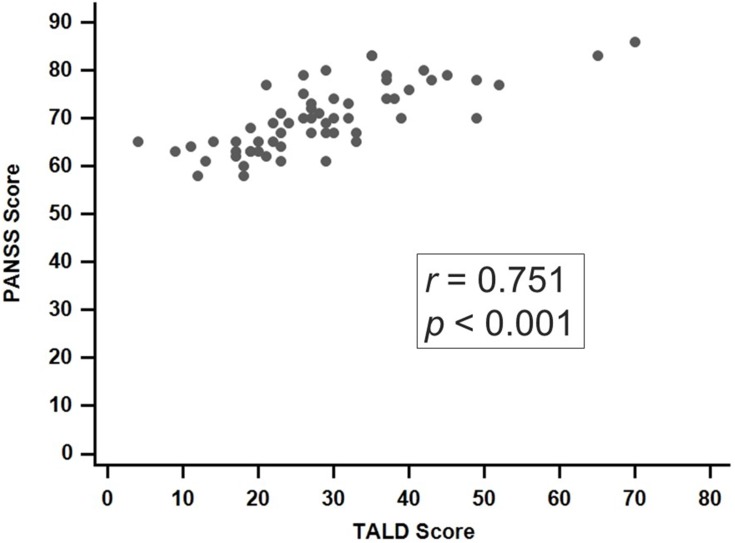
We enrolled 60 patients with schizophrenia. All patients received TALD and PANSS evaluation, and 33 of them had their CRP levels checked. The multivariate regression analysis indicated that CRP levels were significantly associated with the total score on the TALD (t=2.757, =0.010) and the TALD Objective Positive subscale (t=2.749, =0.011), after sex, age, duration of illness (in years), and use of atypical antipsychotics were adjusted for. Additionally, CRP was significantly associated with the PANSS positive subscale (t=2.102, =0.045). A significantly positive correlation was observed between the total scores on the TALD scale and PANSS (ρ =0.751, <0.001).
Our results suggest that abnormal CRP levels are significantly associated with formal thought and language dysfunction in the Objective Positive subdomain and positive psychotic symptoms.
大量研究已证实C反应蛋白(CRP)水平与精神分裂症之间存在关联。然而,关于精神病严重程度和认知的研究结果仍不一致。CRP与形式思维障碍各子领域之间的关系尚不清楚。
根据《精神疾病诊断与统计手册》第五版,我们纳入了诊断为精神分裂症或分裂情感性障碍的稳定患者(定义为在评估前4周内未改变治疗方案的患者)。我们使用30项思维与语言障碍(TALD)量表,通过四个子量表评估思维和语言功能障碍。我们使用阳性和阴性症状量表(PANSS)评估精神病症状。我们采集空腹静脉血并测量血浆CRP水平。
我们纳入了60例精神分裂症患者。所有患者均接受了TALD和PANSS评估,其中33例患者检测了CRP水平。多因素回归分析表明,在对性别、年龄、病程(以年为单位)和非典型抗精神病药物的使用进行校正后,CRP水平与TALD总分(t=2.757,P=0.010)和TALD客观阳性子量表(t=2.749,P=0.011)显著相关。此外,CRP与PANSS阳性子量表显著相关(t=2.102,P=0.045)。TALD量表总分与PANSS之间存在显著正相关(ρ=0.751,P<0.001)。
我们的结果表明,CRP水平异常与客观阳性子领域的形式思维和语言功能障碍以及阳性精神病症状显著相关。