Zhong Ming, Tian Xiaoting, Chen Shuoji, Chen Mingcang, Guo Ziqiong, Zhang Minna, Zheng Gongpu, Li Zhixiong, Shi Zhangpeng, Wang Guanghui, Gao Honggang, Liu Fang, Huang Chenggang
1College of Pharmacy, Jining Medical University, Rizhao, 276826 People's Republic of China.
2Shanghai Research Center for Modernization of Traditional Chinese Medicine, Shanghai Institute of Materia Medica, Chinese Academy of Science, Shanghai, 201203 People's Republic of China.
Chin Med. 2019 Sep 24;14:37. doi: 10.1186/s13020-019-0254-9. eCollection 2019.
Modern pharmacological studies have demonstrated that Baihe-Zhimu decoction (BZD) has antidepressant effects. However, the complex composition and lack of clear evaluation standards for BZD make it less likely to be understood and accepted than evidence-based active natural compounds.
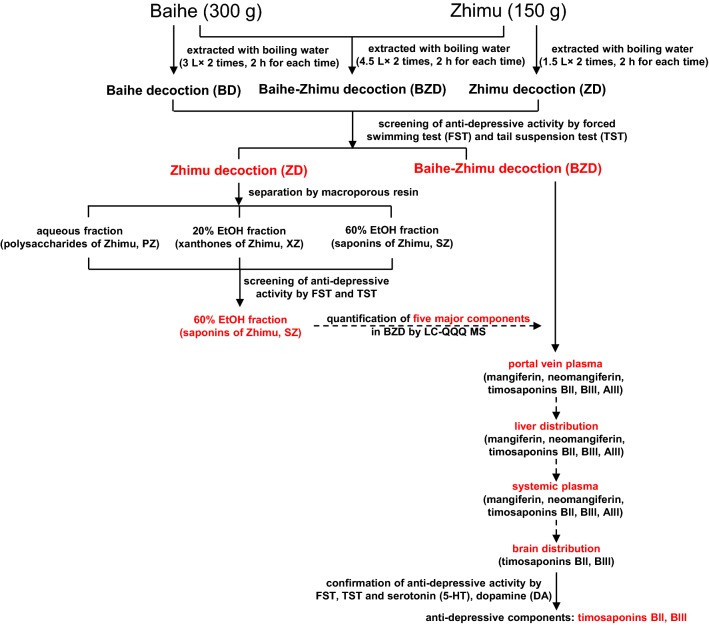
In this study, an effective method for the identification of antidepressant components was demonstrated and applied to BZD. The first step was to evaluate the efficacy of BZD by the forced swimming test (FST) and the tail suspension test (TST), followed by successive quantitative analyses of the absorbed constituents at different stages, such as before hepatic disposition, liver distribution, after hepatic disposition and brain distribution after the oral administration of BZD. Finally, the compounds detected in the brain were confirmed by activity testing.
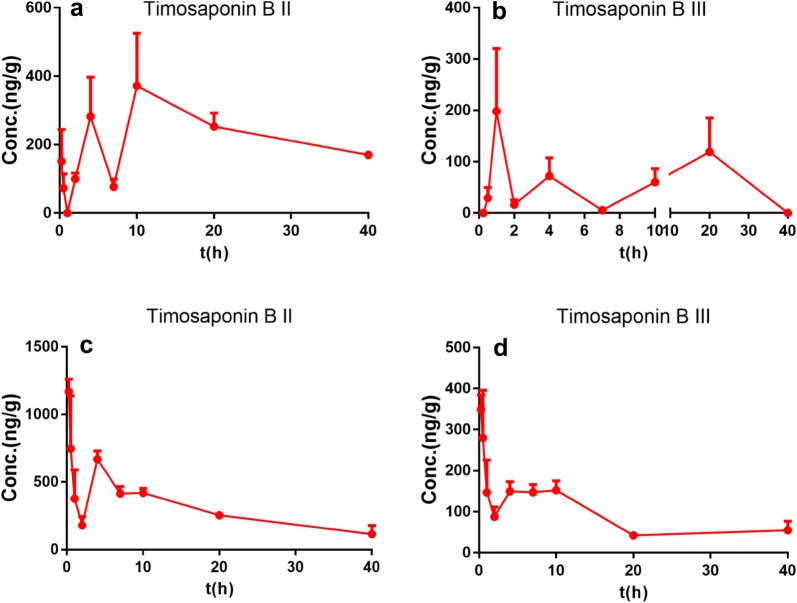
Our investigation observed that timosaponin BII and timosaponin BIII were accurately determined in the brain after oral administration of BZD, and they were further confirmed to reduce the immobility time in the FST and TST. As described above, timosaponin BII and timosaponin BIII were used to scientifically and reasonably explain the effective chemical basis of the effect of BZD on depression.
This research affords an effective method to discover lead molecules for antidepressants from traditional Chinese medicine.
现代药理学研究表明,百合知母汤(BZD)具有抗抑郁作用。然而,BZD的成分复杂且缺乏明确的评价标准,这使得它比基于证据的活性天然化合物更难被理解和接受。
在本研究中,展示了一种鉴定抗抑郁成分的有效方法并将其应用于BZD。第一步是通过强迫游泳试验(FST)和悬尾试验(TST)评估BZD的疗效,随后对口服BZD后不同阶段的吸收成分进行连续定量分析,如肝脏处置前、肝脏分布、肝脏处置后以及脑部分布。最后,通过活性测试确认在脑中检测到的化合物。
我们的研究观察到,口服BZD后,知母皂苷BII和知母皂苷BIII在脑中被准确测定,并且进一步证实它们可减少FST和TST中的不动时间。如上所述,知母皂苷BII和知母皂苷BIII被用于科学合理地解释BZD对抑郁症疗效的有效化学基础。
本研究提供了一种从中药中发现抗抑郁先导分子的有效方法。