Mailman School of Public Health, Department of Epidemiology, Columbia University, USA.
Mailman School of Public Health, Department of Sociomedical Sciences, Columbia University, USA.
Soc Sci Med. 2014 Feb;103:42-50. doi: 10.1016/j.socscimed.2013.07.021.
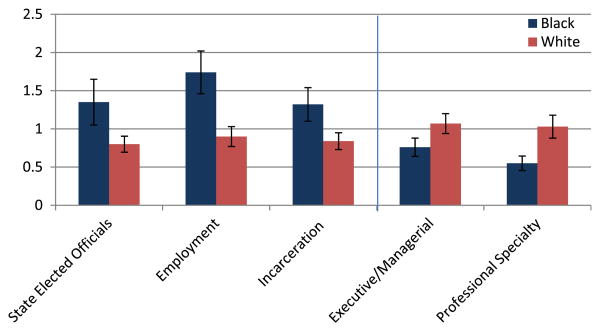
There is a growing research literature suggesting that racism is an important risk factor undermining the health of Blacks in the United States. Racism can take many forms, ranging from interpersonal interactions to institutional/structural conditions and practices. Existing research, however, tends to focus on individual forms of racial discrimination using self-report measures. Far less attention has been paid to whether structural racism may disadvantage the health of Blacks in the United States. The current study addresses gaps in the existing research by using novel measures of structural racism and by explicitly testing the hypothesis that structural racism is a risk factor for myocardial infarction among Blacks in the United States. State-level indicators of structural racism included four domains: (1) political participation; (2) employment and job status; (3) educational attainment; and (4) judicial treatment. State-level racial disparities across these domains were proposed to represent the systematic exclusion of Blacks from resources and mobility in society. Data on past-year myocardial infarction were obtained from the National Epidemiologic Survey on Alcohol and Related Conditions (non-Hispanic Black: N = 8245; non-Hispanic White: N = 24,507), a nationally representative survey of the U.S. civilian, non-institutionalized population aged 18 and older. Models were adjusted for individual-level confounders (age, sex, education, household income, medical insurance) as well as for state-level disparities in poverty. Results indicated that Blacks living in states with high levels of structural racism were generally more likely to report past-year myocardial infarction than Blacks living in low-structural racism states. Conversely, Whites living in high structural racism states experienced null or lower odds of myocardial infarction compared to Whites living in low-structural racism states. These results raise the provocative possibility that structural racism may not only harm the targets of stigma but also benefit those who wield the power to enact stigma and discrimination.
越来越多的研究文献表明,种族主义是破坏美国黑人健康的一个重要风险因素。种族主义可以采取多种形式,从人际互动到制度/结构条件和做法。然而,现有研究往往侧重于使用自我报告措施的个人形式的种族歧视。很少有人关注结构性种族主义是否会使美国黑人的健康状况恶化。本研究通过使用新的结构性种族主义衡量标准,并明确测试结构性种族主义是美国黑人心肌梗死风险因素的假设,来解决现有研究中的空白。结构性种族主义的州级指标包括四个领域:(1)政治参与;(2)就业和工作状况;(3)教育程度;(4)司法待遇。这些领域的州级种族差异被认为代表了黑人在社会中被系统性地排除在资源和流动之外。过去一年心肌梗死的数据来自全国酒精和相关条件流行病学调查(非西班牙裔黑人:N=8245;非西班牙裔白人:N=24507),这是一项对美国 18 岁及以上非住院平民人口的全国代表性调查。模型调整了个体层面的混杂因素(年龄、性别、教育程度、家庭收入、医疗保险)以及州级贫困差异。结果表明,生活在结构性种族主义程度较高的州的黑人,过去一年报告心肌梗死的可能性通常高于生活在结构性种族主义程度较低的州的黑人。相反,生活在结构性种族主义程度较高的州的白人,与生活在结构性种族主义程度较低的州的白人相比,心肌梗死的可能性为零或更低。这些结果提出了一个挑衅性的可能性,即结构性种族主义不仅可能伤害污名的目标,而且可能使那些行使实施污名和歧视的权力的人受益。