School of Public Health, Zunyi Medical University, Zunyi, China.
Cancer Research Division, Cancer Council New South Wales, Sydney, Australia.
PLoS One. 2019 Oct 1;14(10):e0222760. doi: 10.1371/journal.pone.0222760. eCollection 2019.
Information on healthcare costs in low-and-middle-income countries is limited. This study presents a framework to perform healthcare cost estimates for each province in China.
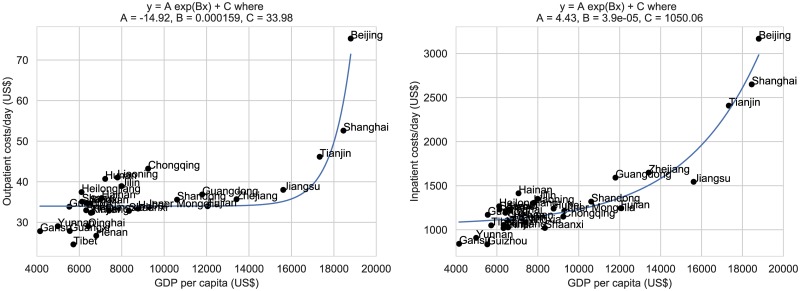
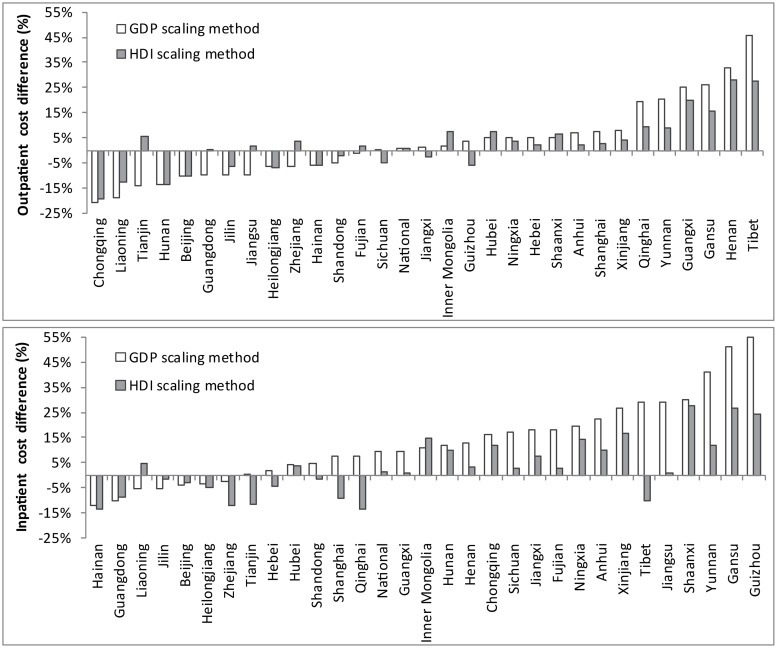
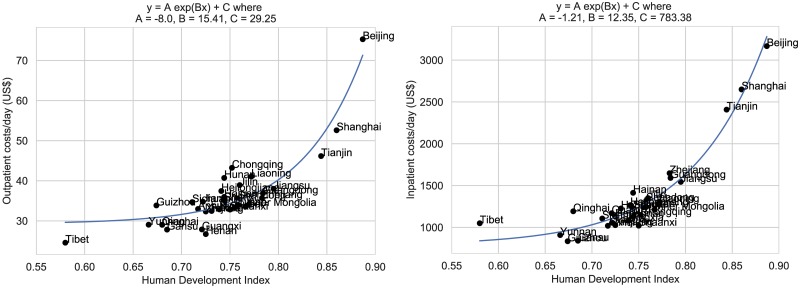
This study has two aims. Using cervical cancer as an example, the first aim is to use data (including micro-costing data) from one province to derive estimates for other provinces in China. This used provincial and national Chinese-language statistical reports and considered levels of service delivery, hospital-seeking behaviour, and the urban/rural population distribution. The second aim is to characterise the relationship between the reference costs estimated using the method mentioned above and two sets of cost estimates derived using simplified cost-scaling method with per capita Gross Domestic Product (GDP), and the Human Development Index (HDI). For simplified methods, regression modelling characterised the relationship between province-specific healthcare costs and macro-economic indicators, then we used the exponential fit to extrapolate costs.
Using the reference method, the estimated costs were found to vary substantially by urban/rural regions and between provinces; the ratios of highest to lowest provincial costs were 3.5 for visual inspection with acetic acid (VIA), 4.4 for cold knife conisation (CKC) and 4.6 for stage II cancer treatment. The HDI-based scaling method generally resulted in a better fit to reference costs than the GDP method.
These reference costs for cervical cancer can inform cost-effectiveness evaluation of cervical screening and HPV vaccination in China. HDI-based methods for cost-scaling-based on social, as well as purely economic, factors-have potential to provide more accurate estimates.
中低收入国家的医疗保健成本信息有限。本研究提出了一种框架,可用于对中国每个省份进行医疗保健成本估算。
本研究有两个目的。以宫颈癌为例,第一个目的是使用一个省份的数据(包括微观成本数据)来估算中国其他省份的成本。这利用了中国省级和国家级的中文统计报告,并考虑了服务提供水平、就医行为以及城乡人口分布。第二个目的是描述使用上述方法估算的参考成本与使用简化成本缩放方法(按人均国内生产总值 (GDP) 和人类发展指数 (HDI))得出的两组成本估算之间的关系。对于简化方法,回归模型描述了特定省份医疗保健成本与宏观经济指标之间的关系,然后使用指数拟合来推断成本。
使用参考方法,发现城市/农村地区和省份之间的估计成本存在很大差异;最高和最低省份成本的比例分别为醋酸视觉检查 (VIA) 的 3.5、冷刀锥切术 (CKC) 的 4.4 和 II 期癌症治疗的 4.6。基于人类发展指数的缩放方法通常比基于 GDP 的方法更能拟合参考成本。
这些宫颈癌的参考成本可用于中国宫颈癌筛查和 HPV 疫苗接种的成本效益评估。基于社会因素而非纯粹经济因素的基于成本缩放的人类发展指数方法有可能提供更准确的估计。