Borys Michał, Domagała Michał, Wencław Krzysztof, Jarczyńska-Domagała Joanna, Czuczwar Mirosław
Second Department of Anesthesia and Intensive Care, Medical University of Lublin.
Faculty of Medicine and Health Sciences, Jan Kochanowski University, Kielce.
Medicine (Baltimore). 2019 Sep;98(39):e17358. doi: 10.1097/MD.0000000000017358.
Previous studies comparing adductor canal block (ACB) with femoral nerve block (FNB) are inconclusive with regard to patient-controlled analgesia (PCA) induced by opioids. Moreover, some postoperative pain severity results differ between previous randomized controlled trials (RCTs). The primary aim of the current study was to compare total intravenous morphine consumption administered via PCA during the first postoperative day in continuous FNB and ACB groups after total knee arthroplasty (TKA). Secondary aims included evaluation of postoperative pain via a visual analog scale, degree of knee extension, quadriceps muscle strength, and ability to sit, stand upright, and walk.
The study was a RCT. Inclusion criteria were presence of gonarthrosis, age >18 and <75 years, and scheduled for TKA under single-shot spinal anesthesia.
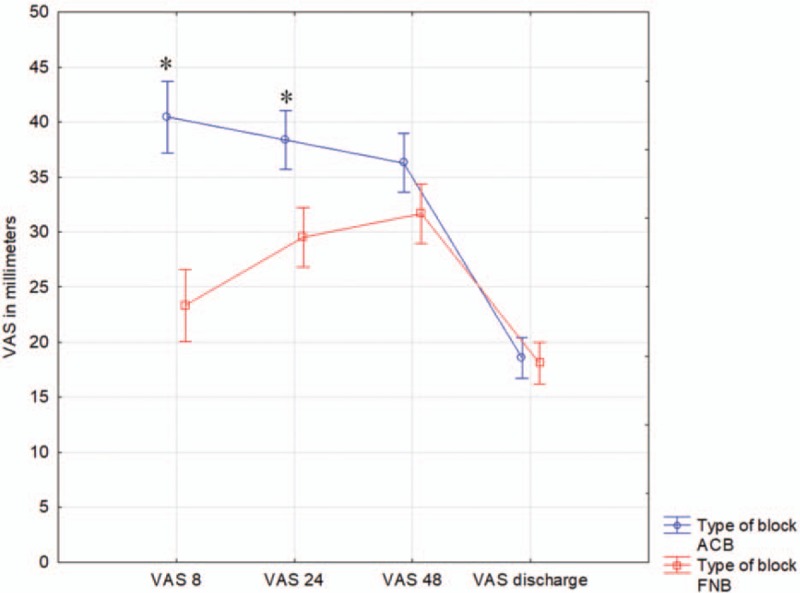
A number of morphine uses was lower in the FNB group than in the ACB group (14, range 12-15 vs 20, range 18-22; P = .0001), and they perceived less severe pain at the 8th (P = .00003) and 24th hours. However, ACB was significantly superior with regard to most of the other parameters pertaining to mobility, including muscle strength at the 8th and 24th hours, degree of knee extension at the 8th hour, sitting at the 8th hour, standing upright at the 24th hour, and walking at the 24th and 48th hours.
FNB was associated with the perception of less severe pain after TKAs. However, ACB was associated with earlier mobility rehabilitation.
以往比较股内侧肌管阻滞(ACB)与股神经阻滞(FNB)的研究在阿片类药物诱导的患者自控镇痛(PCA)方面尚无定论。此外,以往的随机对照试验(RCT)之间的一些术后疼痛严重程度结果有所不同。本研究的主要目的是比较全膝关节置换术(TKA)后连续FNB组和ACB组术后第一天通过PCA给予的静脉注射吗啡总量。次要目的包括通过视觉模拟量表评估术后疼痛、膝关节伸展程度、股四头肌力量以及坐、直立和行走的能力。
本研究为RCT。纳入标准为存在膝关节病、年龄>18岁且<75岁,并计划在单次脊麻下进行TKA。
FNB组的吗啡使用次数低于ACB组(14次,范围12 - 15次 vs 20次,范围18 - 22次;P = 0.0001),且在第8小时(P = 0.00003)和第24小时时,他们感觉到的疼痛较轻。然而,在与活动能力相关的大多数其他参数方面,ACB明显更优,包括第8小时和第24小时的肌肉力量、第8小时的膝关节伸展程度、第8小时的坐姿、第24小时的直立姿势以及第24小时和第48小时的行走能力。
FNB与TKA后较轻的疼痛感知相关。然而,ACB与更早的活动能力康复相关。