Dai Jiali, Chen Yuetong, Gong Yang, Wei Jingsun, Cui Xiaowen, Yu Hualin, Zhao Wenjing, Gu Dongying, Chen Jinfei
Department of Oncology, Nanjing First Hospital, Nanjing Medical University.
Cancer Center, Taikang Xianlin Drum Tower Hospital, Nanjing University.
Medicine (Baltimore). 2019 Sep;98(39):e17384. doi: 10.1097/MD.0000000000017384.
Irinotecan (IRI)-based and oxaliplatin (OXA)-based regimens are available for the treatment of metastatic colorectal cancer (mCRC). Several studies have published inconsistent results in their comparisons of the efficacy and toxicity of IRI ± bevacizumab and OXA ± bevacizumab. This meta-analysis was performed to evaluate the efficacy and safety of these 2 regimens in patients with mCRC.
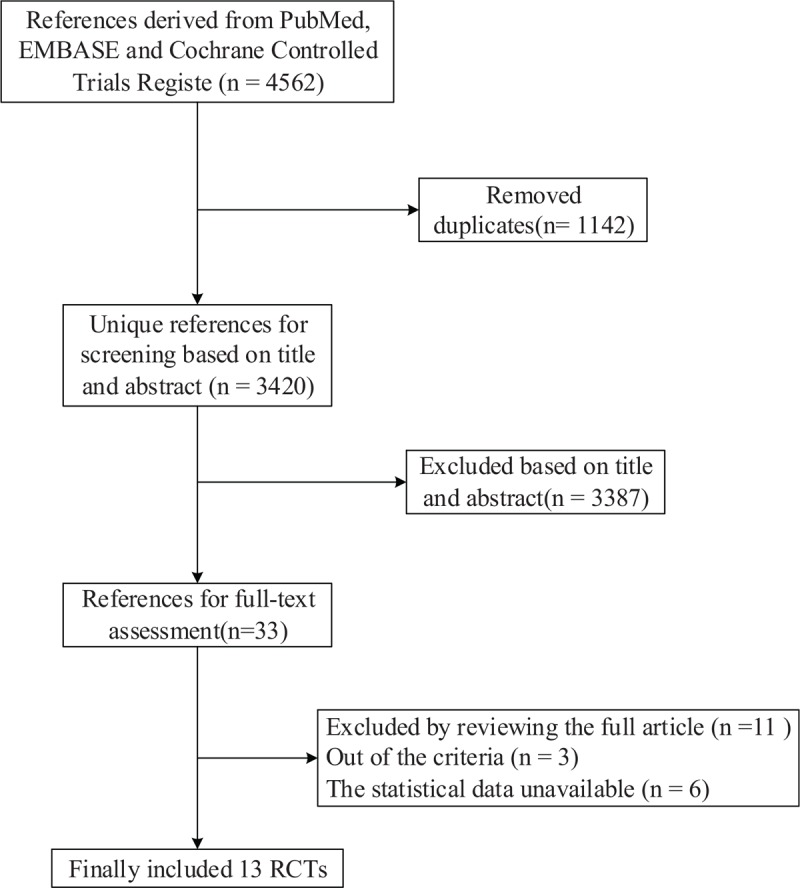
We searched several databases to identify relevant studies, including PubMed, EMBASE, and the Cochrane Controlled Trials Register. The primary endpoints were overall survival (OS) and time to progression (TTP). The secondary comparisons were overall response rate (ORR) and toxicity. In addition, the hazard ratio (HR) or risk ratio (RR) values with their corresponding 95% confidence intervals (CIs) were extracted from these studies.
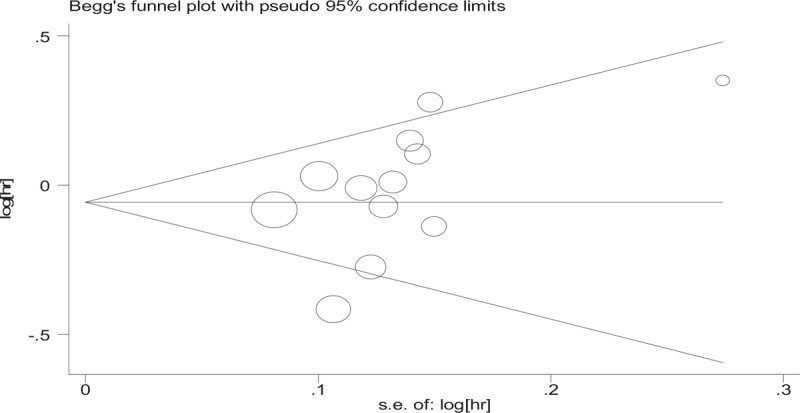
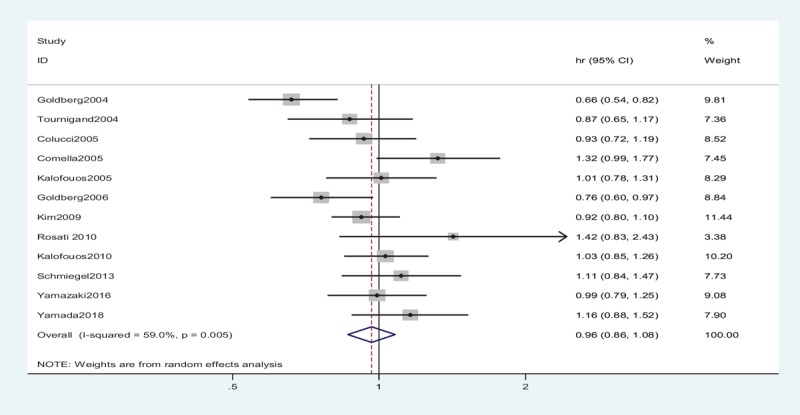
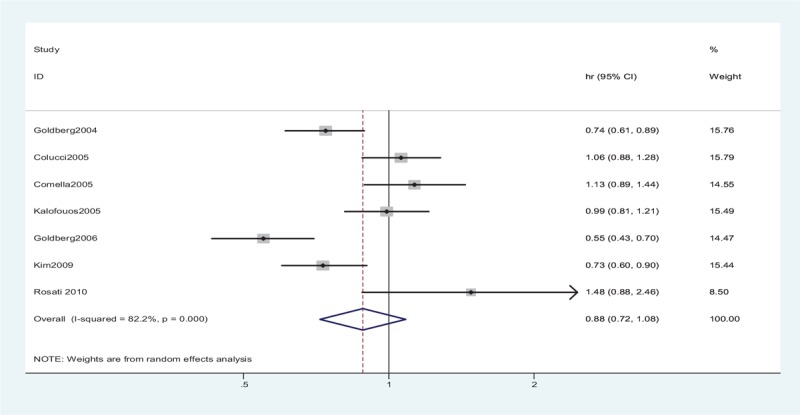
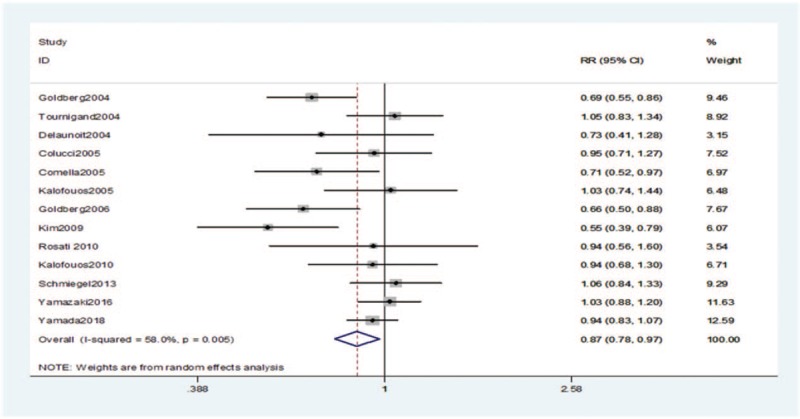
Pooled data of 13 studies demonstrated no significant differences in OS (HR = 0.96, 95% CI: 0.86-1.08, P = .53) and TTP (HR = 0.88, 95% CI: 0.72-1.08, P = .24) between the 2 groups. However, the ORR (RR = 0.87, 95% CI: 0.78-0.97, P = .02) was clearly improved in the OXA ± bevacizumab arm. Higher incidences of grade 3/4 nausea (RR = 1.63, 95% CI: 1.28-2.07, P < .001), vomiting (RR = 1.40, 95% CI: 1.09-1.81, P = .01), diarrhea (RR = 1.44, 95% CI: 1.23-1.70, P < .001), and anemia (RR = 4.13, 95% CI: 2.75-6.22, P < .001) were observed in the IRI group. However, the incidences of grade 3/4 neutropenia (RR = 0.75, 95% CI: 0.68-0.83, P < .001), thrombocytopenia (RR = 0.43, 95% CI: 0.26-0.73, P = .002), and paresthesia/neurological disturbances (RR = 0.04, 95% CI: 0.02-0.07, P < .001) were higher in the OXA group.
This meta-analysis confirmed that the OXA ± bevacizumab regimen as a maintenance therapy significantly improved the ORR in patients with mCRC. Exhibiting strong efficacy and safety, the OXA and OXA plus bevacizumab regimens are preferred as first-line treatments for mCRC.
基于伊立替康(IRI)和基于奥沙利铂(OXA)的方案可用于治疗转移性结直肠癌(mCRC)。多项研究在比较IRI±贝伐单抗与OXA±贝伐单抗的疗效和毒性时发表了不一致的结果。进行这项荟萃分析以评估这两种方案对mCRC患者的疗效和安全性。
我们检索了多个数据库以识别相关研究,包括PubMed、EMBASE和Cochrane对照试验注册库。主要终点为总生存期(OS)和疾病进展时间(TTP)。次要比较为总缓解率(ORR)和毒性。此外,从这些研究中提取危险比(HR)或风险比(RR)值及其相应的95%置信区间(CI)。
13项研究的汇总数据显示,两组之间的OS(HR = 0.96,95%CI:0.86 - 1.08,P = 0.53)和TTP(HR = 0.88,95%CI:0.72 - 1.08,P = 0.24)无显著差异。然而,OXA±贝伐单抗组的ORR(RR = 0.87,95%CI:0.78 - 0.97,P = 0.02)明显改善。IRI组3/4级恶心(RR = 1.63,95%CI:1.28 - 2.07,P < 0.001)、呕吐(RR = 1.40,95%CI:1.09 - 1.81,P = 0.01)、腹泻(RR = 1.44,95%CI:1.23 - 1.70,P < 0.001)和贫血(RR = 4.13,95%CI:2.75 - 6.22,P < 0.001)的发生率较高。然而,OXA组3/4级中性粒细胞减少(RR = 0.75,95%CI:0.68 - 0.83,P < 0.001)、血小板减少(RR = 0.43,95%CI:0.26 - 0.73,P = 0.002)和感觉异常/神经功能障碍(RR = 0.04,95%CI:0.02 - 0.07,P < 0.001)的发生率较高。
这项荟萃分析证实,OXA±贝伐单抗方案作为维持治疗可显著提高mCRC患者的ORR。OXA以及OXA加贝伐单抗方案具有强大的疗效和安全性,是mCRC一线治疗的首选方案。