Singh Vishal, Jha Keshav Kumar, M Jyothsna K, Kumar Rekha V, Raghunathan Varun, Bhat Ramray
Department of Molecular Reproduction Development and Genetics, Indian Institute of Science, Bangalore 560012, India.
Department of Electrical Communications and Engineering, Indian Institute of Science, Bangalore 560012 India.
J Clin Med. 2019 Sep 30;8(10):1562. doi: 10.3390/jcm8101562.
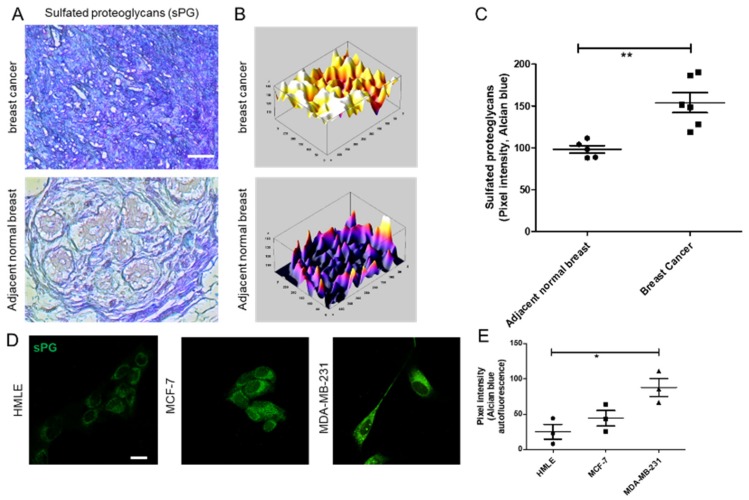
Cancer epithelia show elevation in levels of sulfated proteoglycans including dermatan sulfates (DS). The effect of increased DS on cancer cell behavior is still unclear. We hypothesized that decreased expression of the enzyme Iduronate-2-sulfatase (IDS) can lead to increased DS levels, which would enhance the invasion of cancer cells. Breast cancer sections shows depleted IDS levels in tumor epithelia, when compared with adjacent untransformed breast tissues. IDS signals showed a progressive decrease in the non-transformed HMLE, transformed but non-invasive MCF-7 and transformed and invasive MDA-MB-231 cells, respectively, when cultured on Type 1 collagen scaffolds. DS levels measured by ELISA increased in an inverse-association with IDS levels. Knockdown of IDS in MCF-7 epithelia also increased the levels of DS. MCF-7 cells with depleted IDS expression, when imaged using two photon-excited fluorescence and second harmonic generation microscopy, exhibited a mesenchymal morphology with multiple cytoplasmic projections compared with epithelioid control cells, interacted with their surrounding matrix, and showed increased invasion through Type 1 collagen matrices. Both these traits were phenocopied when control MCF-7 cells were cultivated on Type 1 collagen gels polymerized in the presence of DS. In monolayer cultures, DS had no effect on MCF-7 migration. In the context of our demonstration that DS enhances the elastic modulus of Type 1 collagen gels, we propose that a decrease of IDS expression leads to accumulation within cancer epithelia of DS: the latter remodels the collagen around cancer cells leading to changes in cell shape and invasiveness through fibrillar matrix milieu.
癌症上皮细胞中硫酸化蛋白聚糖(包括硫酸皮肤素,DS)水平升高。DS增加对癌细胞行为的影响仍不清楚。我们假设艾杜糖醛酸-2-硫酸酯酶(IDS)表达降低会导致DS水平升高,进而增强癌细胞的侵袭能力。与相邻未转化的乳腺组织相比,乳腺癌切片显示肿瘤上皮中IDS水平降低。当在I型胶原支架上培养时,IDS信号在未转化的HMLE细胞、转化但无侵袭性的MCF-7细胞以及转化且有侵袭性的MDA-MB-231细胞中分别呈逐渐下降趋势。通过酶联免疫吸附测定法测得的DS水平与IDS水平呈负相关。在MCF-7上皮细胞中敲低IDS也会增加DS水平。与上皮样对照细胞相比,使用双光子激发荧光和二次谐波产生显微镜成像时,IDS表达降低的MCF-7细胞呈现出具有多个细胞质突起的间充质形态,与周围基质相互作用,并显示出通过I型胶原基质的侵袭能力增强。当对照MCF-7细胞在存在DS的情况下聚合的I型胶原凝胶上培养时,这两种特征都被复制。在单层培养中,DS对MCF-7细胞迁移没有影响。鉴于我们证明DS可增强I型胶原凝胶的弹性模量,我们提出IDS表达降低会导致DS在癌症上皮细胞内积累:后者重塑癌细胞周围的胶原,导致细胞形状改变以及通过纤维状基质环境的侵袭性改变。