Neuroscience Program
Tulane Brain Institute.
eNeuro. 2019 Oct 16;6(5). doi: 10.1523/ENEURO.0275-19.2019. Print 2019 Sep/Oct.
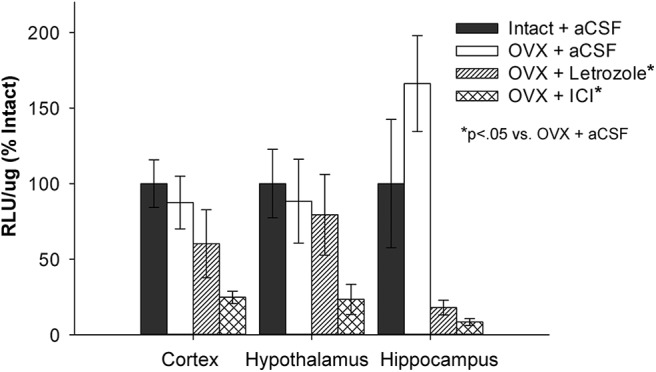
Previous work has demonstrated that estrogen receptors are transcriptionally active in the absence of ovarian estrogens. The current work aims to determine whether brain-derived estrogens influence estrogen receptor-dependent transcription after short- or long-term loss of ovarian function. Experiments were conducted using estrogen response element (ERE)-Luciferase reporter mice, which express the gene for luciferase driven by consensus ERE, allowing for the quantification of ERE-dependent transcription. Brain regions examined were hippocampus, cortex, and hypothalamus. In Experiment 1, short-term (10 d) ovariectomy had no impact on ERE-dependent transcription across brain regions compared with sham surgery. In Experiment 2, chronic intracerebroventricular administration of the aromatase inhibitor letrozole significantly decreased transcriptional activity in 10-d-old ovariectomized mice across brain regions, indicating that the sustained transcription in short-term ovariectomized mice is mediated at least in part via actions of neuroestrogens. Additionally, intracerebroventricular administration of estrogen receptor antagonist ICI-182,780 blocked transcription in 10-d-old ovariectomized mice across brain regions, providing evidence that sustained transcription in ovariectomized mice is estrogen receptor dependent. In Experiment 3, long-term (70 d) ovariectomy significantly decreased ERE-dependent transcription across brain regions, though some residual activity remained. In Experiment 4, chronic intracerebroventricular letrozole administration had no impact on transcription in 70 d ovariectomized mice across brain regions, indicating that the residual ERE-dependent transcription in long-term ovariectomized mice is not mediated by neuroestrogens. Overall, the results indicate that ERE-dependent transcription in the brain continues after ovariectomy and that the actions of neuroestrogens contribute to the maintenance of ERE-dependent transcription in the brain following short-term, but not long-term, loss of ovarian function.
先前的研究表明,雌激素受体在没有卵巢雌激素的情况下也具有转录活性。本研究旨在确定脑源性雌激素是否会影响卵巢功能短期或长期丧失后雌激素受体依赖性转录。实验采用雌激素反应元件(ERE)-荧光素酶报告小鼠进行,该小鼠表达受共识 ERE 驱动的荧光素酶基因,可定量测定 ERE 依赖性转录。检测的脑区包括海马体、皮质和下丘脑。在实验 1 中,与假手术相比,短期(10d)卵巢切除术对各脑区 ERE 依赖性转录没有影响。在实验 2 中,慢性侧脑室给予芳香酶抑制剂来曲唑显著降低了 10d 卵巢切除小鼠各脑区的转录活性,表明短期卵巢切除小鼠的持续转录至少部分是通过神经雌激素的作用介导的。此外,侧脑室给予雌激素受体拮抗剂 ICI-182,780 阻断了 10d 卵巢切除小鼠各脑区的转录,这为卵巢切除小鼠中持续的转录是雌激素受体依赖性的提供了证据。在实验 3 中,长期(70d)卵巢切除术显著降低了各脑区的 ERE 依赖性转录,尽管仍有一些残留活性。在实验 4 中,慢性侧脑室给予来曲唑对 70d 卵巢切除小鼠各脑区的转录没有影响,表明长期卵巢切除小鼠中残留的 ERE 依赖性转录不是由神经雌激素介导的。总的来说,这些结果表明,卵巢切除后大脑中的 ERE 依赖性转录仍在继续,并且神经雌激素的作用有助于维持卵巢功能短期丧失后大脑中 ERE 依赖性转录,但对长期丧失无影响。