Hossain Abeer H, van Gerven Roy, Overkamp Karin M, Lübeck Peter S, Taşpınar Hatice, Türker Mustafa, Punt Peter J
Dutch DNA Biotech B.V., Padualaan 8, 3584 CH Utrecht, The Netherlands.
2Molecular Biology and Microbial Food Safety, Swammerdam Institute for Life Sciences, University of Amsterdam, Science Park 904, 1098 XH Amsterdam, The Netherlands.
Biotechnol Biofuels. 2019 Sep 30;12:233. doi: 10.1186/s13068-019-1577-6. eCollection 2019.
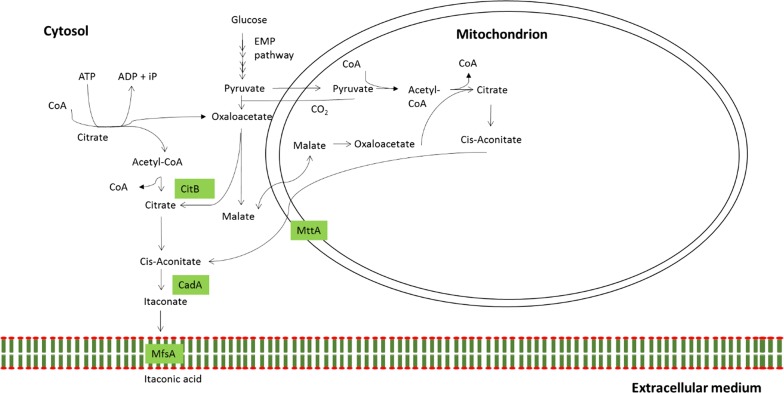
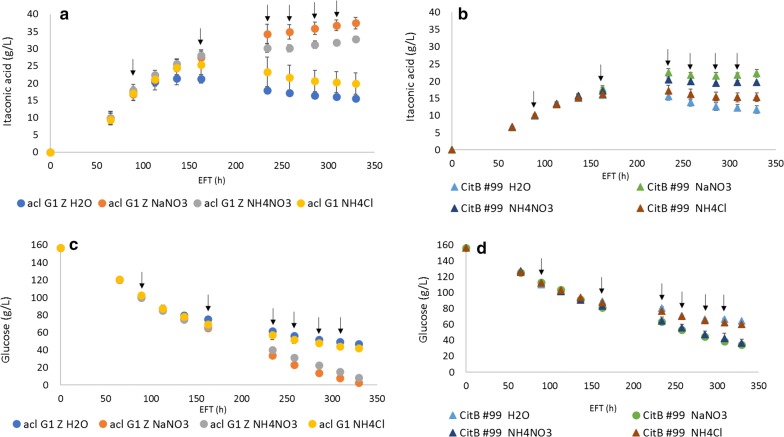
Bio-based production of organic acids promises to be an attractive alternative for the chemicals industry to substitute petrochemicals as building-block chemicals. In recent years, itaconic acid (IA, methylenesuccinic acid) has been established as a sustainable building-block chemical for the manufacture of various products such as synthetic resins, coatings, and biofuels. The natural IA producer is currently used for industrial IA production; however, the filamentous fungus has been suggested to be a more suitable host for this purpose. In our previous report, we communicated the overexpression of a putative cytosolic citrate synthase in an strain carrying the full IA biosynthesis gene cluster from which resulted in the highest final titer reported for (26.2 g/L IA). In this research, we have attempted to improve this pathway by increasing the cytosolic acetyl-CoA pool. Additionally, we have also performed fermentation optimization by varying the nitrogen source and concentration.
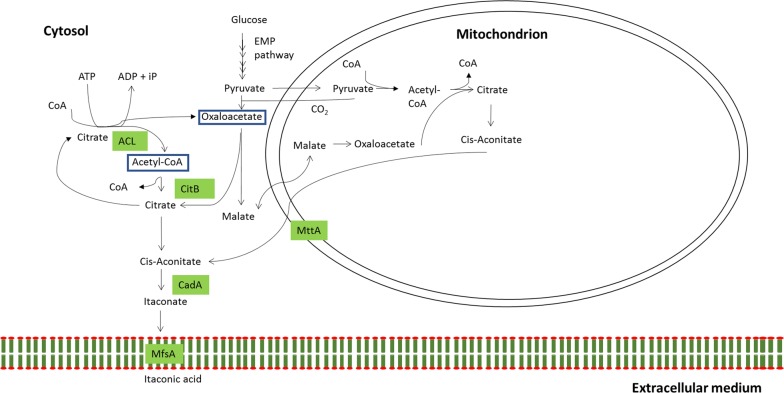
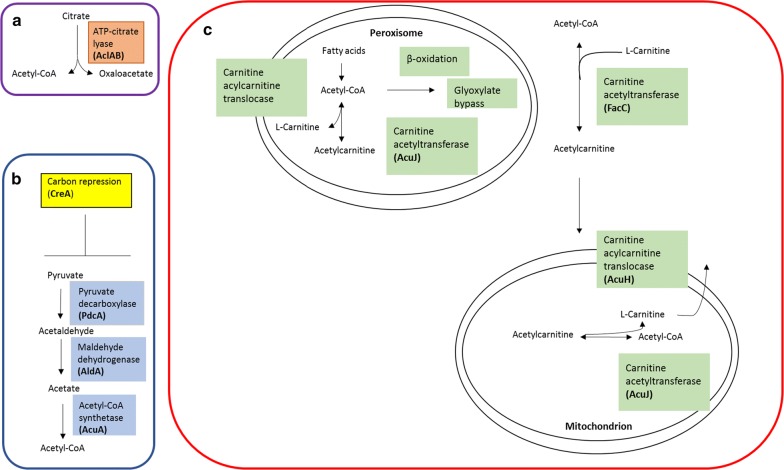
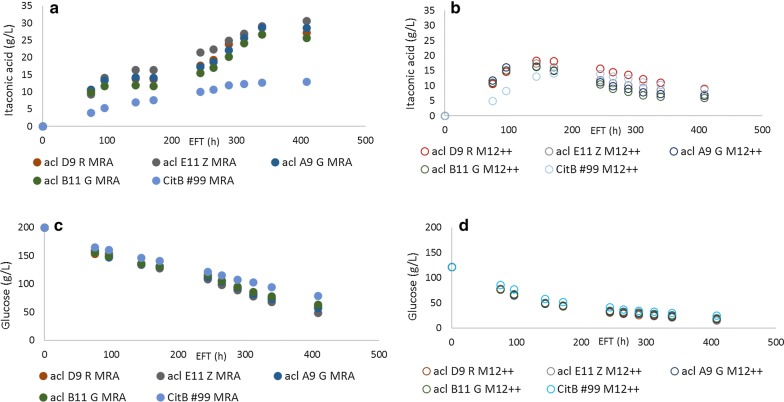
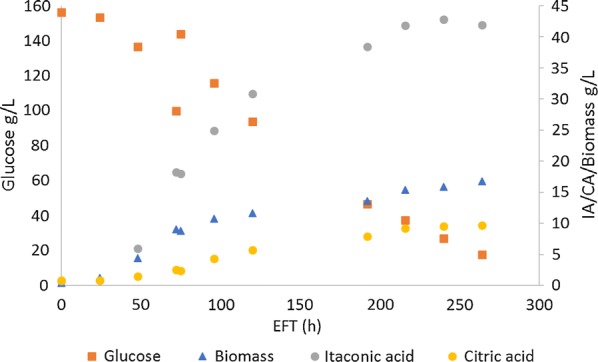
To increase the cytosolic acetyl-CoA pool, we have overexpressed genes and that together encode for ATP-citrate lyase (ACL). Metabolic engineering of ACL resulted in improved IA production through an apparent increase in glycolytic flux. Strains that overexpress show an increased yield, titer and productivity in comparison with parental strain CitB#99. Furthermore, IA fermentation conditions were improved by nitrogen supplementation, which resulted in alkalization of the medium and thereby reducing IA-induced weak-acid stress. In turn, the alkalizing effect of nitrogen supplementation enabled an elongated idiophase and allowed final titers up to 42.7 g/L to be reached at a productivity of 0.18 g/L/h and yield of 0.26 g/g in 10-L bioreactors.
Ultimately, this study shows that metabolic engineering of ACL in our rewired IA biosynthesis pathway leads to improved IA production in due to an increase in glycolytic flux. Furthermore, IA fermentation conditions were improved by nitrogen supplementation that alleviates IA induced weak-acid stress and extends the idiophase.
基于生物的有机酸生产有望成为化工行业替代石化产品作为基础化学品的一种有吸引力的选择。近年来,衣康酸(IA,亚甲基琥珀酸)已成为用于制造各种产品(如合成树脂、涂料和生物燃料)的可持续基础化学品。目前天然的衣康酸生产者被用于工业衣康酸生产;然而,丝状真菌已被认为是更适合此目的的宿主。在我们之前的报告中,我们报道了在携带来自的完整衣康酸生物合成基因簇的菌株中过表达一种假定的胞质柠檬酸合酶,这导致了报道的最高最终滴度(26.2 g/L衣康酸)。在本研究中,我们试图通过增加胞质乙酰辅酶A库来改进此途径。此外,我们还通过改变氮源和浓度进行了发酵优化。
为了增加胞质乙酰辅酶A库,我们过表达了共同编码ATP柠檬酸裂解酶(ACL)的基因和。ACL的代谢工程通过糖酵解通量的明显增加导致衣康酸产量提高。与亲本菌株CitB#99相比,过表达的菌株显示出产量、滴度和生产力增加。此外,通过补充氮改善了衣康酸发酵条件,这导致培养基碱化,从而减轻了衣康酸诱导的弱酸胁迫。反过来,补充氮的碱化作用使生长后期延长,并在10-L生物反应器中以0.18 g/L/h的生产力和0.26 g/g的产量达到高达42.7 g/L的最终滴度。
最终,本研究表明,在我们重新构建的衣康酸生物合成途径中对ACL进行代谢工程可导致衣康酸产量提高,这是由于糖酵解通量增加。此外,通过补充氮改善了衣康酸发酵条件,减轻了衣康酸诱导的弱酸胁迫并延长了生长后期。