Moradi Hamid, Park Christina, Igarashi Miki, Streja Elani, Argueta Donovan A, Soohoo Melissa, Daglian Jennifer, You Amy S, Rhee Connie M, Kashyap Moti L, DiPatrizio Nicholas V, Vaziri Nosratola D, Kalantar-Zadeh Kamyar, Piomelli Daniele
Division of Nephrology and Hypertension, University of California Irvine School of Medicine, Irvine, California.
Tibor Rubin Veterans Affairs Medical Center, Long Beach, California.
J Endocr Soc. 2019 Aug 5;3(10):1869-1880. doi: 10.1210/js.2019-00242. eCollection 2019 Oct 1.
Previous studies have shown that the endocannabinoid system plays a major role in energy metabolism through the actions of its main mediators, 2-arachidonoyl--glycerol (2-AG) and anandamide (AEA).
We examined serum levels of major endocannabinoid mediators and their association with clinical parameters in patients with end-stage renal disease (ESRD).
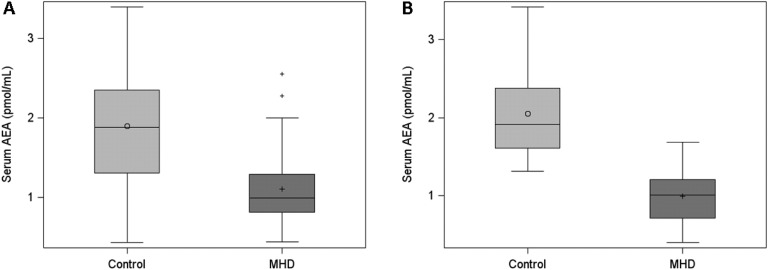
Serum concentrations of 2-AG and AEA were measured in patients on maintenance hemodialysis (MHD) and controls, and correlations with various clinical and laboratory indices were examined. 2-AG was also measured in age and sex-matched healthy subjects for comparison of levels in patients undergoing MHD.
Serum 2-AG.
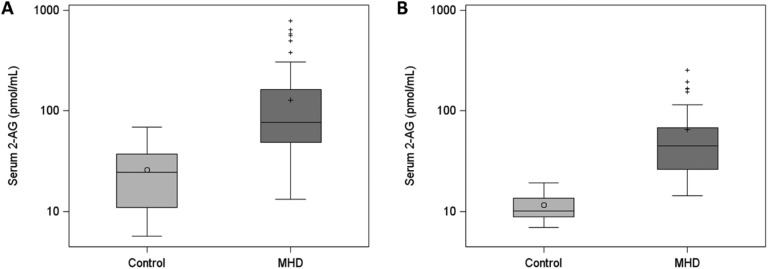
Serum 2-AG levels were significantly elevated in patients with ESRD compared with healthy controls. Higher levels of 2-AG were found in patients on MHD compared to healthy subjects, and similar findings were seen in a second set of subjects in independent analyses. Among 96 patients on MHD, 2-AG levels correlated significantly and positively with serum triglycerides ( = 0.43; < 0.0001), body mass index ( = 0.40; < 0.0001), and body anthropometric measures and negatively with serum high-density lipoprotein cholesterol ( = -0.33; = 0.001) following adjustment for demographic and clinical variables.
In patients on MHD, levels of serum 2-AG, a major endocannabinoid mediator, were increased. In addition, increasing serum 2-AG levels correlated with increased serum triglycerides and markers of body mass. Future studies will need to evaluate the potential mechanisms responsible for these findings.
先前的研究表明,内源性大麻素系统通过其主要介质2-花生四烯酸甘油酯(2-AG)和花生四烯乙醇胺(AEA)的作用在能量代谢中起主要作用。
我们检测了终末期肾病(ESRD)患者体内主要内源性大麻素介质的血清水平及其与临床参数的相关性。
测定维持性血液透析(MHD)患者和对照组血清中2-AG和AEA的浓度,并检测其与各种临床和实验室指标的相关性。还在年龄和性别匹配的健康受试者中检测了2-AG,以比较MHD患者的水平。
血清2-AG。
与健康对照组相比,ESRD患者血清2-AG水平显著升高。与健康受试者相比,MHD患者的2-AG水平更高,在独立分析的另一组受试者中也观察到类似结果。在96例MHD患者中,在对人口统计学和临床变量进行调整后,2-AG水平与血清甘油三酯显著正相关(r = 0.43;P < 0.0001)、体重指数(r = 约0.40;P < 0.0001)以及身体测量指标显著正相关,与血清高密度脂蛋白胆固醇显著负相关(r = -0.33;P = 0.001)。
在MHD患者中,主要内源性大麻素介质血清2-AG水平升高。此外,血清2-AG水平升高与血清甘油三酯升高和体重指标增加相关。未来的研究需要评估导致这些结果的潜在机制。