Department of Physical and Rehabilitation Medicine, Kangbuk Samsung Hospital, Sungkyunkwan University School of Medicine, Seoul, Republic of Korea.
Department of Rehabilitation Medicine, Seoul National University Hospital College of Medicine, Seoul, Republic of Korea.
Sci Rep. 2019 Oct 4;9(1):14308. doi: 10.1038/s41598-019-50488-3.
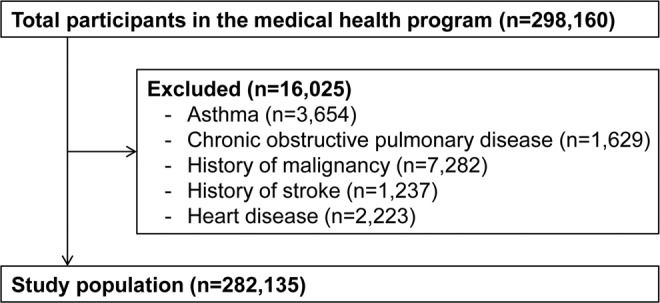
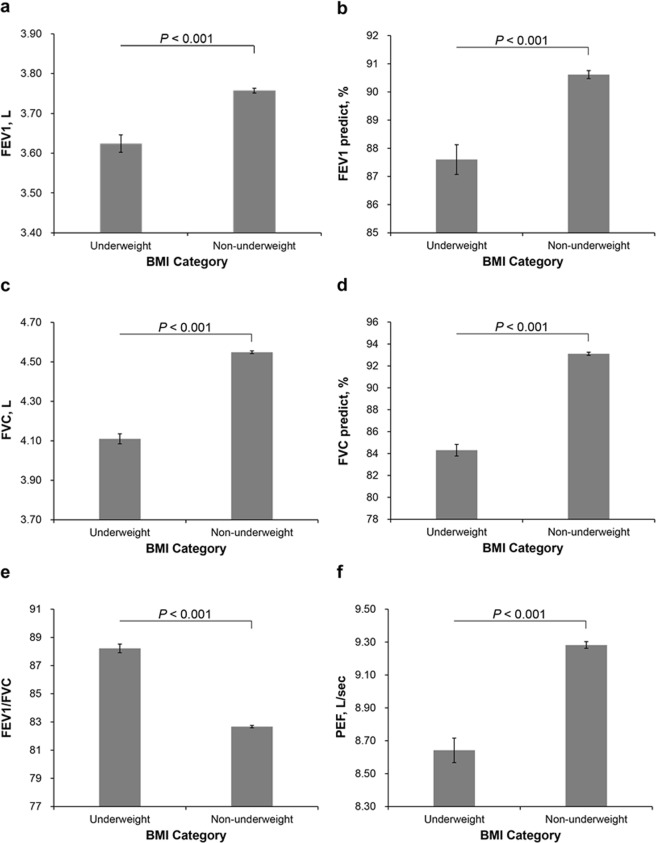
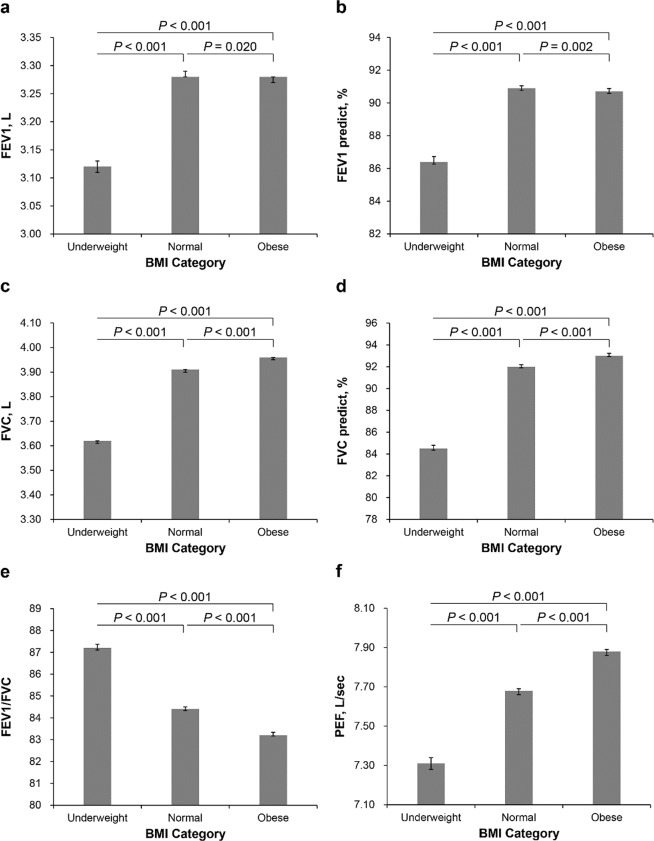
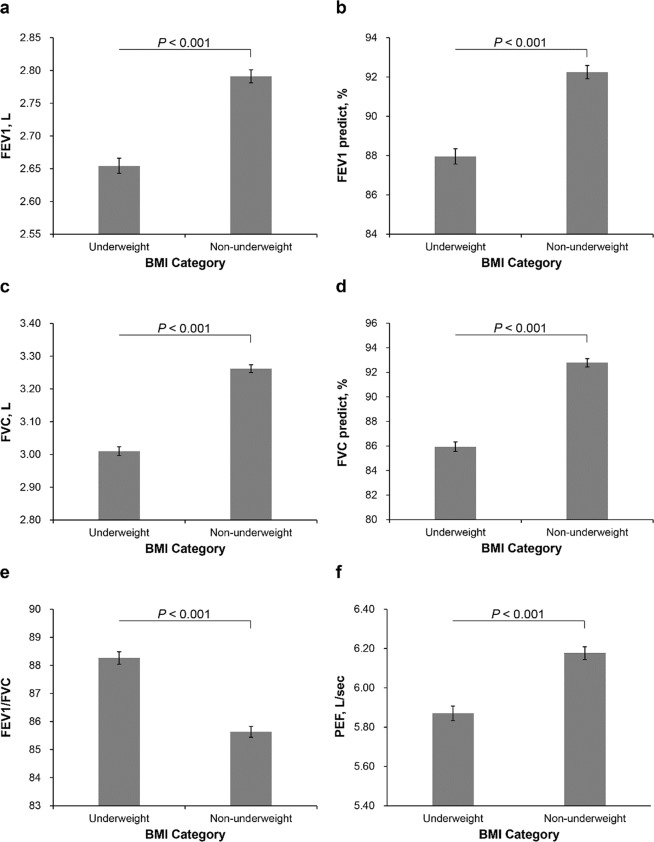
In contrast to obesity, studies on the relationship between underweight and pulmonary function are still sparse. Thus, the objective of this study was to investigate the effect of being underweight on pulmonary function in a general population without apparent lung disease. A total of 282,135 retrospective cohort subjects between January 2012 and December 2014 in Korea were included. Using multivariate-adjusted analysis, the relationship between body mass index (BMI) and pulmonary function were assessed. Underweight individuals represented 5.5% of the total study population (n = 282,135), with most (87.9%) of them being females. Compare to normal weight and obese, underweight was associated with decreased pulmonary function. Forced expiratory volume in first second (FEV1), predicted FEV1 (%), forced vital capacity (FVC), predicted FVC (%), and peak expiratory flow (PEF) were lower in the underweight group than those in other groups after adjusting for age, sex, height, status of smoking, frequency of vigorous exercise, diabetes, and high-sensitivity C-reactive protein (hsCRP) (P < 0.001). Lower BMI tended to decrease pulmonary function parameters such as FEV1 (L), predicted FEV1 (%), FVC (L), predicted FVC (%), and PEF (L/sec) (P for trend <0.001). After adjusting for possible confounders, odds ratios (ORs; 95% confidence interval) for subjects with predicted FEV1% < 80% in underweight and normal weight groups compared to obese group (reference) were 2.10 (1.98-2.21), and 0.93 (0.90-0.97), respectively. ORs for subjects with predicted FVC% < 80% in underweight and normal weight groups compared to obese group (reference) were 4.90 (4.62-5.18) and 1.32 (1.27-1.38), respectively. This study demonstrated a proportional relationship between pulmonary function and the degree of BMI. We found that underweight status was independently associated with decreased pulmonary function in Korean population.
与肥胖相反,关于体重过轻与肺功能之间关系的研究仍然很少。因此,本研究旨在调查在没有明显肺部疾病的一般人群中,体重过轻对肺功能的影响。本研究共纳入了 2012 年 1 月至 2014 年 12 月期间韩国的 282135 例回顾性队列研究对象。采用多变量调整分析评估体重指数(BMI)与肺功能之间的关系。体重过轻个体占总研究人群的 5.5%(n=282135),其中大多数(87.9%)为女性。与正常体重和肥胖相比,体重过轻与肺功能下降有关。用力呼气第一秒容积(FEV1)、预计 FEV1(%)、用力肺活量(FVC)、预计 FVC(%)和呼气峰流速(PEF)在调整年龄、性别、身高、吸烟状况、剧烈运动频率、糖尿病和高敏 C 反应蛋白(hsCRP)后,体重过轻组均低于其他组(P<0.001)。较低的 BMI 倾向于降低 FEV1(L)、预计 FEV1(%)、FVC(L)、预计 FVC(%)和 PEF(L/sec)等肺功能参数(P<0.001)。在调整可能的混杂因素后,与肥胖组(参考)相比,体重过轻和正常体重组预计 FEV1%<80%的患者的比值比(OR;95%置信区间)分别为 2.10(1.98-2.21)和 0.93(0.90-0.97)。与肥胖组(参考)相比,体重过轻和正常体重组预计 FVC%<80%的患者的 OR 分别为 4.90(4.62-5.18)和 1.32(1.27-1.38)。本研究表明,肺功能与 BMI 程度之间存在比例关系。我们发现,在韩国人群中,体重过轻状态与肺功能下降独立相关。