Park Chul-Hyun, Yi Youbin, Do Jong Geol, Lee Yong-Taek, Yoon Kyung Jae
Department of Physical and Rehabilitation Medicine, Kangbuk Samsung Hospital, Sungkyunkwan University School of Medicine Department of Physical Medicine and Rehabilitation, Graduate School of Medicine, Chung-Ang University Department of Rehabilitation Medicine, Seoul National University College of Medicine, Seoul National University Hospital, Seoul, Republic of Korea.
Medicine (Baltimore). 2018 Sep;97(37):e12281. doi: 10.1097/MD.0000000000012281.
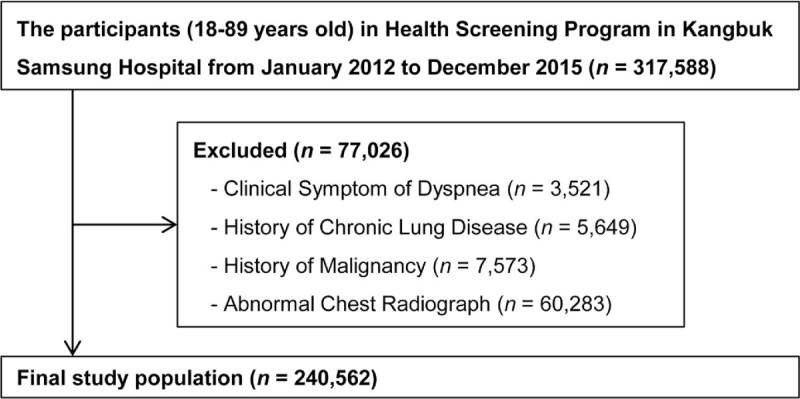
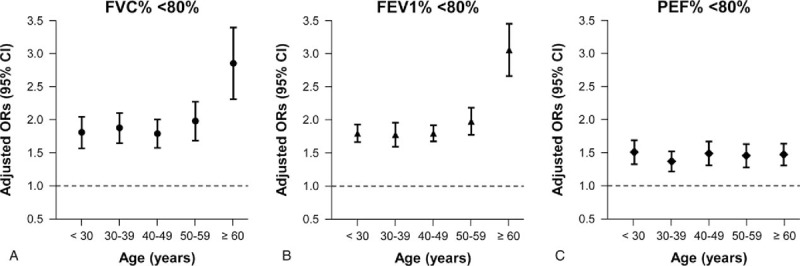
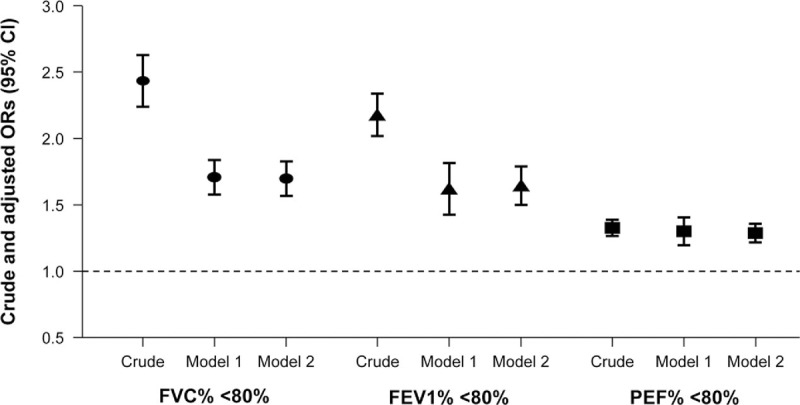
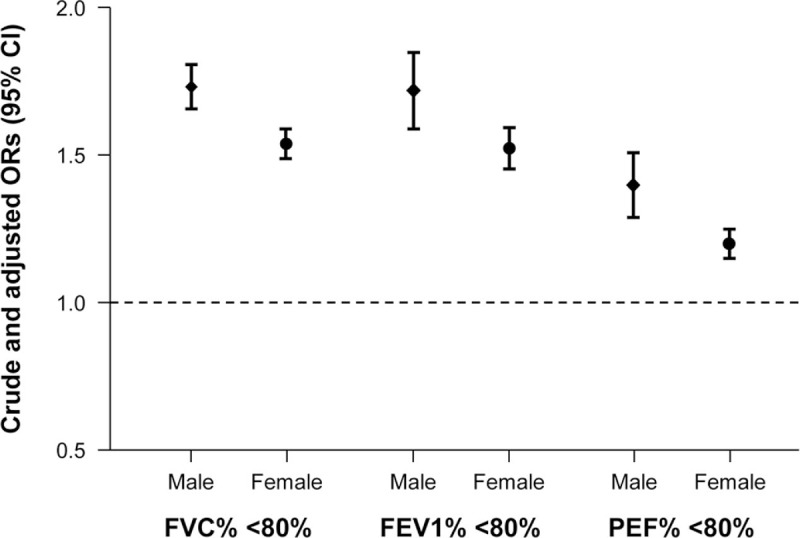
Previous studies have demonstrated that low skeletal muscle mass is related to decreased lung function in patients with chronic obstructive pulmonary disease. However, there is little information about the relationship between skeletal muscle mass and lung function in asymptomatic adults without clinically apparent lung disease.This was a cross-sectional study of 240,562 Korean adults without known lung disease. All subjects underwent both pulmonary function test (PFT) and bioelectrical impedance analysis in the health checkup program at Kangbuk Samsung Hospital. Skeletal muscle mass index (SMI) was estimated as skeletal muscle mass/weight×100. We analyzed the relationship between SMI and PFT using multivariate logistic regression models.Of the 240,562 study subjects, values for forced vital capacity (FVC), forced expiratory volume in 1 second (FEV1), and peak expiratory flow (PEF) were decreased across quartiles (Qs) of decreasing SMI. After adjustments for various confounders including demographic and health behavior-related factors, odds ratios (ORs; 95% confidence interval) for subjects with FVC% <80% for Q1-Q3 compared with Q4 (reference) were 2.97 (2.74-3.17), 2.11 (1.99-2.27), and 1.66 (1.52-1.83), respectively. ORs for subjects with FEV1% <80% for Q1-Q3 compared with Q4 were 2.64 (2.43-2.83), 1.96 (1.83-2.09), and 1.51 (1.43-1.62), respectively. Lastly, OR for subjects with PEF% <80% for Q1-Q3 compared with Q4 were 1.73 (1.58-1.89), 1.35 (1.26-1.45), and 1.23 (1.15-1.30), individually. Subgroup analyses for gender and all age groups showed the associations of decreasing SMI Qs with lower FVC%, FEV1%, and PEF% remained significant.Decreased SMI was independently associated with decline in lung function in apparently healthy adults. This association was sustained in subgroup analyses by gender and all age groups.
既往研究表明,慢性阻塞性肺疾病患者骨骼肌质量较低与肺功能下降有关。然而,关于无临床明显肺部疾病的无症状成年人骨骼肌质量与肺功能之间的关系,相关信息较少。
这是一项针对240562名无已知肺部疾病的韩国成年人的横断面研究。所有受试者在江北三星医院的健康检查项目中均接受了肺功能测试(PFT)和生物电阻抗分析。骨骼肌质量指数(SMI)通过骨骼肌质量/体重×100来估算。我们使用多变量逻辑回归模型分析了SMI与PFT之间的关系。
在240562名研究对象中,随着SMI四分位数(Qs)的降低,用力肺活量(FVC)、第1秒用力呼气容积(FEV1)和呼气峰值流速(PEF)的值均降低。在对包括人口统计学和健康行为相关因素在内的各种混杂因素进行调整后,与Q4(参照组)相比,Q1 - Q3组中FVC%<80%的受试者的比值比(ORs;95%置信区间)分别为2.97(2.74 - 3.17)、2.11(1.99 - 2.27)和1.66(1.52 - 1.83)。与Q4相比,Q1 - Q3组中FEV1%<80%的受试者的ORs分别为2.64(2.43 - 2.83)、1.96(1.83 - 2.09)和1.51(1.43 - 1.62)。最后,与Q4相比,Q1 - Q3组中PEF%<80%的受试者的OR分别为1.73(1.58 - 1.89)、1.35(1.26 - 1.45)和1.23(1.15 - 1.30)。按性别和所有年龄组进行的亚组分析显示,SMI Qs降低与较低的FVC%、FEV1%和PEF%之间的关联仍然显著。
在明显健康的成年人中,SMI降低与肺功能下降独立相关。在按性别和所有年龄组进行的亚组分析中,这种关联仍然存在。