Theofani Efthymia, Semitekolou Maria, Morianos Ioannis, Samitas Konstantinos, Xanthou Georgina
Cellular Immunology Laboratory, Center for Basic Research, Biomedical Research Foundation of the Academy of Athens, 11527 Athens, Greece.
7th Respiratory Clinic and Asthma Center, 'Sotiria' Athens Chest Hospital, 11527 Athens, Greece.
J Clin Med. 2019 Oct 4;8(10):1615. doi: 10.3390/jcm8101615.
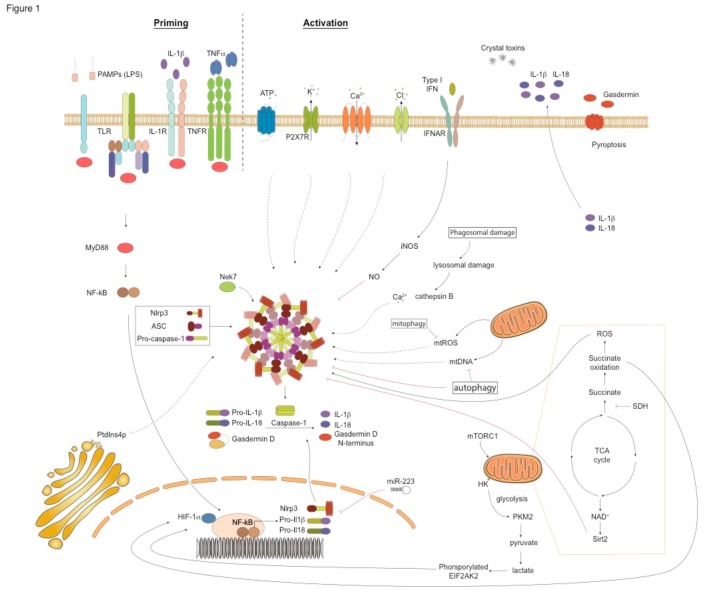
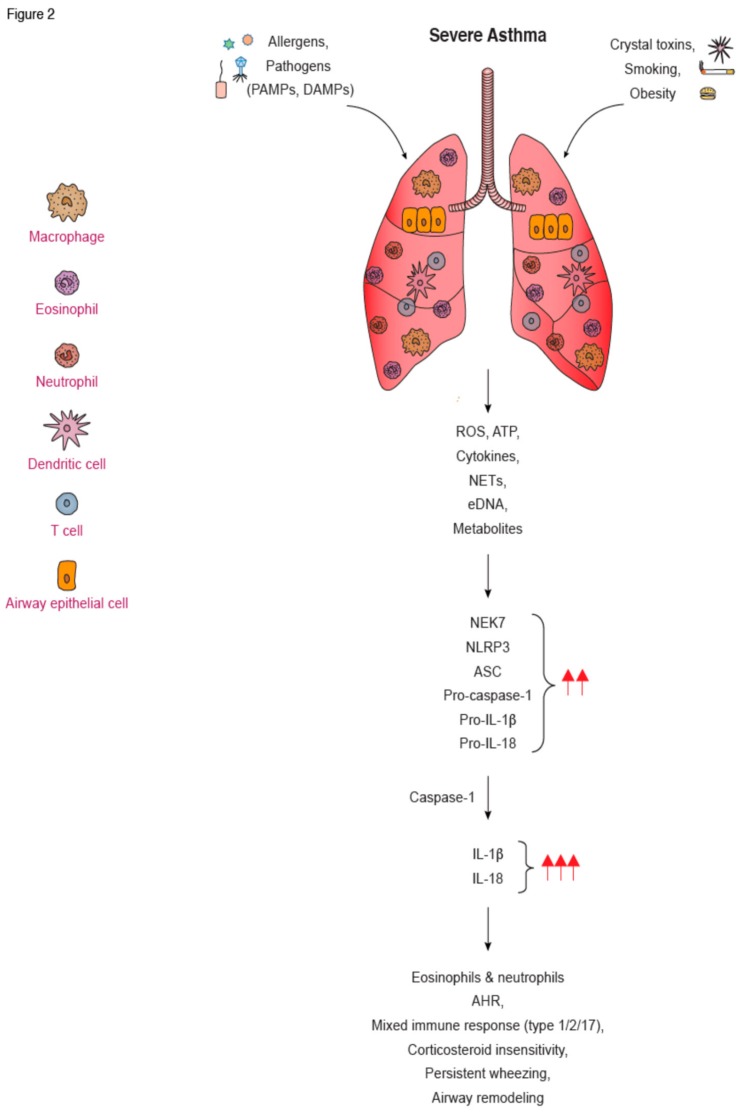
Severe asthma (SA) is a chronic lung disease characterized by recurring symptoms of reversible airflow obstruction, airway hyper-responsiveness (AHR), and inflammation that is resistant to currently employed treatments. The nucleotide-binding oligomerization domain-like Receptor Family Pyrin Domain Containing 3 (NLRP3) inflammasome is an intracellular sensor that detects microbial motifs and endogenous danger signals and represents a key component of innate immune responses in the airways. Assembly of the NLRP3 inflammasome leads to caspase 1-dependent release of the pro-inflammatory cytokines IL-1β and IL-18 as well as pyroptosis. Accumulating evidence proposes that NLRP3 activation is critically involved in asthma pathogenesis. In fact, although NLRP3 facilitates the clearance of pathogens in the airways, persistent NLRP3 activation by inhaled irritants and/or innocuous environmental allergens can lead to overt pulmonary inflammation and exacerbation of asthma manifestations. Notably, administration of NLRP3 inhibitors in asthma models restrains AHR and pulmonary inflammation. Here, we provide an overview of the pathophysiology of SA, present molecular mechanisms underlying aberrant inflammatory responses in the airways, summarize recent studies pertinent to the biology and functions of NLRP3, and discuss the role of NLRP3 in the pathogenesis of asthma. Finally, we contemplate the potential of targeting NLRP3 as a novel therapeutic approach for the management of SA.
重度哮喘(SA)是一种慢性肺部疾病,其特征为可逆性气流受限、气道高反应性(AHR)以及对当前所用治疗具有抗性的炎症反复发作。含吡喃结构域的核苷酸结合寡聚化结构域样受体家族3(NLRP3)炎性小体是一种细胞内传感器,可检测微生物基序和内源性危险信号,是气道固有免疫反应的关键组成部分。NLRP3炎性小体的组装导致促炎细胞因子IL-1β和IL-18的半胱天冬酶1依赖性释放以及细胞焦亡。越来越多的证据表明,NLRP3激活在哮喘发病机制中起关键作用。事实上,虽然NLRP3有助于清除气道中的病原体,但吸入性刺激物和/或无害环境过敏原持续激活NLRP3可导致明显的肺部炎症和哮喘症状加重。值得注意的是,在哮喘模型中给予NLRP3抑制剂可抑制AHR和肺部炎症。在此,我们概述SA的病理生理学,介绍气道异常炎症反应的潜在分子机制,总结与NLRP3生物学和功能相关的最新研究,并讨论NLRP3在哮喘发病机制中的作用。最后,我们思考将NLRP3作为SA新型治疗方法的潜力。