Jiangsu Province Center for Diseases Control and Prevention, Nanjing, China.
Jiangsu Meteorological Service Center, Nanjing, China.
BMC Infect Dis. 2019 Oct 7;19(1):828. doi: 10.1186/s12879-019-4457-6.
Hand, foot and mouth disease (HFMD) is a rising public health problem and has attracted considerable attention worldwide. The purpose of this study was to develop an optimal model with meteorological factors to predict the epidemic of HFMD.
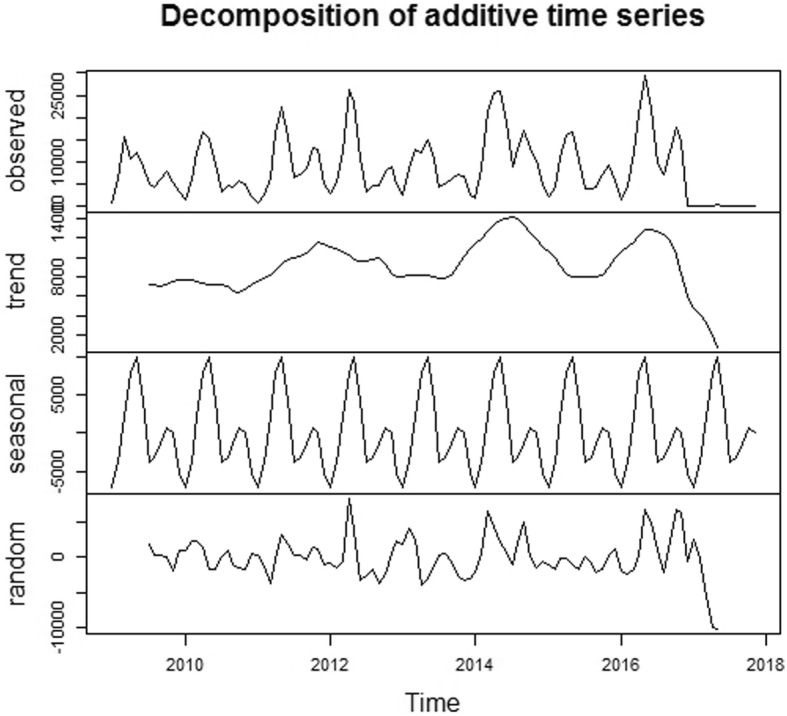
Two types of methods, back propagation neural networks (BP) and auto-regressive integrated moving average (ARIMA), were employed to develop forecasting models, based on the monthly HFMD incidences and meteorological factors during 2009-2016 in Jiangsu province, China. Root mean square error (RMSE) and mean absolute percentage error (MAPE) were employed to select model and evaluate the performance of the models.
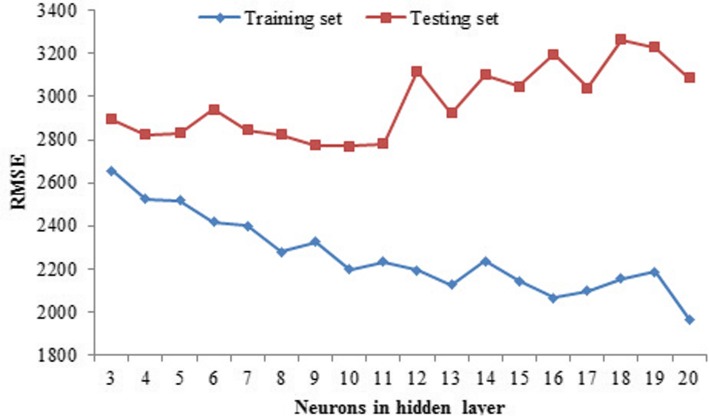
Four models were constructed. The multivariate BP model was constructed using the HFMD incidences lagged from 1 to 4 months, mean temperature, rainfall and their one order lagged terms as inputs. The other BP model was fitted just using the lagged HFMD incidences as inputs. The univariate ARIMA model was specified as ARIMA (1,0,1)(1,1,0) (AIC = 1132.12, BIC = 1440.43). And the multivariate ARIMAX with one order lagged temperature as external predictor was fitted based on this ARIMA model (AIC = 1132.37, BIC = 1142.76). The multivariate BP model performed the best in both model fitting stage and prospective forecasting stage, with a MAPE no more than 20%. The performance of the multivariate ARIMAX model was similar to that of the univariate ARIMA model. Both performed much worse than the two BP models, with a high MAPE near to 40%.
The multivariate BP model effectively integrated the autocorrelation of the HFMD incidence series. Meanwhile, it also comprehensively combined the climatic variables and their hysteresis effects. The introduction of the climate terms significantly improved the prediction accuracy of the BP model. This model could be an ideal method to predict the epidemic level of HFMD, which is of great importance for the public health authorities.
手足口病(HFMD)是一个日益严重的公共卫生问题,已引起全球的广泛关注。本研究旨在建立一个最佳的模型,纳入气象因素,预测 HFMD 的流行情况。
本研究采用基于反向传播神经网络(BP)和自回归综合移动平均(ARIMA)的两种方法,基于中国江苏省 2009-2016 年每月 HFMD 发病率和气象因素,建立预测模型。采用均方根误差(RMSE)和平均绝对百分比误差(MAPE)来选择模型并评估模型的性能。
构建了 4 个模型。多元 BP 模型以滞后 1-4 个月的 HFMD 发病率、平均温度、降雨量及其一阶滞后项作为输入。另一个 BP 模型仅以滞后的 HFMD 发病率作为输入。单变量 ARIMA 模型被指定为 ARIMA(1,0,1)(1,1,0)(AIC=1132.12,BIC=1440.43)。并基于该 ARIMA 模型,拟合一个滞后温度作为外部预测因子的多元 ARIMAX 模型(AIC=1132.37,BIC=1142.76)。多元 BP 模型在模型拟合阶段和前瞻性预测阶段表现最好,MAPE 均不超过 20%。多元 ARIMAX 模型的性能与单变量 ARIMA 模型相似,MAPE 接近 40%,均明显差于两个 BP 模型。
多元 BP 模型有效地整合了 HFMD 发病率序列的自相关性。同时,它还综合考虑了气候变量及其滞后效应。引入气候因素显著提高了 BP 模型的预测精度。该模型可作为预测 HFMD 流行水平的理想方法,对公共卫生部门具有重要意义。