Department of Chemical and Biological Engineering, Tuts University, Medford, MA, 02155, USA.
Nat Commun. 2019 Oct 7;10(1):4548. doi: 10.1038/s41467-019-12497-8.
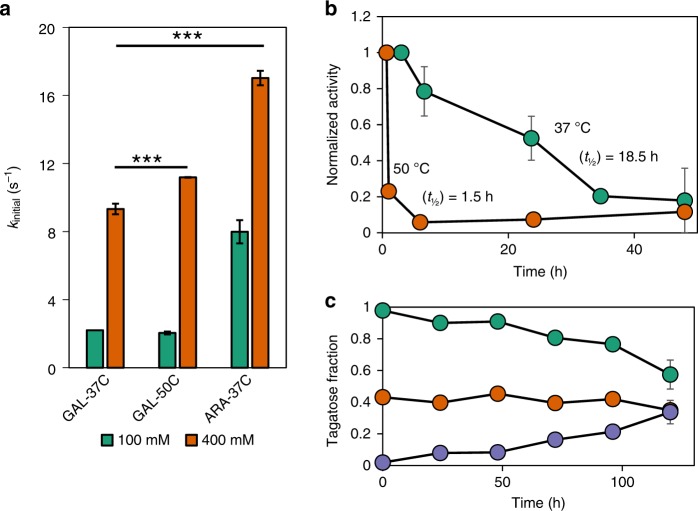
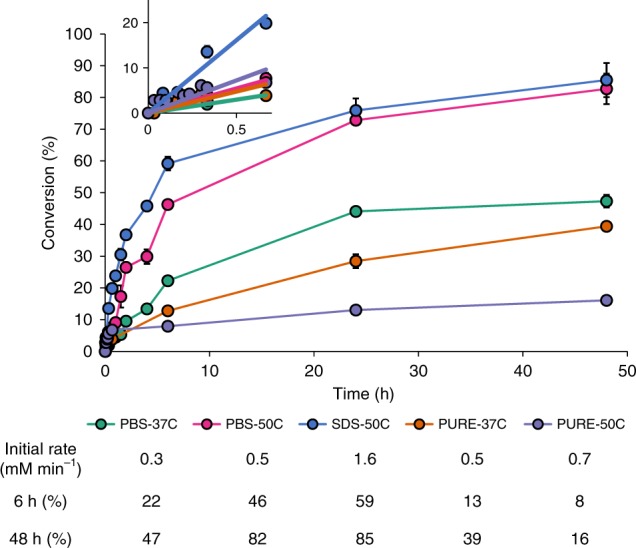
There are many industrially-relevant enzymes that while active, are severely limited by thermodynamic, kinetic, or stability issues (isomerases, lyases, transglycosidases). In this work, we study Lactobacillus sakei L-arabinose isomerase (LsLAI) for D-galactose to D-tagatose isomerization-that is limited by all three reaction parameters. The enzyme demonstrates low catalytic efficiency, low thermostability at temperatures > 40 °C, and equilibrium conversion < 50%. After exploring several strategies to overcome these limitations, we show that encapsulating LsLAI in gram-positive Lactobacillus plantarum that is chemically permeabilized enables reactions at high rates, high conversions, and elevated temperatures. In a batch process, this system enables ~ 50% conversion in 4 h starting with 300 mM galactose (an average productivity of 37 mM h), and 85% conversion in 48 h. We suggest that such an approach may be invaluable for other enzymatic processes that are similarly kinetically-, thermodynamically-, and/or stability-limited.
有许多工业相关的酶,尽管具有活性,但由于热力学、动力学或稳定性问题(异构酶、裂解酶、转糖苷酶)而受到严重限制。在这项工作中,我们研究了用于 D-半乳糖到 D-塔格糖异构化的戊糖乳杆菌 L-阿拉伯糖异构酶(LsLAI)——这受到所有三个反应参数的限制。该酶表现出低催化效率、高于 40°C 的温度下的低热稳定性以及低于 50%的平衡转化率。在探索了几种克服这些限制的策略之后,我们表明将 LsLAI 包埋在革兰氏阳性的植物乳杆菌中,该乳杆菌经过化学渗透处理后,可实现高反应速率、高转化率和高温反应。在分批处理中,该系统可在 4 小时内以 300mM 半乳糖(平均生产率为 37mM/h)起始,实现约 50%的转化率,在 48 小时内实现 85%的转化率。我们认为,对于其他类似受到动力学、热力学和/或稳定性限制的酶促反应,这种方法可能具有很高的价值。