From the Tennessee Department of Health, Office of Informatics and Analytics, 710 James Robertson Parkway, Nashville, TN.
Epidemiology. 2020 Jan;31(1):22-31. doi: 10.1097/EDE.0000000000001110.
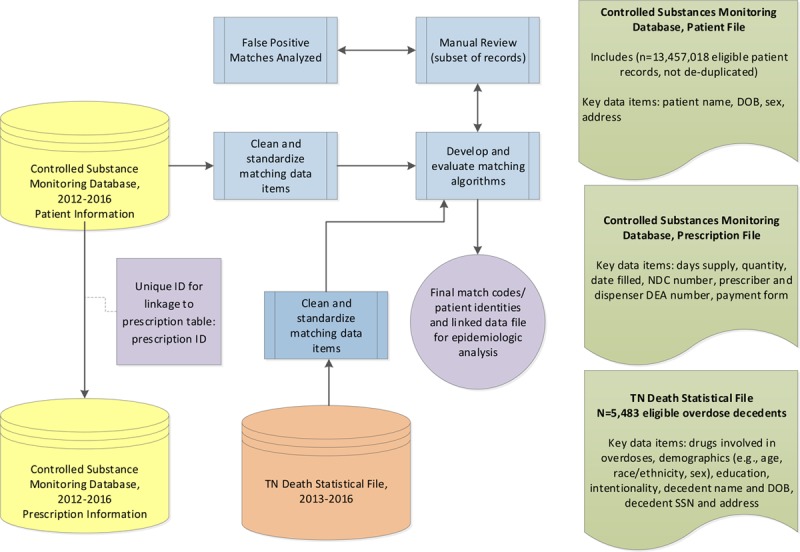
The use of Prescription Drug Monitoring Program (PDMP) data has greatly increased in recent years as these data have accumulated as part of the response to the opioid epidemic in the United States. We evaluated the accuracy of record linkage approaches using the Controlled Substance Monitoring Database (Tennessee's [TN] PDMP, 2012-2016) and mortality data on all drug overdose decedents in Tennessee (2013-2016).
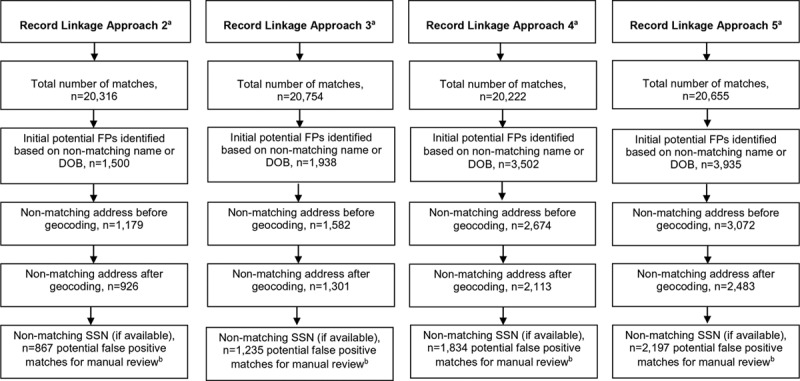
We compared total, missed, and false positive (FP) matches (with manual verification of all FPs) across approaches that included a variety of data cleaning and matching methods (probabilistic/fuzzy vs. deterministic) for patient and death linkages, and prescription history. We evaluated the influence of linkage approaches on key prescription measures used in public health analyses. We evaluated characteristics (e.g., age, education, sex) of missed matches and incorrect matches to consider potential bias.
The most accurate probabilistic/fuzzy matching approach identified 4,714 overdose deaths (vs. the deterministic approach, n = 4,572), with a low FP linkage error (<1%) and high correct match proportion (95% vs. 92% and ~90% for probabilistic approaches not using comprehensive data cleaning). Estimation of all prescription measures improved (vs. deterministic approach). For example, frequency (%) of decedents filling an oxycodone prescription in the last 60 days (n = 1,371 [32%] vs. n = 1,443 [33%]). Missed overdose decedents were more likely to be younger, male, nonwhite, and of higher education.
Implications of study findings include underreporting, prescribing and outcome misclassification, and reduced generalizability to population risk groups, information of importance to epidemiologists and researchers using PDMP data.
近年来,随着处方药物监测计划(PDMP)数据在美国阿片类药物流行应对措施中不断积累,这些数据的使用大大增加。我们评估了使用受控物质监测数据库(田纳西州的 [TN] PDMP,2012-2016 年)和田纳西州所有药物过量死亡者的死亡数据(2013-2016 年)进行记录链接方法的准确性。
我们比较了各种数据清理和匹配方法(概率/模糊与确定性)在患者和死亡链接以及处方历史记录方面的总匹配、漏配和假阳性(FP)匹配(所有 FP 均经过手动验证)。我们评估了链接方法对公共卫生分析中使用的关键处方措施的影响。我们评估了漏配和错误匹配的特征(例如,年龄、教育、性别),以考虑潜在的偏差。
最准确的概率/模糊匹配方法确定了 4714 例过量死亡(与确定性方法相比,n = 4572),FP 链接错误率低(<1%),正确匹配比例高(95%比 92%和~90%用于不使用全面数据清理的概率方法)。所有处方措施的估计都有所改善(与确定性方法相比)。例如,在过去 60 天内填写羟考酮处方的死者频率(%)(n = 1371[32%]与 n = 1443[33%])。漏配的过量死亡者更年轻、男性、非裔美国人、受教育程度更高。
研究结果的影响包括报告不足、处方和结果分类错误,以及向人群风险群体的概括性降低,这对于使用 PDMP 数据的流行病学家和研究人员来说是重要信息。