Australia Institute of Sport, ACT, AUSTRALIA.
First Year College, Victoria University, VIC, AUSTRALIA.
Med Sci Sports Exerc. 2020 Mar;52(3):685-695. doi: 10.1249/MSS.0000000000002182.
The purpose of this study was to investigate the effectiveness of sports compression tights in reducing muscle movement and activation during running.
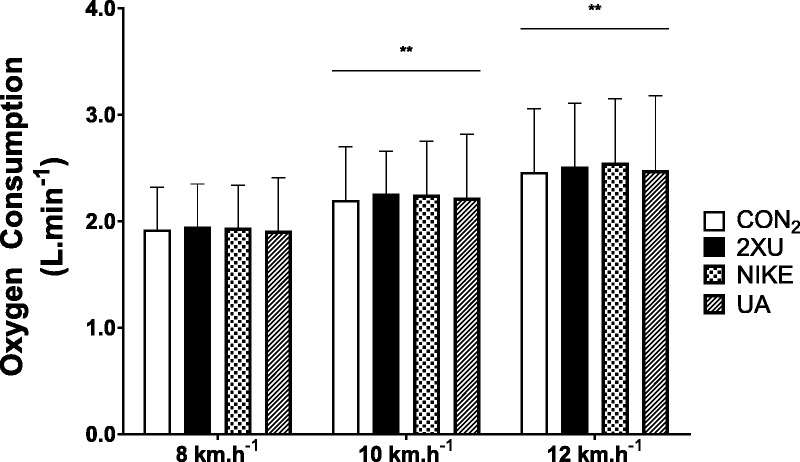
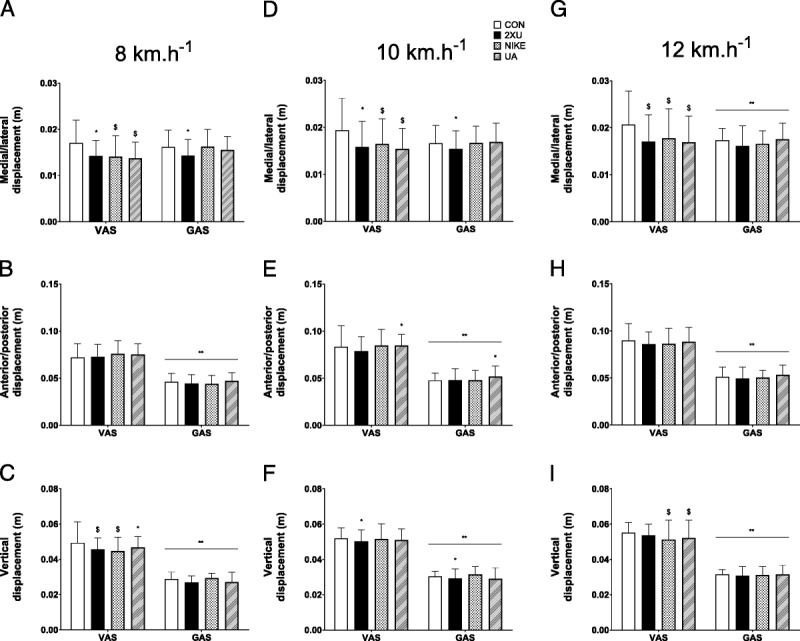
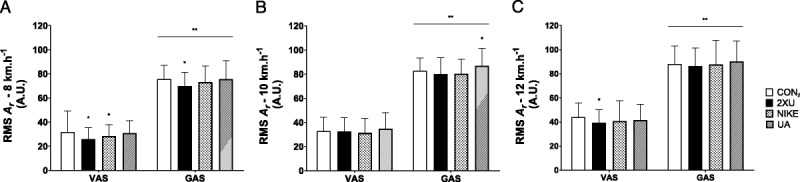
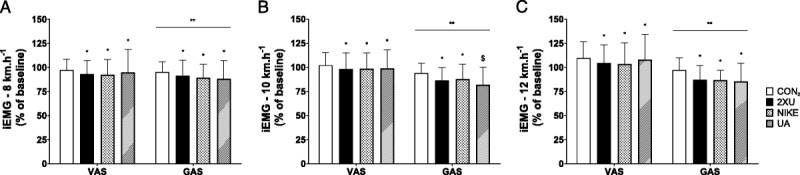
A total of 27 recreationally active males were recruited across two separate studies. For study 1, 13 participants (mean ± SD = 84.1 ± 9.4 kg, 22 ± 3 yr) completed two 4-min treadmill running bouts (2 min at 12 and 15 km·h) under two conditions: a no-compression control (CON1) and compression (COMP). For study 2, 14 participants (77.8 ± 8.4 kg, 27 ± 5 yr) completed four 9-min treadmill running bouts (3 min at 8, 10, and 12 km·h) under four conditions: a no-compression control (CON2) and three different commercially available compression tights (2XU, Nike, and Under Armor). Using Vicon 3D motion capture technology, lower limb muscle displacement was investigated in both study 1 (thigh and calf) and study 2 (vastus lateralis + medialis [VAS]; lateral + medial gastrocnemius [GAS]). In addition, study 2 investigated the effects of compression on soft tissue vibrations (root-mean-square of resultant acceleration, RMS Ar), muscle activation (iEMG), and running economy (oxygen consumption, V˙O2) during treadmill running.
Wearing compression during treadmill running reduced thigh and calf muscle displacement as compared with no compression (both studies), which was evident across all running speeds. Compression also reduced RMS Ar and iEMG during treadmill running, but it had no effect on running economy (study 2).
Lower limb compression garments are effective in reducing muscle displacement, soft tissue vibrations, and muscle activation associated with the impact forces experienced during running.
本研究旨在探讨运动压缩裤在减少跑步时肌肉运动和激活方面的效果。
本研究共招募了 27 名活跃的男性参与者,分为两个独立的研究。在研究 1 中,13 名参与者(平均±标准差=84.1±9.4kg,22±3 岁)在两种条件下完成了两次 4 分钟的跑步机跑步测试:无压缩对照(CON1)和压缩(COMP)。在研究 2 中,14 名参与者(77.8±8.4kg,27±5 岁)在四种条件下完成了四次 9 分钟的跑步机跑步测试:无压缩对照(CON2)和三种市售的压缩裤(2XU、Nike 和 Under Armor)。使用 Vicon 3D 运动捕捉技术,研究了研究 1(大腿和小腿)和研究 2(股外侧肌+股内侧肌[VAS];外侧+内侧比目鱼肌[GAS])中下肢肌肉位移。此外,研究 2 还研究了压缩对跑步机跑步时软组织振动(均方根加速度,RMS Ar)、肌肉激活(iEMG)和跑步经济性(耗氧量,V˙O2)的影响。
与无压缩相比,跑步机跑步时穿着压缩裤可减少大腿和小腿肌肉位移(两个研究),这在所有跑步速度下都很明显。压缩还减少了跑步机跑步时的 RMS Ar 和 iEMG,但对跑步经济性没有影响(研究 2)。
下肢压缩服装可有效减少与跑步时冲击相关的肌肉位移、软组织振动和肌肉激活。