Institute of Medical Microbiology, German Center for Infection Research (DZIF), Partner Site Giessen-Marburg-Langen, Justus-Liebig University Giessen, Giessen, Germany.
Institute of Medical Virology, Justus-Liebig University Giessen, Giessen, Germany.
mBio. 2019 Oct 8;10(5):e01223-19. doi: 10.1128/mBio.01223-19.
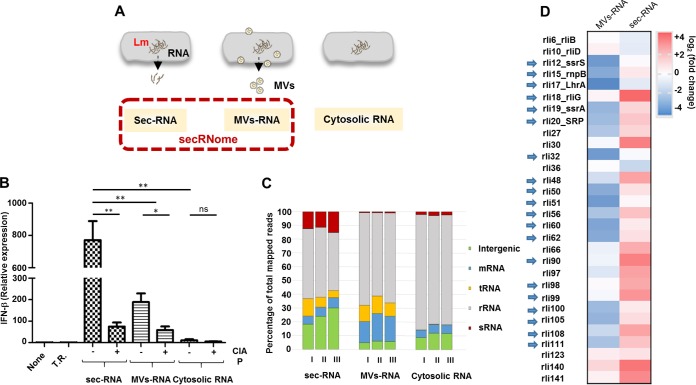
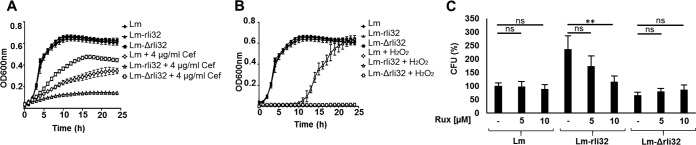
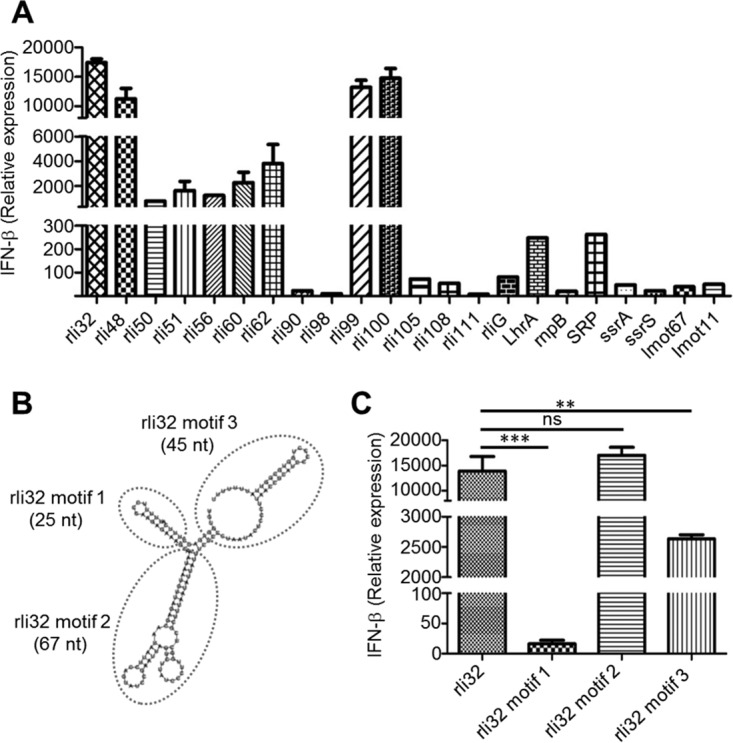
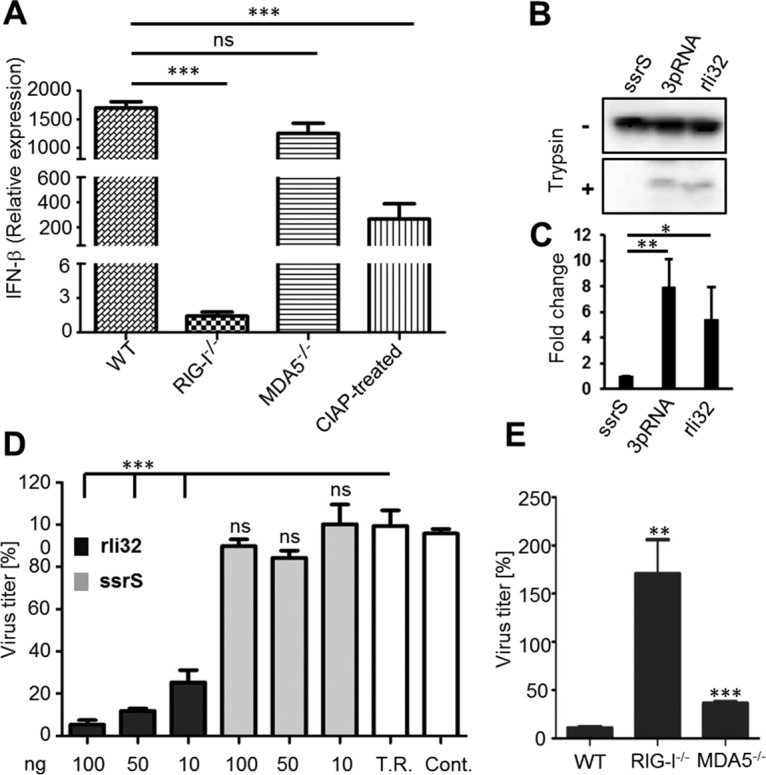
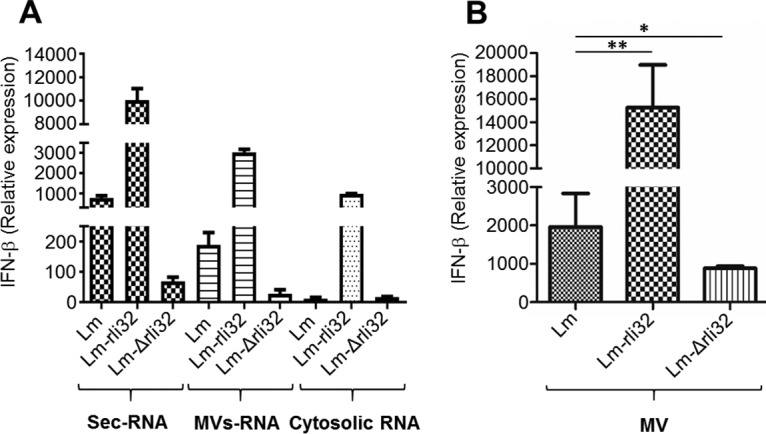
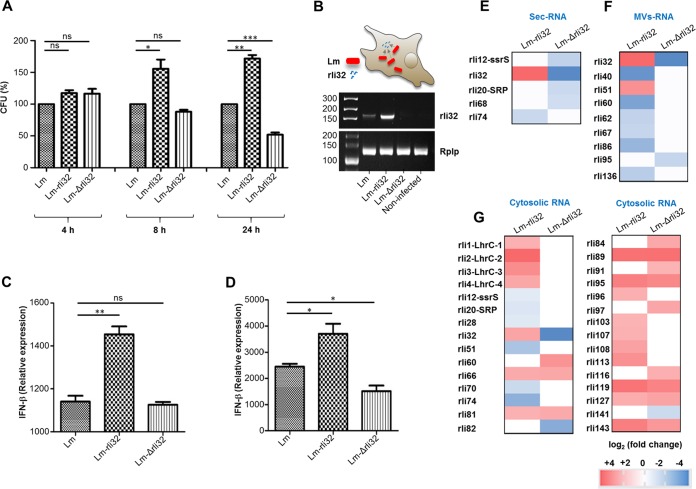
Cellular sensing of bacterial RNA is increasingly recognized as a determinant of host-pathogen interactions. The intracellular pathogen induces high levels of type I interferons (alpha/beta interferons [IFN-α/β]) to create a growth-permissive microenvironment during infection. We previously demonstrated that RNAs secreted by (comprising the secRNome) are potent inducers of IFN-β. We determined the composition and diversity of the members of the secRNome and found that they are uniquely enriched for noncoding small RNAs (sRNAs). Testing of individual sRNAs for their ability to induce IFN revealed several sRNAs with this property. We examined ril32, an intracellularly expressed sRNA that is highly conserved for the species and that was the most potent inducer of IFN-β expression of all the sRNAs tested in this study, in more detail. The rli32-induced IFN-β response is RIG-I (retinoic acid inducible gene I) dependent, and cells primed with rli32 inhibit influenza virus replication. We determined the rli32 motif required for IFN induction. rli32 overproduction promotes intracellular bacterial growth, and a mutant lacking rli32 is restricted for intracellular growth in macrophages. rli32-overproducing bacteria are resistant to HO and exhibit both increased catalase activity and changes in the cell envelope. Comparative transcriptome sequencing (RNA-Seq) analysis indicated that ril32 regulates expression of the locus, previously shown to be involved in cell envelope stress. Inhibition of IFN-β signaling by ruxolitinib reduced rli32-dependent intracellular bacterial growth, indicating a link between induction of the interferon system and bacterial physiology. rli32 is, to the best of our knowledge, the first secreted individual bacterial sRNA known to trigger the induction of the type I IFN response. Interferons are potent and broadly acting cytokines that stimulate cellular responses to nucleic acids of unusual structures or locations. While protective when induced following viral infections, the induction of interferons is detrimental to the host during infection. Here, we identify specific sRNAs, secreted by the bacterium, with the capacity to induce type I IFN. Further analysis of the most potent sRNA, rli32, links the ability to induce RIG-I-dependent induction of the type I IFN response to the intracellular growth properties of the bacterium. Our findings emphasize the significance of released RNA for infection and shed light on a compartmental strategy used by an intracellular pathogen to modulate host responses to its advantage.
细胞对细菌 RNA 的感应越来越被认为是宿主-病原体相互作用的决定因素。胞内病原体 诱导产生高水平的 I 型干扰素 (alpha/beta 干扰素 [IFN-α/β]),以在感染期间创造一个有利于生长的微环境。我们之前的研究表明, 分泌的 RNA(包括 secRNome)是 IFN-β 的有效诱导剂。我们确定了 secRNome 成员的组成和多样性,并发现它们独特地富含非编码小 RNA (sRNA)。对个别 sRNA 诱导 IFN 的能力进行测试,发现了一些具有这种特性的 sRNA。我们更详细地研究了 ril32,这是一种在同种内高度保守的胞内表达 sRNA,是本研究中测试的所有 sRNA 中诱导 IFN-β 表达最有效的诱导物。Ril32 诱导的 IFN-β 反应依赖于 RIG-I(视黄酸诱导基因 I),并且用 ril32 预处理的细胞可抑制流感病毒复制。我们确定了诱导 IFN 所需的 rli32 基序。rli32 的过度产生促进了细菌的胞内生长,并且缺乏 rli32 的突变体在巨噬细胞中限制了胞内生长。rli32 过度产生的细菌对 HO 具有抗性,并表现出过氧化氢酶活性的增加和细胞包膜的改变。比较转录组测序 (RNA-Seq) 分析表明,ril32 调节 基因座的表达,先前的研究表明该基因座参与细胞包膜应激。通过 ruxolitinib 抑制 IFN-β 信号转导可降低 rli32 依赖性的胞内细菌生长,表明诱导干扰素系统与细菌生理学之间存在联系。据我们所知,rli32 是第一个已知的可触发 I 型 IFN 反应诱导的分泌性单个细菌 sRNA。干扰素是一种有效的、广泛作用的细胞因子,可刺激细胞对异常结构或位置的核酸做出反应。虽然在病毒感染后诱导时具有保护作用,但在 感染期间,干扰素的诱导对宿主有害。在这里,我们鉴定了由细菌分泌的具有诱导 I 型 IFN 能力的特定 sRNA。对最有效的 sRNA rli32 的进一步分析将诱导 RIG-I 依赖性 I 型 IFN 反应的能力与细菌的胞内生长特性联系起来。我们的研究结果强调了释放 RNA 在 感染中的重要性,并揭示了胞内病原体用于使其宿主反应有利于自身的一种隔室化策略。