Reese Aspen T, Kartzinel Tyler R, Petrone Brianna L, Turnbaugh Peter J, Pringle Robert M, David Lawrence A
Society of Fellows, Harvard University, Cambridge, Massachusetts, USA.
Department of Ecology and Evolutionary Biology, Brown University, Providence, Rhode Island, USA.
mSystems. 2019 Oct 8;4(5):e00458-19. doi: 10.1128/mSystems.00458-19.
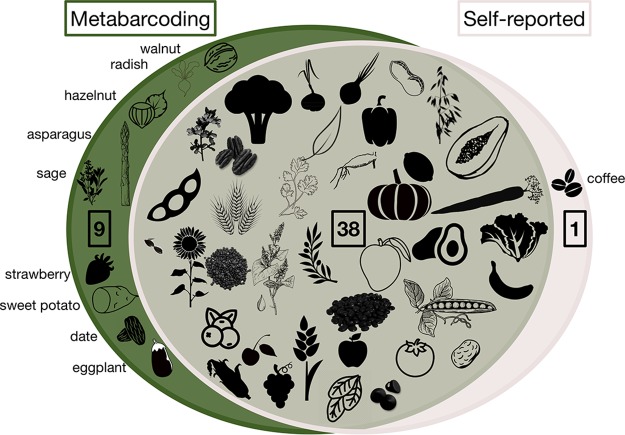
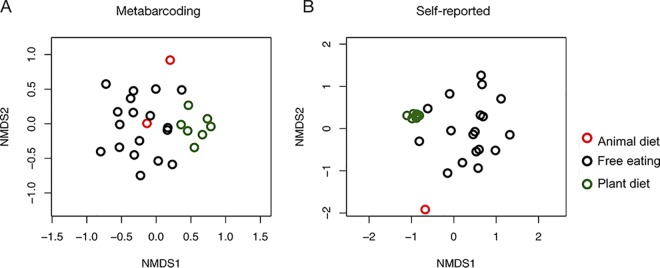
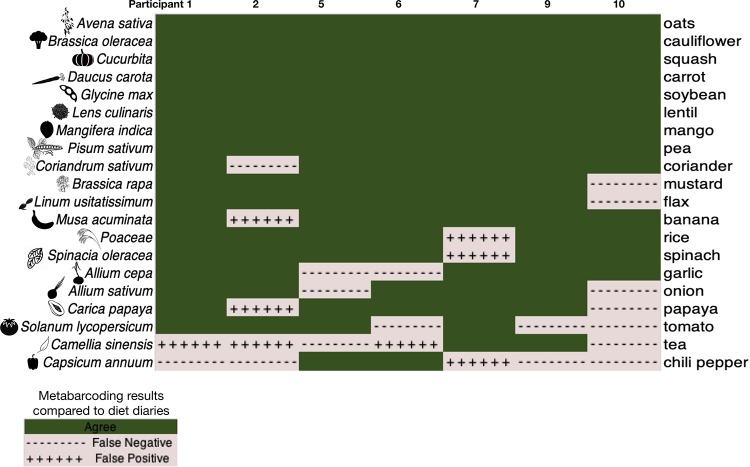
Dietary intake is difficult to measure reliably in humans because approaches typically rely on self-reporting, which can be incomplete and biased. In field studies of animals, DNA sequencing-based approaches such as metabarcoding have been developed to characterize diets, but such approaches have not previously been widely applied to humans. Here, we present data derived from sequencing of a chloroplast DNA marker (the P6 loop of the L [UAA] intron) in stool samples collected from 11 individuals consuming both controlled and freely selected diets. The DNA metabarcoding strategy resulted in successful PCR amplification in about 50% of samples, which increased to a 70% success rate in samples from individuals eating a controlled plant-rich diet. Detection of plant taxa among sequenced samples yielded a recall of 0.86 and a precision of 0.55 compared to a written diet record during controlled feeding of plant-based foods. The majority of sequenced plant DNA matched common human food plants, including grains, vegetables, fruits, and herbs prepared both cooked and uncooked. Moreover, DNA metabarcoding data were sufficient to distinguish between baseline and treatment diet arms of the study. Still, the relatively high PCR failure rate and an inability to distinguish some dietary plants at the sequence level using the L-P6 marker suggest that future methodological refinements are necessary. Overall, our results suggest that DNA metabarcoding provides a promising new method for tracking human plant intake and that similar approaches could be used to characterize the animal and fungal components of our omnivorous diets. Current methods for capturing human dietary patterns typically rely on individual recall and as such are subject to the limitations of human memory. DNA sequencing-based approaches, frequently used for profiling nonhuman diets, do not suffer from the same limitations. Here, we used metabarcoding to broadly characterize the plant portion of human diets for the first time. The majority of sequences corresponded to known human foods, including all but one foodstuff included in an experimental plant-rich diet. Metabarcoding could distinguish between experimental diets and matched individual diet records from controlled settings with high accuracy. Because this method is independent of survey language and timing, it could also be applied to geographically and culturally disparate human populations, as well as in retrospective studies involving banked human stool.
在人类中,饮食摄入量很难可靠地测量,因为常用方法通常依赖自我报告,而这可能不完整且存在偏差。在动物的野外研究中,已开发出基于DNA测序的方法(如代谢条形码技术)来描述饮食特征,但此类方法此前尚未广泛应用于人类。在此,我们展示了从11名食用受控饮食和自由选择饮食的个体所采集粪便样本中对叶绿体DNA标记(L [UAA] 内含子的P6环)进行测序获得的数据。DNA代谢条形码策略在约50%的样本中成功进行了PCR扩增,在食用富含植物的受控饮食个体的样本中成功率提高到了70%。与基于植物性食物受控喂养期间的书面饮食记录相比,在测序样本中检测植物分类群的召回率为0.86,精确率为0.55。大多数测序的植物DNA与常见的人类食用植物匹配,包括谷物、蔬菜、水果以及烹饪和未烹饪的草药。此外,DNA代谢条形码数据足以区分研究的基线饮食和治疗饮食组。然而,相对较高的PCR失败率以及无法使用L - P6标记在序列水平区分某些食用植物表明,未来有必要对方法进行改进。总体而言,我们的结果表明DNA代谢条形码技术为追踪人类植物摄入量提供了一种有前景的新方法,并且类似方法可用于描述我们杂食性饮食中的动物和真菌成分。当前捕捉人类饮食模式的方法通常依赖个体回忆,因此受到人类记忆的限制。基于DNA测序的方法常用于分析非人类饮食,不存在同样的局限性。在此,我们首次使用代谢条形码技术广泛描述人类饮食中的植物部分。大多数序列对应已知的人类食物,包括富含植物的实验性饮食中除一种食物外的所有食物。代谢条形码技术能够高精度地区分实验饮食和来自受控环境的个体饮食记录。由于该方法独立于调查语言和时间,它还可应用于地理和文化背景不同的人群,以及涉及保存人类粪便的回顾性研究。