Department of Ecology and Evolution, University of Chicago, Chicago, IL 60637.
Department of Ecology and Evolution, University of Chicago, Chicago, IL 60637;
Proc Natl Acad Sci U S A. 2019 Oct 22;116(43):21634-21640. doi: 10.1073/pnas.1909216116. Epub 2019 Oct 8.
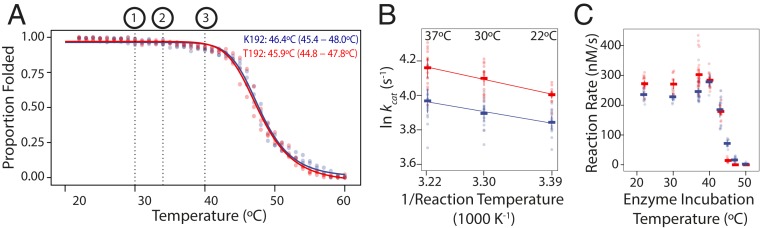
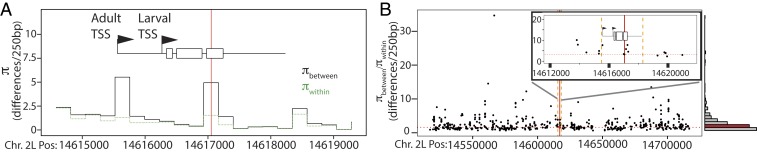
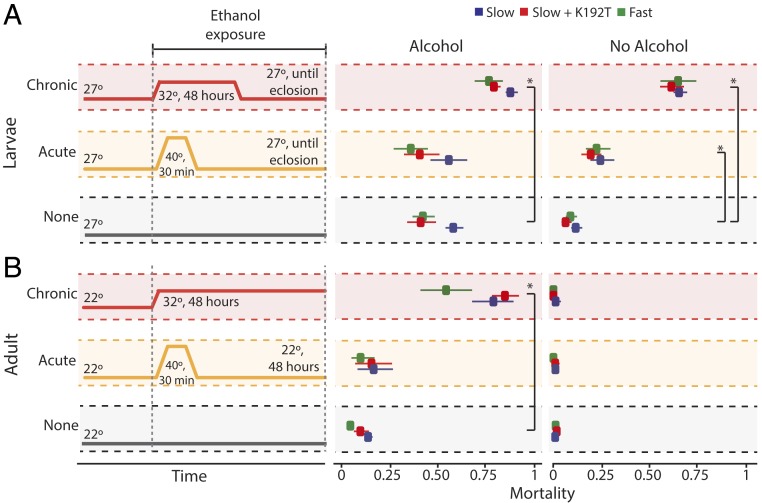
Polymorphism in the alcohol dehydrogenase (ADH) protein of , like genetic variation in many other enzymes, has long been hypothesized to be maintained by a selective trade-off between thermostability and enzyme activity. Two major variants, named Fast and Slow, are distributed along latitudinal clines on several continents. The balancing selection trade-off hypothesis posits that Fast is favored at high latitudes because it metabolizes alcohol faster, whereas Slow is favored at low latitudes because it is more stable at high temperatures. Here we use biochemical and physiological assays of precisely engineered genetic variants to directly test this hypothesis. As predicted, the Fast protein has higher catalytic activity than Slow, and both the Fast protein and regulatory variants linked to it confer greater ethanol tolerance on transgenic animals. But we found no evidence of a temperature-mediated trade-off: The Fast protein is not less stable or active at high temperatures, and Fast alleles increase ethanol tolerance and survivorship at all temperatures tested. Further, analysis of a population genomic dataset reveals no signature of balancing selection in the gene. These results provide strong evidence against balancing selection driven by a stability/activity trade-off in and they justify caution about this hypothesis for other enzymes except those for which it has been directly tested. Our findings tentatively suggest that environment-specific selection for the Fast allele, coupled with demographic history, may have produced the observed pattern of variation.
像许多其他酶的遗传变异一样,酒精脱氢酶(ADH)蛋白的多态性长期以来一直被假设是通过热稳定性和酶活性之间的选择性权衡来维持的。两种主要的变体,命名为 Fast 和 Slow,沿着几个大陆的纬度梯度分布。平衡选择权衡假说认为,Fast 在高纬度地区更受欢迎,因为它能更快地代谢酒精,而 Slow 在低纬度地区更受欢迎,因为它在高温下更稳定。在这里,我们使用精确设计的遗传变异的生化和生理测定来直接检验这一假设。正如预测的那样,Fast 蛋白的催化活性高于 Slow 蛋白,与 Fast 蛋白相关的两种调节变体都赋予转基因动物更高的乙醇耐受性。但我们没有发现温度介导的权衡的证据:Fast 蛋白在高温下的稳定性或活性并没有降低,而且 Fast 等位基因在所有测试的温度下都能提高乙醇耐受性和存活率。此外,对一个种群基因组数据集的分析表明, 基因中没有平衡选择的特征。这些结果强烈反对稳定性/活性权衡驱动的平衡选择,并为除已直接测试的酶以外的其他酶的这一假说提供了谨慎的理由。我们的研究结果初步表明,Fast 等位基因的环境特异性选择,加上人口历史,可能导致了观察到的 变异模式。